
Comparison · Software comparisons and alternatives
Follow Up Boss vs Sierra Interactive: CRM, IDX and team operations
Follow Up Boss is a CRM you pay for per user with no contract. Sierra Interactive is an IDX website, CRM and ad service sold on a 12-month agreement from $299.95 a month. Which a team should buy, how each routes leads, and what neither does once the contract is signed.
Follow Up Boss, Sierra Interactive and DeedSpring on the points a team lead decides
| Decision | DeedSpring | Follow Up Boss | Sierra Interactive |
|---|---|---|---|
| What you are buying | Transaction coordination from signed contract to keys | A CRM. The website comes from another vendor | IDX website and CRM in one package, ad management as an add-on |
| Entry price | $15 a month for one closing a month | $69 a user a month on Grow, billed monthly | $299.95 a month for Starter, one user, paid annually |
| Contract | Month to month | No contracts, 14-day free trial | 12-month agreement, annual or monthly billing |
| Setup fee | None listed | None listed | $0 on annual billing, $500 on monthly billing |
| Seats | Unlimited agents and teammates on Standard | Per user on Grow. Ten included on Pro, thirty on Platform | One, three or five included. Extra users $75 down to $5 |
| Lead routing | None. It starts at the signed contract | Per-source rules, round robin, first to claim, groups | Rules plus five distribution types, including lead ponds |
| Roles | Broker/admin, Team lead, Transaction coordinator, Agent, Assistant | Owner, Admin, Agent, Lender. Team leads on Platform only | Primary Manager, Manager, Agent, Lender |
| After the contract is signed | Reads the contract, builds the deadline list, drafts follow-ups for approval | Deals pipeline, stages and reporting | A transaction record for reporting |
What are you actually buying from each?
Follow Up Boss sells a CRM and stops there. Its pricing page calls itself an open platform and tells you to “plug in the website, lead gen and marketing systems that make sense for your needs today”, and its feature table files IDX websites under integrations rather than features. The help pages list the website vendors it connects to and say any website company can integrate through the open API. So the website is a second purchase with its own invoice.
Sierra Interactive sells the website first. Every package on its pricing page comes with an IDX website, one MLS feed, a CRM and a set of website designs. Essential and Growth include the dialer, and Growth adds dedicated onboarding and advanced reporting. Google ad management is an add-on with a 10 percent monthly fee on a minimum $500 of ad spend. One commenter summed up the split in a thread about CRM recommendations.
“Follow up boss as far as a stand alone CRM with integrations is the best. If you want one that offers a website and automations then Sierra Interactive is the best option.”
Another, replying to an agent choosing a CRM, described Sierra as Follow Up Boss with an IDX site attached. If the website matters more than the CRM, Sierra. If the CRM matters more than the website, Follow Up Boss.
What does each contract look like?
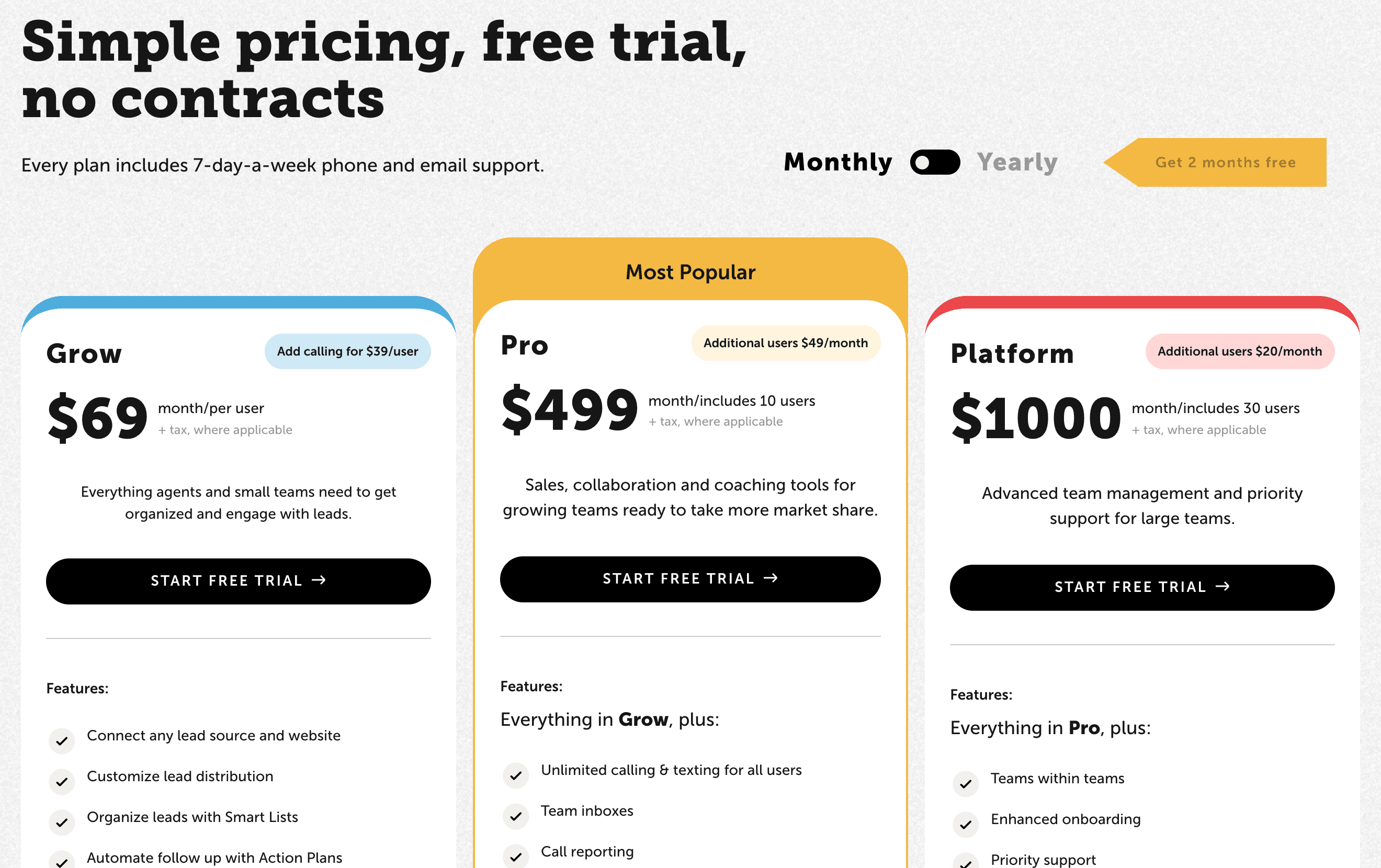
Follow Up Boss publishes three plans. Grow is $69 a user a month billed monthly, or $58 a user on annual billing. Pro is $499 a month for ten users, with extra users at $49. Platform is $1,000 a month for thirty users, with extra users at $20. Calling is a $39 a user add-on on Grow. The page says no contracts, offers a 14-day free trial, and gives two months free on annual billing. The plan breakdown pitches Grow at teams of five or fewer, Pro at five to twenty users and Platform at twenty or more.
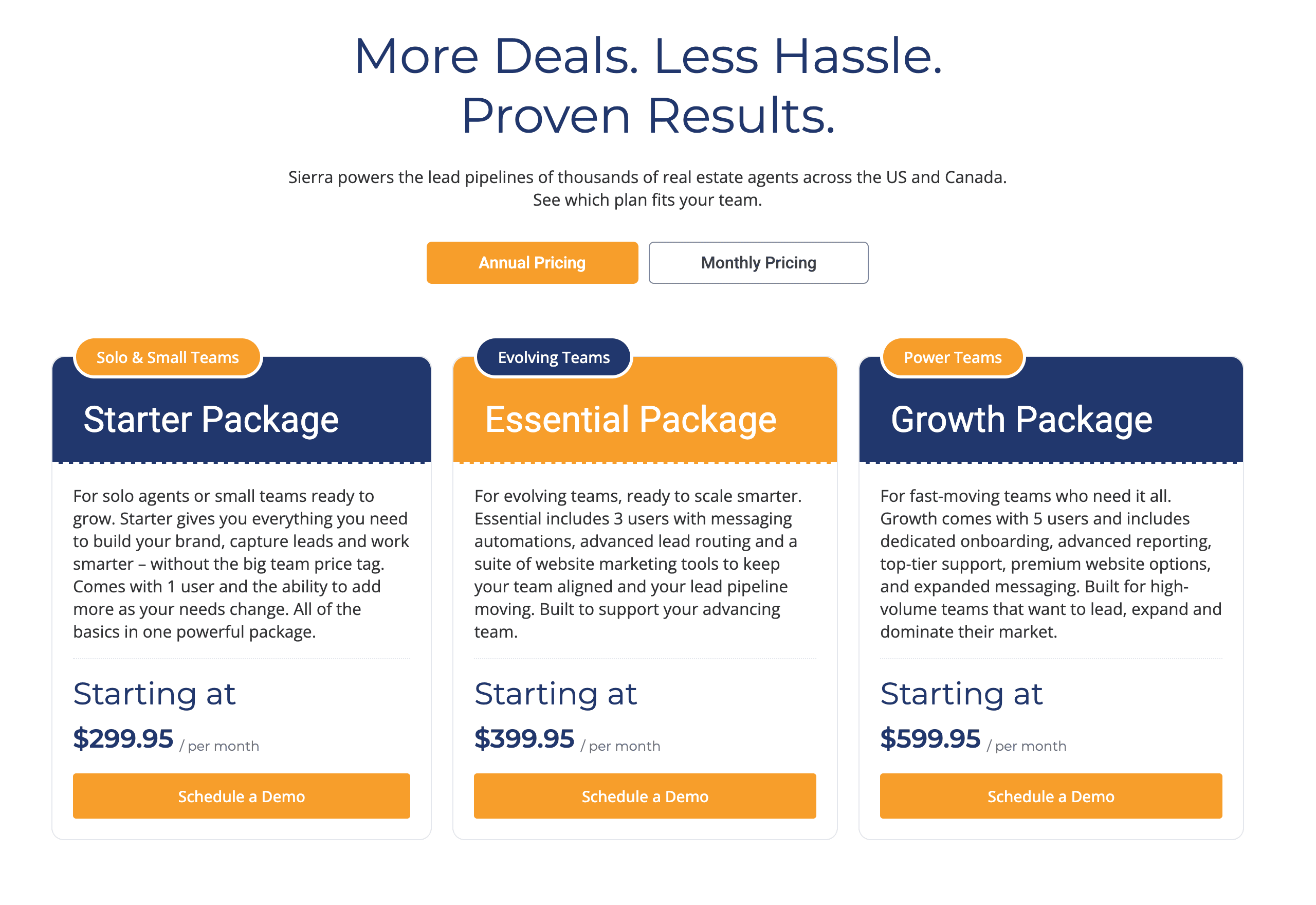
Sierra Interactive publishes three packages too, but the shape is different. Starter is $299.95 a month with one user, Essential $399.95 with three, Growth $599.95 with five. All three are sold “under a 12-month agreement paid annually upfront”. The same twelve-month term is available with monthly billing at $359.95, $474.95 and $724.95, and monthly billing carries a $500 setup fee that annual billing waives. Extra users cost $75 each on Starter, $60 then $25 on Essential, and $20, $10 and $5 on Growth as the headcount climbs. A second MLS feed is $25 a month.
Put a five-person team on each. Follow Up Boss Grow is five times $69, or $345 a month, cancellable at any time. Sierra Growth on annual billing is $599.95 a month, which is $7,199.40 paid up front for the year, with the website included. At ten people Follow Up Boss Pro is $499 flat, and Sierra Growth is $599.95 plus five extra users at $20, or $699.95. The CRM-only route is cheaper at both sizes, but it leaves you to buy and pay for the website separately.
Read Sierra's terms before you sign. Subscriptions renew automatically at the end of each billing cycle, and you cancel the renewal by contacting the billing team “subject to the contract term and provisions of your signed agreement”. Notice to terminate can go by email to [email protected]. There is no cancellation clause to read on the Follow Up Boss side, because there is no term to cancel.
Which routes leads better for a team?
Follow Up Boss routes by lead source. For each source you set the agent or group, the lender and the action plan that fires, and advanced rules can split a source by tags, price, city, state or ZIP code, processed top to bottom until one matches. Groups hand leads out round robin or first to claim. First to claim pushes an alert to the mobile app, and if nobody claims within the window, thirty minutes at most, the lead goes to the fallback you set: a round robin group, another first-to-claim group or one person. Round robin, first to claim and distribution by price or ZIP code are ticked on all three plans. What Grow lacks is help connecting your lead sources, which Pro and Platform include.
Sierra's lead routing rules are richer and need more care. A Manager builds rules on source, tag, lead type, location, price range, property type and site, with a catch-all at the bottom. Each rule picks one of five distribution types: auto-assign, claim with timeout, instant call, first to claim or a lead pond. Claim and instant call only fire inside an actionable window, 8 AM to 9 PM by default, and instant call needs the Dialer. Location matches the criteria saved on the lead's search rather than the lead's physical location, and a lead who searched by drawing a shape on the map cannot match a location rule at all. Two more things override the rules. A lead that registers on an agent's own subdomain is assigned to that agent, and the account-level rules are bypassed entirely. A tracking link does the same.
For a team lead the difference is where the mistakes hide. Follow Up Boss has fewer knobs and the default rule catches what the others miss. Sierra can express almost any policy, but the saved-search location logic and the agent-site bypass are the two places a lead can go somewhere you did not intend.
How do team roles differ?
Every Follow Up Boss account has four roles: Account Owner, Admin, Agent and Lender. Only the owner changes billing, grants export permission and edits custom stages and fields, and owners and admins edit Lead Flow. The team layer, where a team leader sees every lead assigned to their own team members, is a Platform feature. That matters because Platform is the $1,000 a month plan with thirty seats. A twelve-person team on Pro gets owner, admin and agent, and nothing in between.
Sierra's user types are Primary Manager, Manager, Agent and Lender. There is one Primary Manager per account, who owns billing and is the only user who can permanently delete leads. Managers build routing rules and global action plans. Agents see their own leads and run personal action plans. There is no team-lead type on that page. Anyone above Agent is a Manager, and Managers can edit routing.
Neither product runs the file once the buyer and seller have signed. DeedSpring does. It reads the executed contract into dates and parties and builds the deadline list from a playbook. By default the chases it drafts wait for someone on your team to approve them.
Can you run Sierra's website with Follow Up Boss as the CRM?
Yes, and both vendors document it. Follow Up Boss describes Sierra as a full integration that tracks when a lead registers, returns to the site, views a property, favorites one or saves a search. Sierra's own setup guide is the more useful read, because it tells you what to switch off. You need admin rights in both systems, an API key from an owner-level Follow Up Boss user, and the same email address for every user on both sides. Then Sierra recommends routing in Follow Up Boss rather than in Sierra: “Because Sierra lead routing may not always sync cleanly to FUB, we recommend toggling this ON and using FUB Lead Routing instead.” It also warns that Sierra lead ponds are not supported with the integration and tells you to be cautious with first to claim on the Sierra side. Assignment changes sync within about ten minutes.
Read that as a product decision. If you connect the two, Sierra's own documentation points you at Follow Up Boss for routing, which means you are paying for a Sierra package, a Follow Up Boss plan on top, and using Sierra's CRM mostly as the website's back end. A five-person team doing this pays the $599.95 Growth package plus $345 for Grow, or $944.95 a month before ad spend. That is a fine price for a team that wants Sierra's site and Follow Up Boss's CRM, but go in knowing which system is in charge.
Which should a team lead choose?
Choose Follow Up Boss when the team already has a website it likes, or buys leads from portals and ad vendors that post straight into the CRM, when the headcount changes month to month, or when the team is five to twenty people and Pro's flat $499 covers them. Accept that team-level visibility for leads costs you Platform.
Choose Sierra Interactive when you do not have a website worth keeping, when organic and paid search is a core lead source and you want the site, the MLS feed and the ad management on one invoice, and when you can commit to a year and pay it up front to avoid the $500 setup fee. Put a Manager in charge of routing and test the agent-site and saved-search cases before leads go live.
Whichever you buy, the CRM's job ends at a signed contract. Follow Up Boss's Deals feature is a pipeline of stages for reporting, set up by the account owner. Sierra's transactions are a record with a lead type, a date, an amount and an agent, kept for reporting. Neither tracks the inspection deadline or chases the lender.
What happens after the contract is signed?
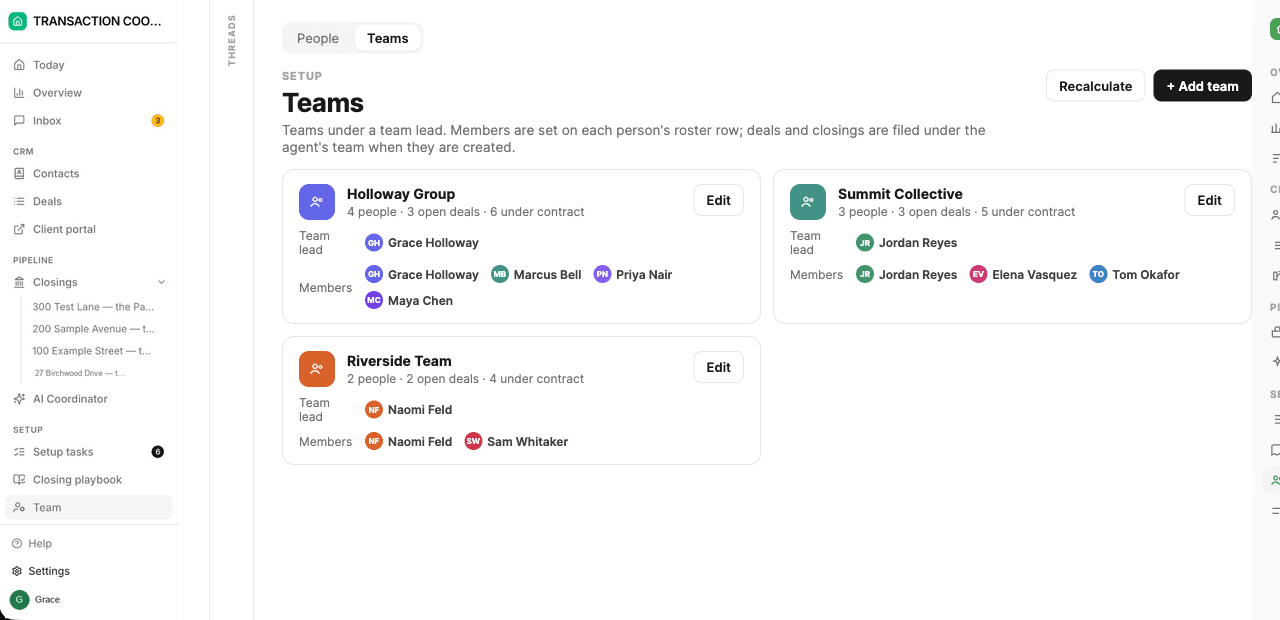
DeedSpring picks up where either CRM stops. You upload the executed contract and it reads the parties and dates into a closing, shows you what it found, and builds the task list from a playbook you can edit on your confirmation. Chases to the lender and the title company are drafted first, and on the default setting a person on your team sends them. Anything sensitive or negotiable is always a draft, whatever the setting. E-signing is built in. For a brokerage, the roster carries the same shape you have just read about: Broker/admin, Team lead, Transaction coordinator, Agent and Assistant, with a Sharing grid that sets how far each role sees, and Teams that give each lead an Overview of their own team's pipeline. A Follow Up Boss connector sits on the Data connections list, which the help page says syncs the systems that already hold your contacts and deals into DeedSpring.
Starter is $15 a month for one closing a month. Standard is $25 a closing, falling to $19 at volume, with unlimited agents and teammates, unused closings rolling over, and no term to sign. Brokerage pricing is on application. Pick the CRM on the points above, then put DeedSpring behind it for the part of the deal neither CRM runs. See DeedSpring pricing.
How we compared
We read both vendors' pricing pages, terms and help articles on lead routing, user roles and the integration between them, plus two public Reddit threads on choosing a CRM. We compared what each sells, the contract shape, routing and roles, and what happens after a contract is signed.