
Research · Investigations and price histories
How many deals does the average agent close a year? NAR's 10 vs the vendor dashboards' 15
Nine transaction sides, says NAR's 2026 Member Profile. SkySlope's dashboards say 14.9, after dropping every agent with fewer than five deals. Paperless Pipeline's median producing agent closed three. Here is who each number counted, who it left out, and which one to measure yourself against.
What does NAR actually say?
The 2026 Member Profile, released on June 25, 2026, is the first edition to ask members for their own sides and their team's sides separately. On their own, the typical agent reported nine transaction sides in 2025 and $2.7 million in volume. Twenty-one percent of members work on a team, teams average four people, and a team reported a median of 32 sides and $17.5 million.
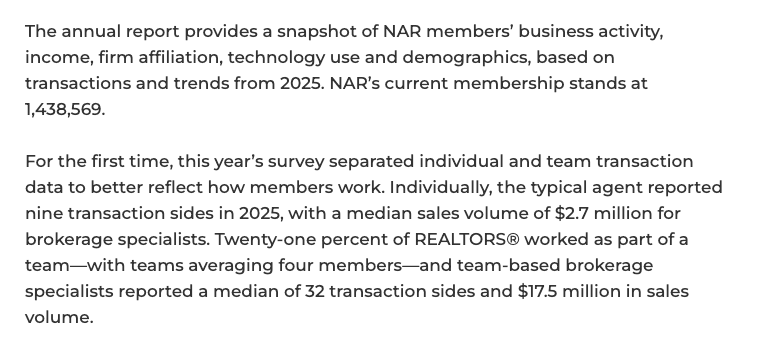
The ten is real too, but it belongs to a subgroup. In the full report, brokerage specialists with six or more years of experience had a median of ten sides, those with three to five years had six, and those in their first two years had two. The year before, the 2025 edition put every typical agent at ten transactions for 2024, the same as 2023. Do not read nine as a fall from ten. NAR changed the question, and its own methodology note says the 2026 figures may not be comparable with earlier years.
Remember what kind of number this is. In March 2026 NAR emailed a 63-question survey to a random sample of 286,777 members and got 5,116 answers back, a response rate of 1.7%, then weighted them to match membership by state. Members typed in their own sides. The full report also shows the spread behind the median: 6% of brokerage specialists closed nothing in 2025, 30% closed one to five sides, 23% six to ten, 17% eleven to fifteen, and 17% closed more than twenty.
Where does SkySlope's 14.9 come from?
From its own servers. SkySlope's report card, posted on August 19, 2026, says the average full-time agent on SkySlope closed 14.9 transactions between July 2025 and July 2026, with a median deal size of $518,594, and calls that nearly 1.5 times NAR's median. The sentence that matters comes next.
“Note that we excluded agents with fewer than 5 transactions so the number captures full-time production, not occasional or part-time activity.”
So 14.9 is the average of agents who had already closed five deals. NAR's nine includes the 36% of brokerage specialists who closed five or fewer. The two numbers describe different groups of people before either one says anything about production. SkySlope also picked the comparison. Its chart puts 14.9 against the ten for agents with six or more years, which rounds to 1.5 times. Against the nine that NAR leads with, it is 1.7 times.
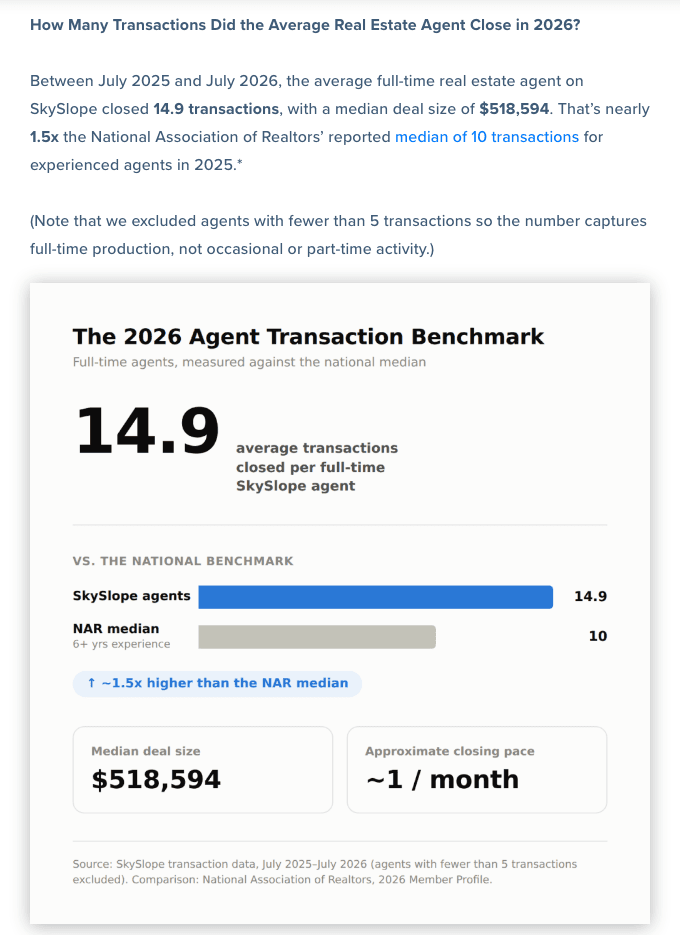
The post does not say how many agents or brokerages sit behind the figure, whether average means the mean, or how a deal with two SkySlope agents on it is counted. Every agent in it is on SkySlope, and the post ends by offering coaching to anyone below 14.9. The count is of active agents on SkySlope. The framing, with that coaching offer at the end, is a sales page.
Why does Paperless Pipeline's agent close three?
Because Paperless Pipeline kept everyone in. Its Brokerage Data Snapshot covers 328,000 closed transactions at 634 of its brokerages from January 2024 to September 2026, sales between $50,000 and $10 million, leases excluded. Across about 21,000 producing agents, the median agent closed three deals in 2025 and earned about $23,700 gross. Of those agents, 43% closed two or fewer, and 14% averaged one deal a month. The top 10% took 47% of the gross commission, the one-page PDF says nearly half, and the bottom half took 10%.
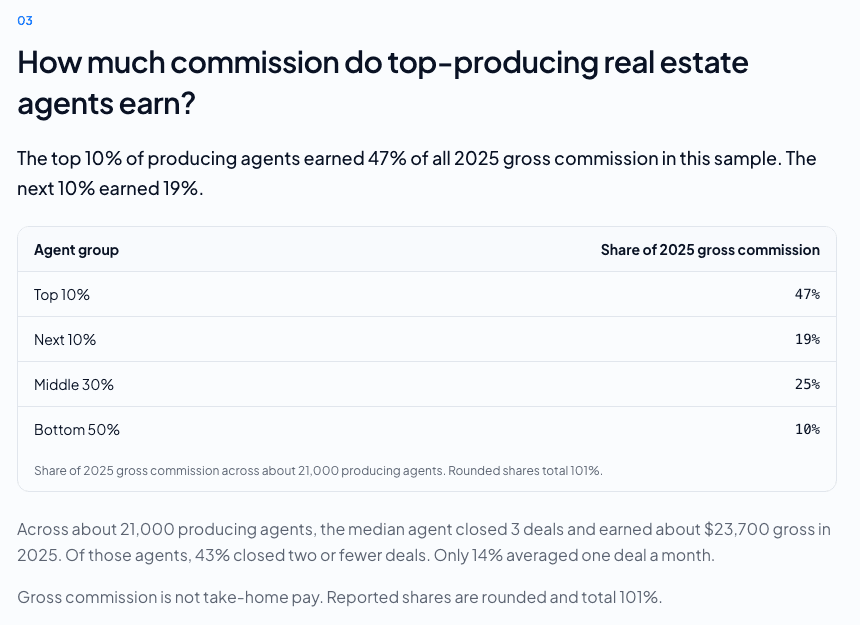
The only filter on agents is the word producing, which the report does not define beyond that, and there is no cutoff at five. That one choice is most of the distance between three and 14.9. The report is careful about the rest: it says it reflects Paperless Pipeline brokerages rather than the US market, that it does not specify weighting or every cohort rule, and that the figures are descriptive. Its platform-wide figures, 1,700 brokerages and 8% of US transactions, are a separate marketing claim and are not the sample. It also does not say whether an in-house deal with two agents counts once for each of them.
Five releases, five populations
Who each data release counted, when, and who it left out
| Release | Who was counted | Period | Left out | Headline | What it shows |
|---|---|---|---|---|---|
| NAR 2026 Member Profile | 5,116 members who answered a survey, weighted to membership | 2025, surveyed March 2026 | The 98% of sampled members who did not answer | Median 9 sides; 10 with six-plus years; 32 per team | What members who answer say they closed |
| SkySlope agent report card | Agents on SkySlope with five or more transactions; count not given | July 2025 to July 2026 | Anyone with fewer than five transactions | Average 14.9; median deal $518,594 | Output of active agents on SkySlope |
| Paperless Pipeline snapshot | About 21,000 producing agents at 634 brokerages | 2025 for agent production | Leases, sales under $50,000 or over $10 million, and any agent the report does not count as producing | Median 3 deals; 43% two or fewer; 14% one a month | Closed files at brokerages on one back-office system |
| Compass pre-marketing studies | Compass sell-side closed deals; 70,809 in the 2026 study | 2024; then April 2025 to March 2026 | Listings withdrawn or expired without a sale | Pre-marketed homes closed 2.9% higher, then 4.6% | Price gap between Compass sellers who chose differently |
| Zillow off-MLS study | 2.72 million of 10 million transactions meeting Zillow's rules | 2023 and 2024 | New builds, foreclosures, auctions, sales under $10,000 or over $10 million | Off-MLS homes sold 1.5% lower, $4,975 at the median | Sale price against a Zestimate for homes kept off the MLS |
Can you turn nine into fifteen by dropping the part-timers?
Nearly, and NAR's own table shows how. Take the distribution above and remove everyone with five or fewer sides, which is 36% of brokerage specialists. The median of the agents left over lands in the eleven-to-fifteen band. Nobody closed an extra deal. The middle agent moved from nine into the low teens because a third of the room walked out. SkySlope's cutoff keeps agents with exactly five, so it drops slightly fewer people than this, and it reports an average rather than a median. Put midpoints on NAR's bands and the average of the whole survey comes out near thirteen, with the average of the five-plus group in the high teens. SkySlope's 14.9 sits inside the band NAR's own distribution lands in once the same people are dropped.
The same move runs the other way. Paperless Pipeline's three comes from keeping every producing agent, with no cutoff above that. NAR counts sides, so a dual-agency deal is two for one agent. SkySlope counts files on its platform. Each is a fair count of its own population and none of them is a fair count of yours until you know which population you are in.
Do the numbers add up?
NAR describes existing-home sales as just over 4 million a year, which is about 8 million sides. Its membership stood at 1,438,569 in June 2026. If every one of those sides went to a member, the average member would have 5.6 sides a year, and the 76% of members whose main business is residential brokerage would have about seven. New homes, land and commercial deals add some sides on top, and sales with no agent or a non-member agent take some away.
Set that against a survey median of nine and an implied average near thirteen. The simplest way for both to be true is that the members who answer a 63-question survey do more business than the members who do not. Paperless Pipeline's median of three, counted from closed files rather than answers, fits inside that arithmetic. None of this makes NAR wrong. Nine describes members who answer the survey. Three describes every producing agent at 634 brokerages.
What about Compass's 2.9% and Zillow's $4,975?
Compass's February 2025 study found that its listings pre-marketed as Private Exclusives or Coming Soons closed 2.9% higher in 2024 than its listings that went straight to the MLS, from a regression on Compass's own closed sell-side deals, with a confidence interval of 1.9% to 3.9%. Its July 2026 study raised that to 4.6% across 70,809 closed transactions, and says in its own methodology that it covers closed sales only and leaves out listings withdrawn or expired without a sale. Both compare Compass sellers who chose pre-marketing with Compass sellers who did not.
Zillow's study of 2023 and 2024 sales points the other way: homes sold off the MLS went for a median 1.5% less, $4,975, than homes listed on it. Zillow kept 2.72 million of 10 million transactions, defined a pocket listing as one that hit the MLS with at most a day active and the same agent or office on both sides, and measured each sale against the home's Zestimate three months earlier. A portal that lives on MLS feeds found a penalty for leaving the MLS, and a brokerage that sells private listings found a premium for them. Both publishers say so themselves: Compass measured sellers who chose pre-marketing, and Zillow measured sellers who opted to sell off the MLS.
Which number should you measure yourself against?
The one whose population looks like you. If you have been licensed six years or more and work alone, NAR's ten sides is your peer group, and nine is the whole membership. If you are on a team, the team closed 32 sides and you closed some share of them. If you are on SkySlope and already past five deals, SkySlope's 14.9 is the room you are in, and an average is pulled up by the agents at the top. If you want to know where a working agent at a mid-size brokerage really sits, Paperless Pipeline's three is the honest median, with one agent in seven doing a deal a month.
Count sides, not deals, so your number matches NAR's. Count a full twelve months, since SkySlope's window runs July to July and NAR's runs the calendar year. And when a vendor shows you a benchmark, ask the same three questions: who was counted, who was dropped, and whether the headline is a mean or a median.
Your deal count is also what your software should be priced on. A per-seat subscription costs the same whether you close three deals this year or thirty. DeedSpring charges per closing instead: Starter is $15 a month for one closing a month, and Standard is $25 a closing, less at volume, with unlimited agents and teammates and unused closings rolling over. Both are month to month, so an agent at NAR's nine and an agent at SkySlope's fifteen each pay for the files they actually run. See the pricing page for the volume tiers.