
Research · Transaction coordinator operations
How to measure transaction coordinator workload and capacity
A full-time TC who does everything on a file carries 15 to 20 at once, 30 to 40 on review-only work, and experienced coordinators report 40 to 60. The number that sets your own ceiling is hours per active file, and a two-week log gets it.
How many files does a TC carry?
The figures in circulation run from 15 to 75, and no survey or association has measured any of it. SkySlope's own buyer's guide says no reliable public figure exists and that the numbers online are mostly vendor estimates. So the table is what each source says, and the second column matters as much as the first: half the figures count files in flight and half count closings a month, and those are different numbers.
Every public coordinator-capacity figure we found
| Who says it | Files | What it counts |
|---|---|---|
| TC Track | 15–20 full service with client contact. 20–25 agent contact only. 30–40 compliance review only. | Active files, on a 40–45-hour week |
| ListedKit | 20–60 a month with good tools. 20 active files strain intake, 40 is unsustainable. | Files a month, then active files |
| Paperless Pipeline | 20–30 with software. 10–15 without. | Files a month |
| RealAnalytica | 15–30 | Active files |
| Avenue Transactions, a TC firm | 40 closings a month while working 50–75. One-month high of 65. | Closings a month and files in flight |
| Two coordinators, via their agents on r/realtors | 40–60 at a time for about 25 agents. 20–40 at a time, with 20 closings a good month. | Active files |
Three things explain the four-to-one spread. Scope first. TC Track is the only source that conditions its number on what the coordinator is asked to do, and its tiers run from 15 to 20 files for full contract-to-close work with client communication up to 30 to 40 for compliance review alone. Unit second. A coordinator closing 20 a month with 30-day escrows holds about 22 files at any moment. With 45-day escrows it is about 32. Software third. Every vendor figure is the with-software number, and Paperless Pipeline puts a solo TC at 20 to 30 files a month with it and 10 to 15 without.
If you only know how many agents you serve, start there. The typical agent closed nine sides in 2025, and the average full-time agent on SkySlope closed 14.9 in the year to July 2026, so 25 agents feed a coordinator roughly 19 to 31 closings a month.
Why do closings a month mislead you?
Megan Walz of Avenue Transactions puts “a good work/life balance” at “40 Closings / month (typically you are working on about 50-75 consistently)”, and her one-month high of 65 closings left her miserable. The gap between her two numbers is escrow length and fall-through. Nationally, contracts closed in about 30 days, 7% were terminated and 14% settled late in the three months to August 2026. At 30 days, 20 closings a month means about 22 files in flight. At 45 days, the top of the range TC Track calls typical, it means about 32. Same closings report, half again as many open files to watch.
Terminations hide the same way. At a 7% fall-through rate, closing 20 files means opening about 22, and the ones that died used up intake and contingency minutes that never show in a closings count. Bunching hides it too. Twenty files that go under contract in the same ten days produce the same monthly total as 20 spread evenly, but they all sit in their contingency windows at once, which is 17.5 hours of contingency work in one week against about 8 at a steady pace. A closings target is a revenue number. A staffing decision needs files in flight, how many of them need you this week, and hours per active file.
Which of your files are actually work?
A file under contract is busy for three weeks and then mostly quiet. In Texas the earnest money is due within three days of the effective date, the option period runs from the same date, and the buyer has seven days after receiving the seller's disclosure. California's C.A.R. purchase agreement gives three days for the loan application and 17 for the loan, appraisal and investigation contingencies. Florida's AS IS contract gives three days for the deposit, five for the loan application, 15 for inspections and 30 for loan approval. After that, nothing is due until title objections and closing week.
SkySlope's advice is to count deadlines rather than files, because a file in its contingency period generates far more work than one waiting to close. ListedKit counts 20 to 30 due dates on a contract, so a coordinator opening 20 files a month is tracking 400 to 600 deadlines, most of them in each file's first three weeks. The useful split is who owes the next move. A file is active when you do: a deadline you prepare for falls in the next seven days, or a task is yours. It is waiting when the clock is running on the lender's 17 days, the title company's 20 days to deliver a commitment, or the other agent's reply. Waiting files still cost you the check-in and the nudge, and a deadline missed on one of them still becomes your problem.
Your software will not make the split for you. SkySlope marks a file Pending whenever today falls between acceptance and closing, whether or not anyone owes anything. Paperless Pipeline's pending inventory is a status plus a close date, and its Tasks page drops any item without a due date. Open To Close's Task Pipeline sorts by due day, ListedKit's dashboard buckets Overdue and Upcoming, and Trackxi offers a task calendar. All of them answer when. None of them answers who.
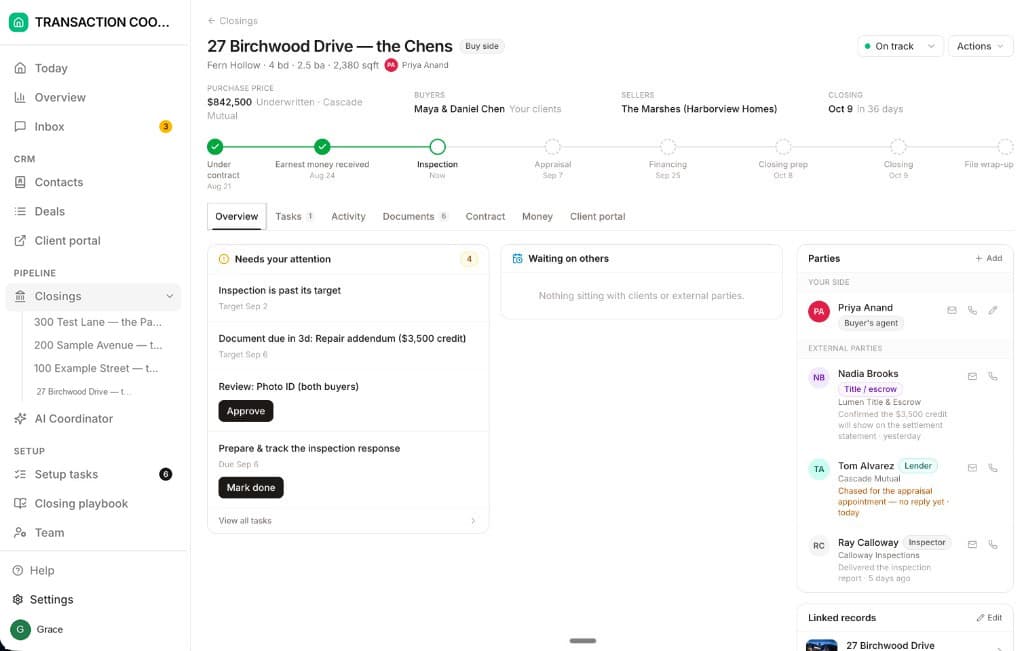
DeedSpring does. Every playbook task names its owner, whether that is the deal owner, the client, an outside party or the AI coordinator, and each closing's Overview splits open items into Needs your attention and Waiting on others. The coordinator checks every active file every hour, sends the chase to the lender or title company itself, and keeps going until the answer is in writing. The waiting files stop costing you minutes.
How many hours does one file take?
The published estimates agree more than the caseload figures do. ListedKit puts a clean deal at 3 to 6 hours of coordinator time and a complex one at 8 to 15. ProFile TM, a TC firm, sums its per-task minutes to 8 to 15 hours. RealAnalytica says 10 to 20. Intake alone is 30 to 90 minutes in ListedKit's estimate, and one agent on r/RealEstateTechnology spends 15 to 20 minutes a contract just pulling the dates and setting reminders.
Put those against a 40-hour week with 30-day escrows and the ceilings fall out. At 4.5 hours a file, a clean book, one coordinator clears about 38 active files. At 8.75 hours, the middle of ProFile TM's range, about 19. At 12 hours, about 14. TC Track's own example of 20 files at 2.5 tasks a day and 12 minutes a task comes to 50 hours a week, which lands in that middle row too. That one calculation reconciles the forum reports of 40 to 60 files with TC Track's 15 to 20. The first is an experienced coordinator on cleaner, narrower work. The second is full service on every file.
How do you measure your own book?
Two weeks and a spreadsheet. Export every open file with its acceptance date and scheduled close, add the files that terminated in the last 90 days, and work out your own average days under contract. Place each open file in a stage using your contract's clocks: deposit and loan application, inspection or option period, loan and appraisal contingency, title, closing week. Then tag every task due in the next seven days with its owner, you or a counterparty, and treat a reply you are waiting for as the counterparty's even if your name is on it.
For ten working days, log your minutes in four buckets: intake, contingency, communication and monitoring, closing prep. They mirror the published estimates, so your totals compare. Count inbound interrupts per day and write down the response time you promise, because that sets the share of the week you cannot schedule. One TC firm, ROCKSTAR TC, publishes a 24-hour response window with a 4 PM cutoff, which lets its coordinators batch. A promise to answer within the hour does not. Count terminations and delayed settlements separately from closings for the same period. At the end, divide your total hours by your active files for hours per active file per week, and divide 40 by that for your ceiling.
When do you hire the second TC?
When your measured ceiling is below the files you carry, and after you have taken the chasing off the desk. Check two things first. If the waiting share is high, the problem is monitoring and interrupts, and a tighter owner tag and a batching window recover hours before a hire does. If the files are clean and the hours per file still run past eight, the problem is scope. TC Track's tiers show the same coordinator carrying twice the files when client communication comes off the desk. ListedKit's experience is that 20 active files make intake a constant drain, 30 crowd out the transaction work and 40 is unsustainable. If your log puts you past 30 with no change in scope, hire.
What does DeedSpring do for a coordinator at capacity?
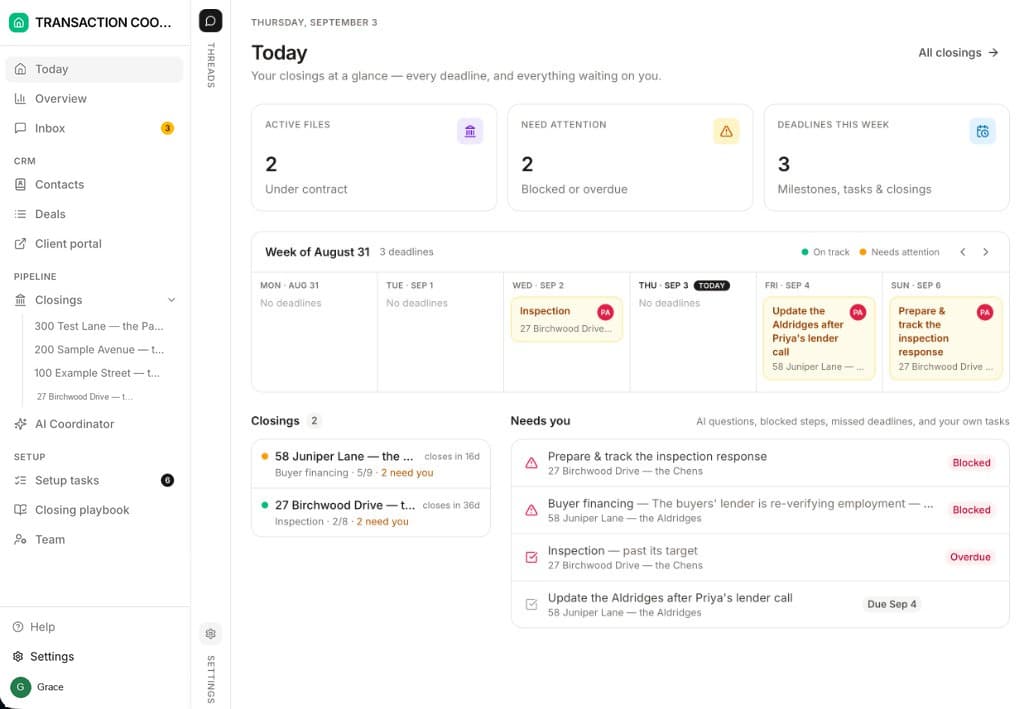
It takes the two biggest buckets in your log. Upload the executed contract and the AI coordinator reads the price, deposits, contingencies and dates into deadlines on the file. It then checks every active file every hour, flags a milestone past target or a task nobody has moved on Today and on the closing's Overview, sends the chase to the lender or title company, notes who said what, and keeps going until the item is confirmed in writing. Anything sensitive or negotiable waits for you as a draft. The Today page opens on Active files, Need attention and Deadlines this week, which are the counts the two-week audit asks you to keep by hand.
Starter is $15 a month for one closing. Standard is $25 a closing for up to four a month, $22 from five, $20 from ten and $19 from twenty, with unlimited agents and teammates and unused closings rolling over. Everything on the pricing page is month to month and free to try.