Explainer · Transaction coordinator careers, pay and licensing
What a TC may not touch: trust accounts and earnest money by state
Florida, Georgia and North Carolina let an unlicensed assistant record and deposit earnest money. Georgia forbids collecting or holding it in the same rule. Texas lets only a license holder be authorized to withdraw or transfer trust money, Colorado lets the broker name unlicensed cosigners, and Arizona bars withdrawals outside property-management accounts. Seven states, every cell from the regulator's text.
Which actions does each regulator's text allow?
The question is never "can a TC handle earnest money" in one piece. Each state writes rules around verbs, and the verbs do not line up. The table takes the four that recur, receiving the check, recording and depositing it, holding it, and taking it out of the account, and puts the regulator's wording in each cell. An empty cell means the text does not speak to that verb. It does not mean the act is allowed.
What each regulator's text says about unlicensed assistants and trust money, verb by verb
| State and text | Receive or receipt | Record and deposit | Hold | Withdraw, transfer or sign |
|---|---|---|---|---|
| Texas (22 TAC §535.146 and TREC article, 2024) | — | Bookkeeping is on the administrative list, deposits are not named | Speaks to sales agents only: they shall not maintain a trust account and must deliver trust money to the broker | The broker may only authorize another license holder to withdraw or transfer |
| Florida (FREC list, 2009, and 61J2-14.010) | Receive, record and deposit earnest money, security deposits and advance rents | On the permitted list, same line | A broker who receives a deposit shall immediately place it in an insured escrow or trust account | The broker must be a signatory on all escrow accounts |
| Georgia (Rule 520-1-.07(6)) | Shall not collect deposit monies received from the owner or a prospective purchaser or lessee | May record and deposit earnest money, security deposits and rents | Shall not hold deposit monies | — |
| Colorado (Rules 5.1 to 5.3 and CP-20, 2026) | Collect and receipt for earnest money deposits, security deposits, or rents | Money accepted by a broker or firm must be deposited into the firm's trust or escrow accounts | Written controls must cover the financial activities of unlicensed persons | The employing broker must be able to withdraw, but may authorize licensed or unlicensed cosigners |
| North Carolina (Bulletin 2012-V43-2 and Comments) | — | Record and deposit trust monies under the close supervision of the broker-in-charge | The broker-in-charge is responsible for all money being held in a trust account | — |
| Washington (WAC 308-124E-105 and RCW 18.85) | Receipting is the designated broker's responsibility | Depositing is the designated broker's responsibility | Holding funds in a sale is a brokerage service, and office personnel are exempt only while they do none of it | Disbursing is the designated broker's responsibility |
| Arizona (SPS 2025.02) | May collect in-person rent and give a receipt as a clerical duty, and earnest money is not named | — | — | Not permitted to withdraw from the broker's trust account, and a signatory only on a property-management account as a bona fide employee |
Why do the lists permit "deposit" but forbid "hold"?
Georgia is the clearest case because both lines sit in one rule. Paragraph (6) of Rule 520-1-.07 says Support personnel may not perform any real estate brokerage activities of a real estate licensee, requires a written agreement specifying their duties, then lists the tasks the Commission has identified that they may perform. Item 9 of that list is to record, and deposit earnest money, security deposits, and rents. Item 11 of the prohibited list, in the next paragraph, is to collect or hold deposit monies, rent, other monies or anything of value received from the owner of real estate or from a prospective purchaser or lessee. The Commission's July 2024 newsletter repeats both lines as items 10 and 8 of its two summary lists. Side by side, the assistant may record and deposit the money, and may not collect it from a buyer, owner or tenant, or hold it.
Florida's list is shorter and goes further on receiving. The FREC sheet, revised and approved in September 2009, has a single bullet that reads Receive, record and deposit earnest money, security deposits and advance rents, so receiving is on the permitted list there and on the prohibited one in Georgia. The broker rule then takes over: every broker who receives a deposit from sales associates, principals or prospects shall immediately place it in an insured escrow or trust account, and the broker must be a signatory on all escrow accounts.
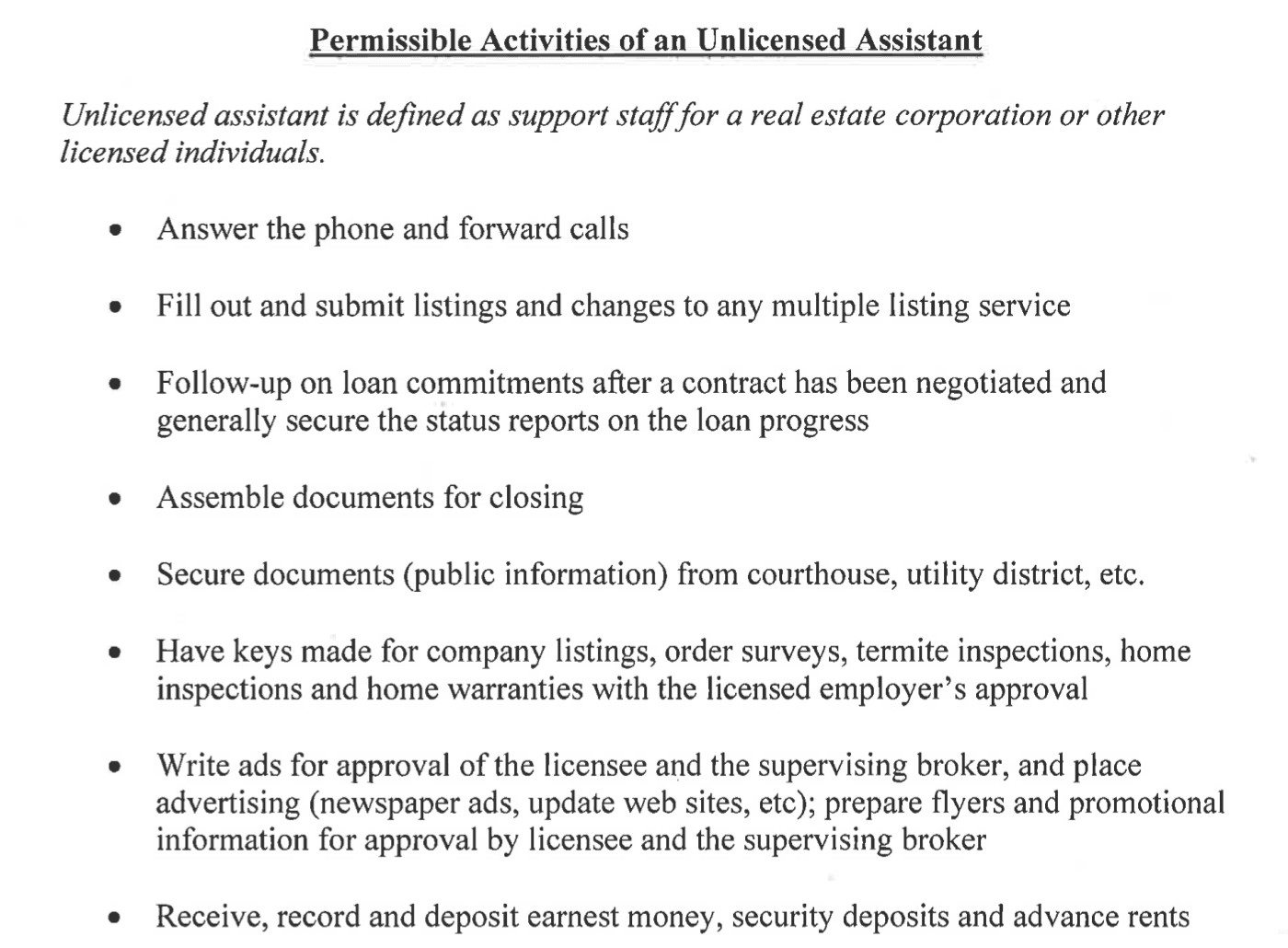
North Carolina adds a condition rather than a verb. The Commission's bulletin lists Record and deposit trust monies under the close supervision of the office broker-in-charge among what assistants may do, and its rule comments carry the same task on a list that applies so long as the assistant or employee is salaried or hourly paid and is not paid on a per-transaction basis. A coordinator paid per file is not covered by that list. Colorado's Commission Position 20, revised in August 2026, names transaction coordinators among its administrative professionals, and item 13 of its task list reads Collect and receipt for earnest money deposits, security deposits, or rents, the widest receiving language of the seven.
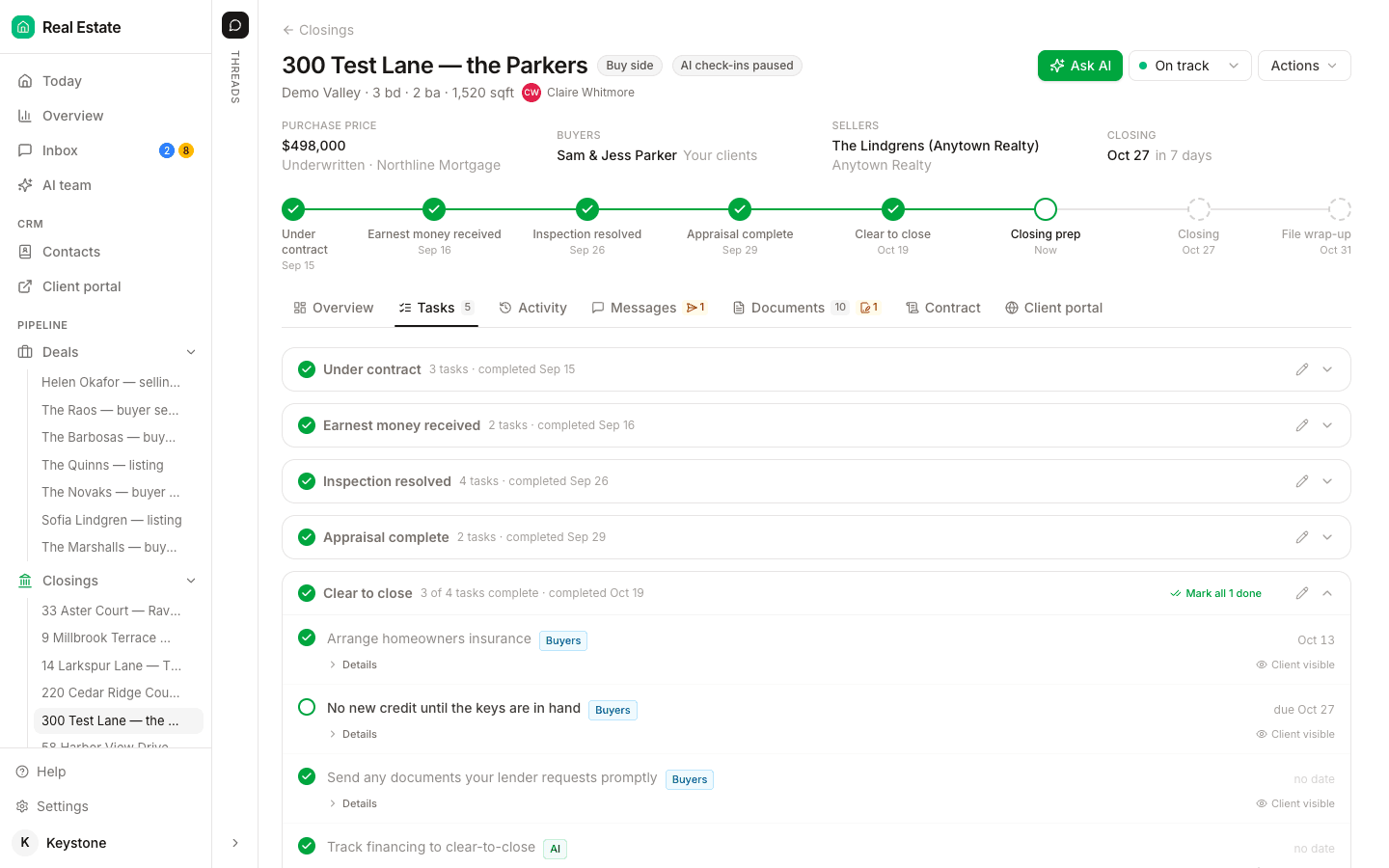
Whoever carries the check, the file still needs the record, and DeedSpring keeps it without touching the money. The closing carries an Earnest money received milestone with its own tasks and its completion date, and the receipt goes under Documents. The AI coordinator reads the deposit terms off the contract and flags the milestone if it runs past target. Anything to do with money is always a draft for a person to send, and it never does anything in another system that moves money.
Who may be a signer on the trust account?
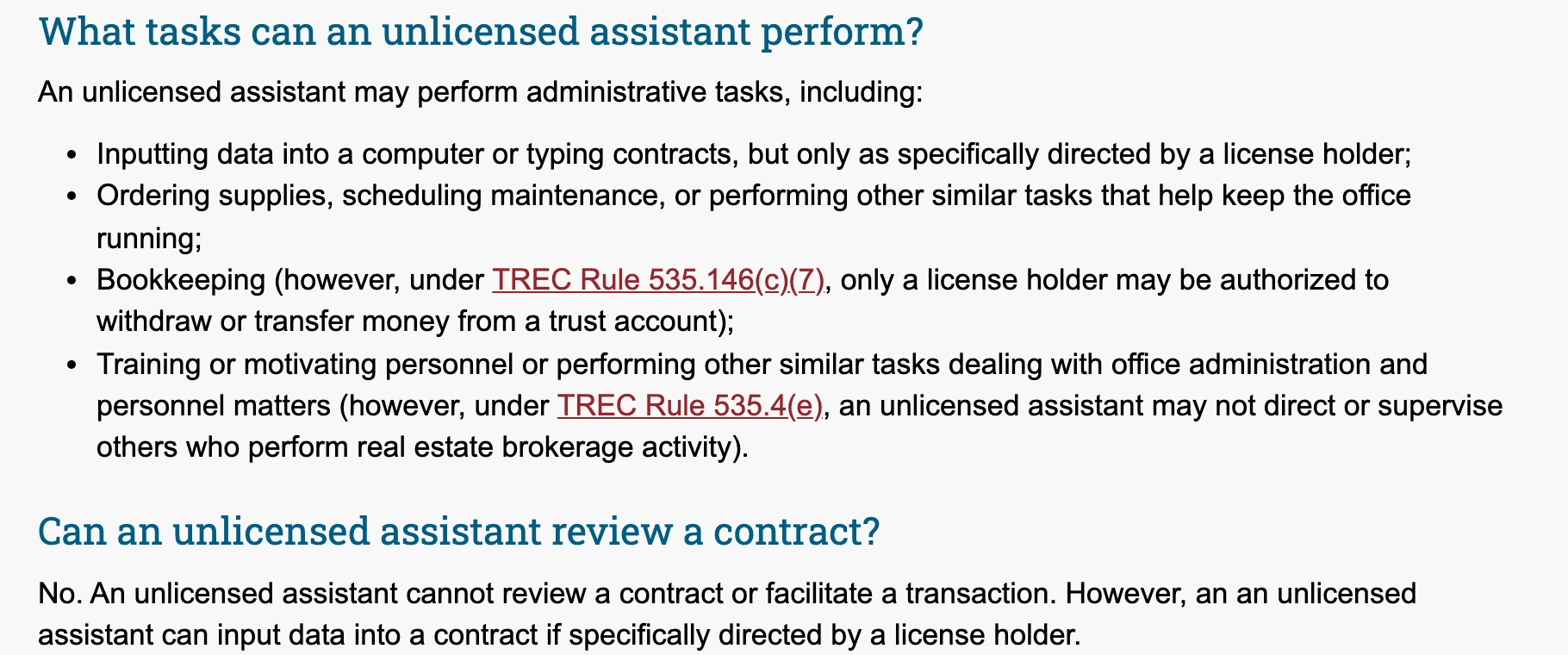
This is where the states split hardest. Texas Rule 535.146(c)(7) says A broker may only authorize another license holder to withdraw or transfer money from any trust account and that the broker remains responsible for every deposit and disbursement regardless. TREC's 2024 article on unlicensed individuals lists bookkeeping as a permitted administrative task and attaches that rule as the caveat in the same sentence. An unlicensed Texas coordinator may keep the books and may not be authorized to withdraw or transfer trust money.
Colorado reads the other way. Rule 5.3.C makes the employing or independent broker responsible for each separate account and says the broker may authorize other licensed or unlicensed cosigners, with the authorization relieving the broker of nothing. Rule 5.1 requires written accounting controls with checks and balances over the financial activities of unlicensed persons. Arizona's policy statement, revised in February 2025, allows an unlicensed assistant to transfer money or sign only on a property management trust account and only as a bona fide officer, member, principal or employee in the broker's direct employ. Beyond that, the statement says an unlicensed assistant is otherwise not permitted to withdraw monies from the broker's trust account.
Washington does not write an assistant list at all. WAC 308-124E-105 makes the designated broker responsible for the administration of trust funds, with depositing, holding, disbursing, receipting, posting and recording in the enumerated duties. The licensing statute then defines collecting, holding or disbursing funds in connection with a sale as a brokerage service, and exempts office personnel only who does not engage in any conduct or activity specified in any of the definitions.
The cell that is empty is not a yes
What goes on the file, whoever carries the check?
The coordinator's job survives every version of the rule, because none of the seven texts forbids recording. Whoever receives, deposits or signs, the file needs the same four lines: who took the money and when, the date it reached the trust or escrow account, the receipt from the holder, attached rather than described, and the rule line the brokerage is acting under, including who signs on the account. North Carolina demands close supervision and Colorado demands written controls, and the record shows both. In Texas and Arizona it shows the coordinator stayed off the withdrawals the text reserves.
The trust-account rule is one part of a state's file. Our state pages put it beside the contract, the closing model and what a coordinator costs there, for North Carolina, Texas and Florida among others. What we take on as your coordinator, in any state, is on our real estate transaction coordinator page.