Research · Listing and closing workflows
Earnest money deadlines by state: the two clocks a transaction coordinator tracks
Nine states' broker deposit rules and five public purchase contracts, read in their own text. The contract gives the buyer three to five days to deliver the money, or in Colorado makes it due with the contract; the state gives the broker who receives it from the next banking day to five business banking days to bank it. The units differ, and so do the start dates.
How fast must the broker deposit it in each state?
Faster than most contracts give the buyer, and in a unit the contract never uses. Seven of the nine states put a number on it. Two, Georgia and Arizona, say promptly or immediately and leave it there. Only Florida defines its adverb.
The broker's deposit clock, from each state's trust-money rule
| State and rule | Deposit clock | Counted from | Unit |
|---|---|---|---|
| Arizona (A.R.S. §32-2151) | Immediately to a neutral escrow, or on receipt to the trust account | Receipt | No number |
| California (10 CCR §2832) | Not later than 3 business days | Receipt; a check held uncashed counts from acceptance | Business days |
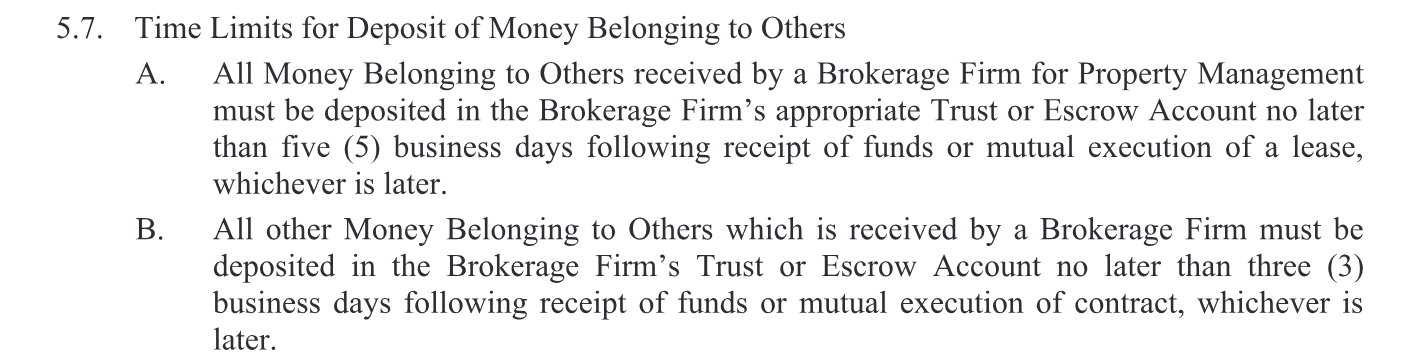
| Colorado (4 CCR 725-1 Rule 5.7) | No later than 3 business days | Receipt of funds or mutual execution, whichever is later | Business days |
| Florida (61J2-14.008, .010) | Immediately, defined as the end of the third business day | Receipt of the item | Business days; weekends and legal holidays excluded |
| Georgia (Rule 520-1-.08) | Promptly; the agent hands it to the broker as soon as practicably possible | Receipt | No number |
| North Carolina (21 NCAC 58A .0116) | No later than 3 banking days; a check with a pending offer, 3 days after acceptance | Receipt, or acceptance for a check that came with the offer | Banking days |
| Texas (22 TAC §535.146) | Close of business of the second working day | The date the broker receives the money | Working days |
| Virginia (Va. Code §54.1-2108.2) | End of the fifth business banking day | Ratification if the firm holds it; receipt if it goes to a named escrow agent | Business banking days |
| Washington (RCW 18.85.285; WAC 308-124E-105) | The next banking day | Receipt | Banking days; weekends and legal holidays excluded |
Read the unit column twice. Texas counts working days, Florida and Colorado business days, North Carolina banking days, Virginia business banking days. Florida and Washington say what their unit excludes: Saturdays, Sundays and legal holidays. North Carolina's rule does not define banking day, but its contract does, as Monday through Friday minus Federal Reserve holidays. The others leave the definition to the reader.
The start date is the second trap. Texas and Florida count from the day the broker receives the item, and in Florida a sales associate's receipt counts as the broker's. Colorado counts from receipt or mutual execution, whichever is later. Virginia counts from ratification when the firm will hold the money and from receipt when it is passing the deposit on to the escrow agent named in the contract. Its five days sit in the statute: the Real Estate Board repealed the regulation that used to carry them on 1 April 2026, and the regulation that replaced it points to the Code. California lets a broker hold a buyer's check uncashed until the offer is accepted, provided the check is not negotiable by the broker or the buyer has said so in writing and the seller is told, and then gives three business days after acceptance. North Carolina does the same for a check that comes with a pending offer: three days after acceptance, and the acceptance date must be written in the contract.
Five of the nine rules let the parties set a different time in writing: Texas and Virginia by agreement of the principals, Arizona by all parties, Georgia by the parties at interest, Washington when the purchase agreement itself provides for deferred deposit or delivery. The Florida, Colorado and North Carolina rules carry no such clause, and California's only lets the offeree, the seller on a buyer's check, authorize the broker to keep holding it.
Texas: the rule and the FAQ count from different days
TREC Rule 535.146(b)(3) counts the second working day from the date the broker receives the trust money. TREC's FAQ page answers the same question with the second working day after execution of the contract by the principals, and cites the rule for it. The table uses the rule's words. A broker who receives a check on the second working day after signing has two more working days under the rule, and under the FAQ's wording would have to bank it by close of business that same day.
How long does the buyer have under the standard contract?
Three days in Texas and Florida, three business days in California, five days in North Carolina, and in Colorado no days at all unless the parties write some in. These are the five standard purchase contracts we could read. Arizona, Georgia, Virginia and Washington sit in the deposit table alone because we could not open their association contracts. This is the clock the coordinator calendars, because it is the one the buyer can miss and the seller can act on.
The contract's delivery clock, in the five published purchase forms
| Form and paragraph | Buyer must deliver | How the form counts | If the last day is a weekend or holiday |
|---|---|---|---|
| California, C.A.R. RPA ¶3D(1) | Within 3 business days after Acceptance, or a written-in number, by wire transfer unless another method is written in | Business days for the deposit; calendar Days elsewhere | After Acceptance, a day for performance that lands on a Saturday, Sunday or Legal Holiday moves to the next day that is not one |
| Colorado, CBS1 §4.3 (2026 form) | With the contract, unless an Alternative Earnest Money Deadline is agreed | A day ends 11:59 p.m. Mountain; first day excluded, last day included | Extended only if the Will box in §3.3.3 is checked |
| Florida, FAR/BAR AS IS ¶2(a) | Within the days written in, or 3 if blank, after Effective Date | Calendar days | Extends to the next day that is not a weekend or national legal holiday |
| North Carolina, Form 2-T ¶1(d) | Within five days of the Effective Date | Consecutive calendar days, counting from the day after | No extension clause; ¶22 counts Saturdays, Sundays and holidays as days |
| Texas, TREC 20-19 ¶5A | Within 3 days after the Effective Date | Calendar days, starting the day after the effective date | Extends to the end of the next day that is not a weekend or Legal Holiday |
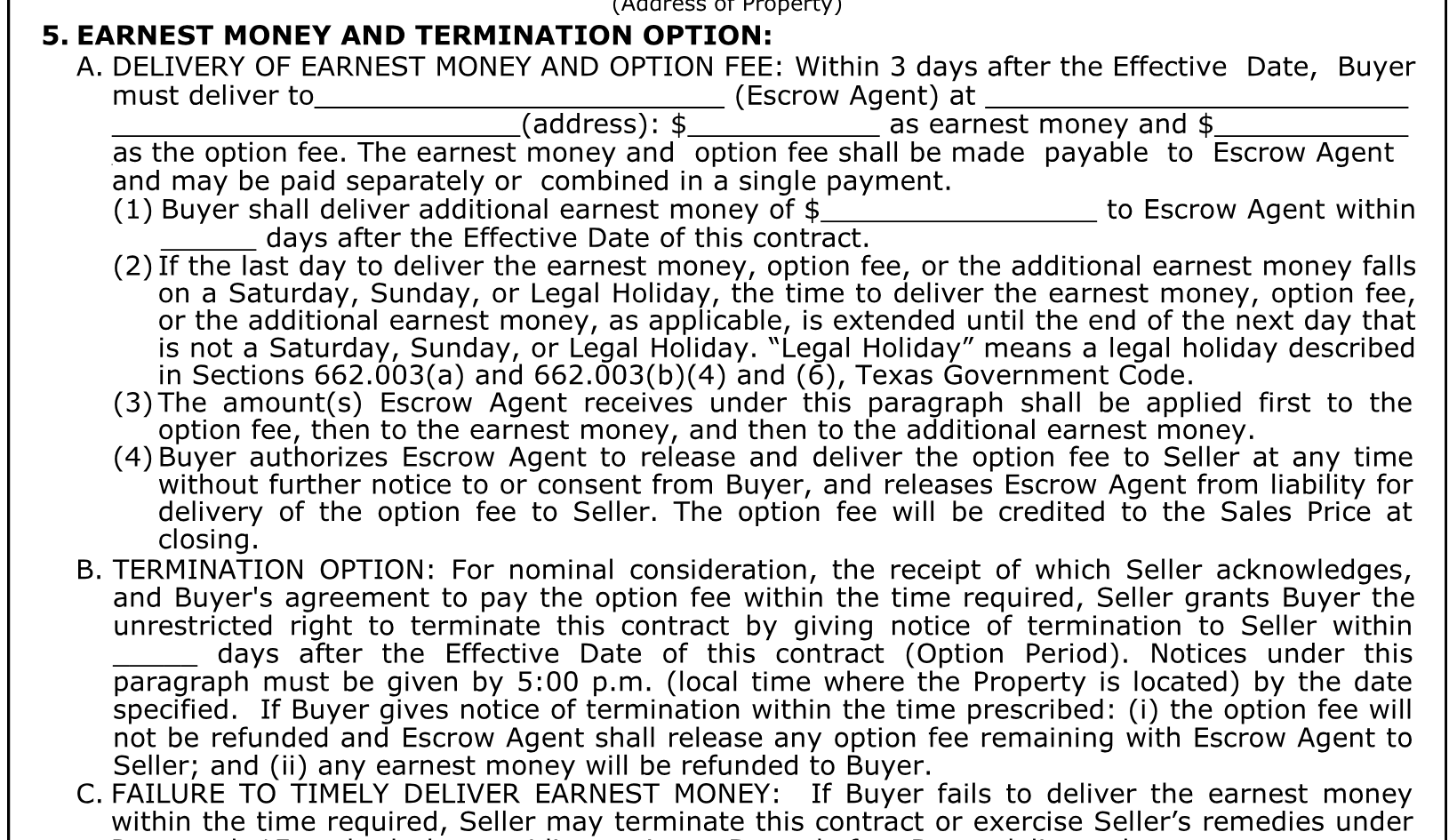
The Texas form gives the buyer 3 days after the Effective Date, counted in calendar days starting the day after signing, and if the third day lands on a Saturday, Sunday or Legal Holiday the time runs to the end of the next day that is not one. Miss it and ¶5C lets the seller terminate, pursue the Paragraph 15 remedies or both, by notice given before the buyer delivers. The Florida form takes the number written into ¶2(a) and 3 days if the blank is left empty, in calendar days, with Standard F rolling a deadline that lands on a weekend or national legal holiday to the next day that is neither. The North Carolina form says within five days of the Effective Date and defines days as consecutive calendar days including weekends and holidays, counted from the day after.
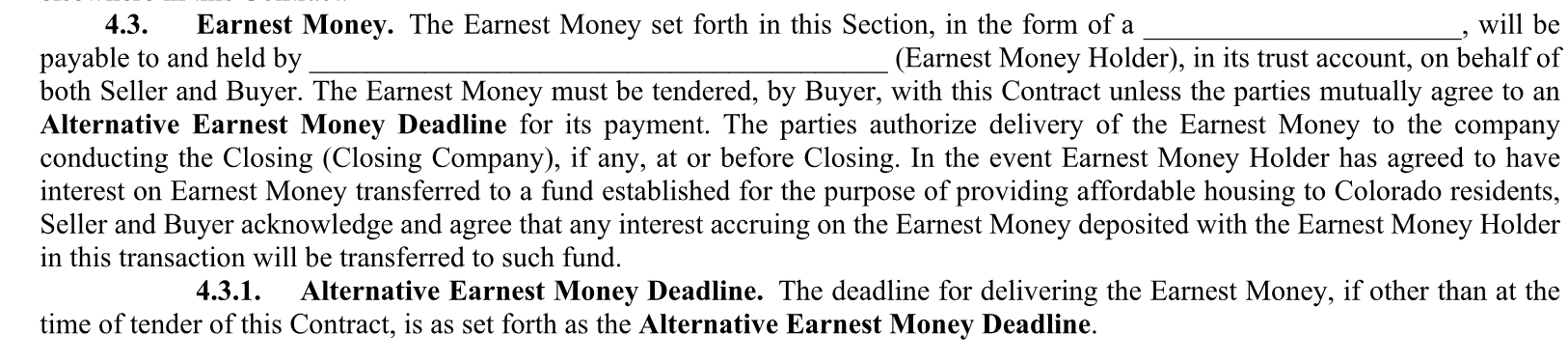
Colorado is the odd one out. The CBS1 form mandatory from 1 January 2026 says the Earnest Money must be tendered, by Buyer, with this Contract unless the parties agree an Alternative Earnest Money Deadline, which is item 2 in the §3.1 dates table. If that line is blank, §3.2 deletes the provision and the money is due with the contract. Colorado's day runs to 11:59 p.m. Mountain time, the first day is excluded and the last included, and a deadline that falls on a weekend or holiday is extended only if the Will box in §3.3.3 is checked. Unchecked, it is not extended.
The C.A.R. form splits its own counting. The initial deposit is due within 3 business days after Acceptance, delivered by the buyer straight to the Escrow Holder, by wire transfer unless another method is written in. Everything else in the agreement runs in calendar Days, and after Acceptance a day for performance that lands on a Saturday, Sunday or Legal Holiday moves to the next day that is not one.
What happens when the two clocks disagree?
Nothing, if you keep them apart. The contract clock binds the buyer. The deposit clock binds the broker, and only when a broker actually receives the money. In Texas the form has the buyer deliver to the Escrow Agent named in ¶5A; when that is a title company and the money goes straight to it, no broker receives trust money and Rule 535.146 has nothing to start. When a Florida deposit is placed with a title company or attorney, the rule gives the broker of the licensee who prepared or presented the contract a different job, unless the deposit is held by a title company or by an attorney nominated in writing by the seller or the seller's agent: within ten business days after each deposit is due, a written request for written verification of receipt, and within ten business days of that request, the verification or a notice that none came, to the seller's broker, or to the seller directly if the seller has no broker.
North Carolina is where the two numbers sit closest, because the contract says five days and the rule says three banking days. NC REALTORS' legal staff answer it the way the rule reads: the five days govern when the buyer must deliver, and the escrow agent then has three banking days from receiving the check to deposit it. A check that arrives on day five is not late on day three.
Washington has the shortest second clock of the nine, with its own carve-outs. The statute wants the money in the trust account the next banking day following receipt, unless the purchase agreement provides for deferred deposit or delivery, in which case the broker follows the agreement, and it excuses a firm from keeping a trust account at all for a transaction whose agreement tells the broker to deliver the check to a named closing agent or to the seller. The rule excepts a check the agreement says to hold, and takes Saturdays, Sundays and legal holidays out of the banking-day count.
One contract, both clocks, dated
Take a Texas contract with an Effective Date of Wednesday, 21 October 2026. Day one is Thursday the 22nd, day three is Saturday the 24th, so ¶5A(2) carries the delivery deadline to the end of Monday, 26 October. That date goes on the file as the buyer's task. If the money goes to the title company named as Escrow Agent, there is no second clock for the brokerage to track. If instead the listing broker receives the check on Monday the 26th, Rule 535.146(b)(3) gives it until close of business on Wednesday, 28 October, the second working day after receipt.
Run the same dates in Colorado on the 2026 form with the Alternative Earnest Money Deadline left blank. The money is due with the contract on the 21st. A brokerage that receives it that day has until the end of Monday, 26 October under Rule 5.7B: three business days following the later of receipt and mutual execution, which are the same day here, so Thursday, Friday, Monday. Had the parties written Friday, 23 October into the table and the check arrived then, the deposit clock would run to Wednesday the 28th.
Which clock does the coordinator put on the file?
The delivery clock, every time, with the counting rule the form uses written beside it: three calendar days extended off a weekend in Texas, five calendar days in North Carolina, three business days in California, with the contract in Colorado unless the table says otherwise. Add a second line for the receipt from the escrow agent, which is the evidence the clock was met. The deposit clock is the broker's to track in the trust ledger, and it starts on a date the coordinator often cannot see: the day the check reached the broker's desk.
The deposit is one line of a state's file. The contract deadlines, who closes and what a coordinator may do sit together on our pages for Texas, Florida and North Carolina. What we take on as your coordinator, in any state, is on our real estate transaction coordinator page.
Each state has a page covering its contract, who closes, the deadlines and what coordinators charge. The states not linked above are Alabama, Alaska, Arkansas, Connecticut, Delaware, District of Columbia, Hawaii, Idaho, Illinois, Indiana, Iowa, Kansas, Kentucky, Louisiana, Maine, Maryland, Massachusetts, Michigan, Minnesota, Mississippi, Missouri, Montana, Nebraska, Nevada, New Hampshire, New Jersey, New Mexico, New York, North Dakota, Ohio, Oklahoma, Oregon, Pennsylvania, Rhode Island, South Carolina, South Dakota, Tennessee, Utah, Vermont, West Virginia, Wisconsin and Wyoming.