
Template · Listing and closing workflows
Buyer contract-to-close checklist for agents and coordinators
The twenty-five things a buyer has to pay, receive or decide between the executed contract and the keys, in the order the deadlines fall, with the TREC and C.A.R. paragraph that sets each clock. For buyer's agents and transaction coordinators.
What does a buyer's agent have to do between contract and closing?
The deadlines below are written to TREC 20-19 with its 40-11 financing and 36-11 association addenda, and to the C.A.R. RPA-CA 12/18 public sample. The current C.A.R. 12/24 revision is members-only, so check its blanks against yours. Before you start, take four numbers from the executed contract: the Effective Date or Acceptance date, the Closing Date, the option or investigation days, and the financing days.
Days 0 to 3: bind the deal
- Get the complete executed contract and confirm the Effective Date (Texas) or Acceptance date (California) with the buyer in writing. Every clock below starts here.
- Deliver the earnest money, and in Texas the option fee, to the escrow agent named in the contract. TREC ¶5A gives 3 days after the Effective Date, and a last day that lands on a weekend or legal holiday rolls to the next day that is not one. C.A.R. ¶3A gives 3 business days after Acceptance. Keep the escrow agent's receipt. A late option fee costs the buyer the unrestricted right to terminate (¶5D).
- Verify the wire instructions by phone, on a number the buyer already has, before any money moves. The CFPB warns that scammers pose as the agent or the settlement office and send last-minute changes.
- Make the formal loan application and send the lender the executed contract. TREC 40-11 ¶1 says apply promptly. C.A.R. ¶3J(1) wants the pre-approval letter with the seller within 3 days after Acceptance. The lender owes a Loan Estimate within three business days of the application. Ask if it has not arrived.
- California only: deliver verification of the down payment and closing funds to the seller within 3 days after Acceptance (¶3H). The TREC contract has no equivalent line.
- On a home built before 1978, review the lead-based paint disclosure and decide on a lead inspection inside the federal 10-day window, which the parties can only change in writing (24 CFR 35.90). No disclosure on a pre-1978 home means a call to the broker before anything else moves.
The option or investigation period
- Book the inspection the day the option fee clears. In Texas the fee is what buys the Option Period (¶5B). In California the investigation contingency runs 17 days after Acceptance on the 12/18 form (¶14B(1)). Aim to have the report in hand five days before the cut-off.
- Decide, and deliver the paper: an amendment, a repair request or a termination notice, with proof of delivery. Texas notices under ¶5B are due by 5:00 p.m. local time on the last day. California counts to the end of the last Day as ¶30 defines it.
- Receive the Seller's Disclosure Notice (Texas) or the seller's disclosures (California). If the Texas notice arrives after contract, the buyer has 7 days from receipt to terminate for any reason (¶7B(2)). In California the seller has 7 Days After Acceptance to deliver (¶14A).
- Receive and read the HOA or subdivision documents. The Texas addendum gives the buyer 3 days from receipt to terminate (36-11 ¶A). California's seller discloses common-interest status within 7 days (¶7F).
- Get an insurance quote and check the flood zone now. C.A.R. ¶12B(vi) lists insurability among the Buyer Investigations to finish inside the period, and one lender's checklist wants the binder a week before closing.
Financing, appraisal and title
- Appraisal: the lender orders it, the buyer pays, you read the value against the price. TREC 40-11 ¶2B lets the buyer terminate on or before the 3rd day before the Closing Date, with notice and the lender's written statement. C.A.R. ¶3I gives 17 days after Acceptance. Order it before the repair talks end, or the clock compresses.
- Financing decision: confirm status with the lender before the deadline, then remove or terminate in writing. TREC 40-11 ¶2A runs the number of days in the blank, and termination needs the notice plus the lender's letter. C.A.R. ¶3J(3) gives 21 days after Acceptance on the 12/18 sample, so check the current form.
- Clear underwriting conditions as they arrive and take on no new credit. The lender's sequence is conditional approval, conditions cleared, clear to close. No clear to close five days out means an extension amendment, drafted now.
- Receive the title commitment (Texas) or preliminary report (California) and read the exceptions. TREC ¶6B gives the title company 20 days from receiving the contract, with an automatic extension of up to 15 days or 3 days before closing, whichever is earlier, and a late commitment lets the buyer terminate. In California the preliminary report review is a ¶14B contingency (¶13A).
- Texas: object to title and survey matters in writing by the ¶6D deadline, the earlier of the Closing Date or the blank number of days after receiving the commitment, exceptions and survey. Silence waives every objection except the Schedule C requirements. The seller then has 15 days to cure.
- Texas: get the existing survey with the T-47 or T-47.1 affidavit, or a new one, within the ¶6C blank. If the seller's survey is rejected or never arrives, the buyer gets a new one no later than 3 days before closing.
- Bind homeowners insurance, and flood insurance where the lender requires it, and send proof to the lender at least a week before closing. No binder, no clear to close.
- Texas: if the lender requires repairs, agree who pays before closing. Under ¶7E the contract terminates if the parties cannot agree, and the buyer may terminate if the cost exceeds 5% of the sales price.
Closing week
- Receive the Closing Disclosure at least three business days before closing and compare it with the Loan Estimate. A corrected disclosure restarts the three days if the APR becomes inaccurate, the loan product changes or a prepayment penalty is added, and every date below moves with it. Log the day the buyer received it.
- Confirm cash to close and send the funds as title directs, one or two days out, after the same phone call-back as item 3.
- Walk through and check the agreed repairs and their receipts. C.A.R. ¶15 sets it within 5 Days before Close Of Escrow and says it is not a contingency. Texas has no walk-through clause, but ¶7F has the seller finish agreed repairs before closing and hand over the repair documentation, and lets the buyer extend the Closing Date up to 5 days if they are not done.
- Sign: government photo ID, the loan and closing documents, the buyer's expenses. The TREC Closing Date is the stated date or 7 days after title objections are cured or waived, whichever is later (¶9A).
- Take possession. In Texas that is on closing and funding or under a temporary lease, with the Smart Device access codes handed over (¶10A, ¶10B). In California it is 6 PM on the day of Close Of Escrow unless the form says otherwise (¶9B). Possession before closing without a written lease is a tenancy at sufferance in Texas.
- Deliver the buyer's file within two days: contract, disclosures, Loan Estimate, Closing Disclosure, receipts, inspection reports and warranty transfers.
Buyer contract-to-close checklist
CSV · 10 KB · No sign-up required · Preview every row
When does each deadline start?
Most of them count forward from the Effective Date in Texas or Acceptance in California: earnest money, the option or investigation period, the financing and appraisal contingencies, the HOA window. The Texas title clock is the exception. Its 20 days run from the day the title company receives the contract, so a contract that sits in an inbox for a week delivers the commitment a week late. Two count backward from closing: the Texas appraisal exit, on or before the 3rd day before the Closing Date, and the Closing Disclosure, which the buyer must receive three business days before consummation. The lead-paint window runs 10 days from contract unless the parties change it in writing.
Weekend rules differ by clause. TREC ¶5A rolls an earnest-money day that lands on a weekend or legal holiday to the next day that is not one. ¶5B gives the Option Period no such roll, so an option that ends on a Saturday ends on that Saturday at 5:00 p.m. The C.A.R. form counts the deposit in business days and defines every other Day in ¶30.
What happens if the buyer misses one?
It depends on which form the buyer signed. The national checklist line about releasing your contingency in writing before the deadline is right in California and wrong in Texas.
In Texas the Option Period simply ends. ¶5B gives the buyer an unrestricted right to terminate by notice within the blank number of days, due by 5:00 p.m. local time, and contains no removal document and no extension. Financing works the same way: a buyer who does not terminate under 40-11 ¶2A in time holds a contract that is no longer subject to Buyer Approval. Title objections not made by the ¶6D deadline are waived, Schedule C aside. A low appraisal on its own is no way out either. The Texas REALTORS® legal FAQ says ¶2B gives no right to terminate when the property still meets the lender's underwriting requirements, and that if the lender lends less, the buyer brings more cash.
California puts a step in between. ¶14 wants every removal or cancellation in writing on Form CR or CC, and under ¶14B(4) the buyer keeps the right to remove or cancel after day 17 until the seller cancels. The seller can only cancel after delivering a Notice to Buyer to Perform of at least 2 Days (¶14D(1), ¶14E). The 12/18 form also carries its own appraisal contingency at ¶3I. Late is survivable in California until that notice arrives. In Texas it is over at 5:00 p.m.
This is what a miscount looks like. In July 2025 a California first-time buyer with a 14-day contingency, accepted on Thursday, July 3 going into the holiday weekend, posted that the seller had served a Notice to Perform. The replies found a deadline counted one day short and an appraisal left until after everything else.
“If your contract date was July 3rd and your contingency was 14 days, it was due Thursday the 17th, not Wednesday.”
Another reply told the buyer to have the agent email the verbal extension with the signed form attached for the seller's signature. That signed page is the proof item 8 asks for.
Who watches the dates once the list is written?
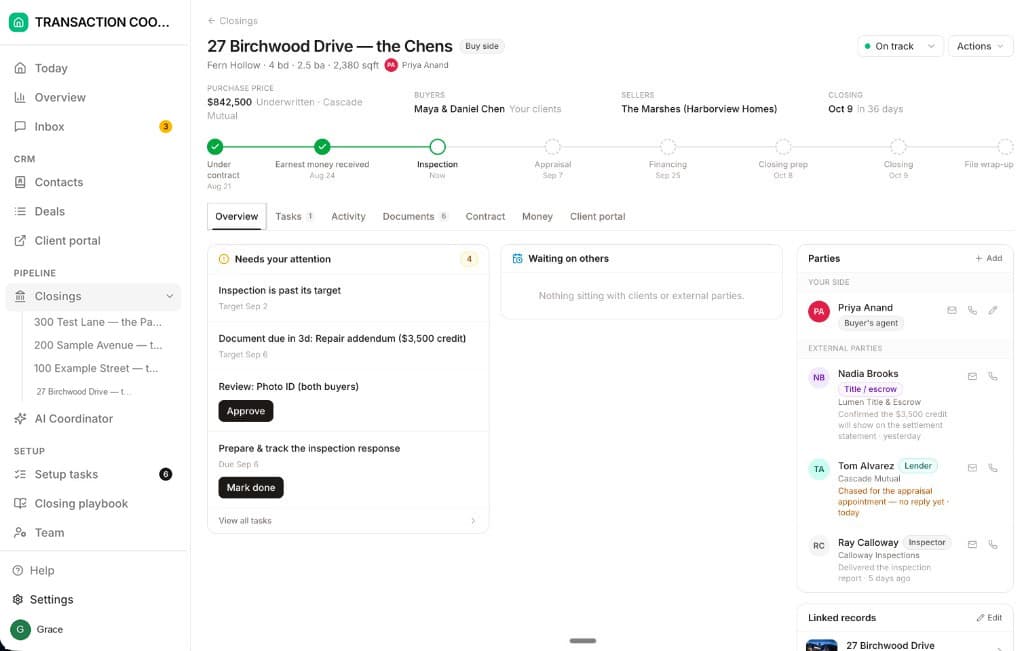
Nobody, unless you build it in. The buyer owns most of the twenty-five items and never sees the list. The lender does not chase the appraisal appointment for you. The agent finds out a date slipped when the Notice to Perform lands. DeedSpring closes that gap. Upload the executed contract and it reads the price, deposits, contingencies and dates into deadlines on the closing. It checks every active file every hour, flags a milestone past its target on Today and on the closing's Overview, and drafts the chase to the lender or the reminder to the buyer for you to send. Anything that touches money, contract terms or a moving deadline is always a draft for you.
Does the list work outside Texas and California, or for a cash buyer?
The owners, the order and the proofs hold everywhere. The deadline numbers do not. NAR's consumer guide says the process differs in each state, and due-diligence periods, attorney review and business-day counting are where it differs most, so replace each deadline from your own form before you use it. The deposit holder moves too: an escrow agent in Texas, an escrow holder in California, a broker's trust account in some states, so item 2's receipt comes from whoever holds it. Items 16, 17 and 19 come from TREC clauses with no C.A.R. equivalent, so drop them on a California file or swap in your own title-review step. For a cash buyer, delete the loan application, funds verification, appraisal, financing decision, underwriting, binder and Closing Disclosure items (4, 5, 12, 13, 14, 18 and 20). The funds step and its phone call-back are all that remain.
How does DeedSpring run this list for you?
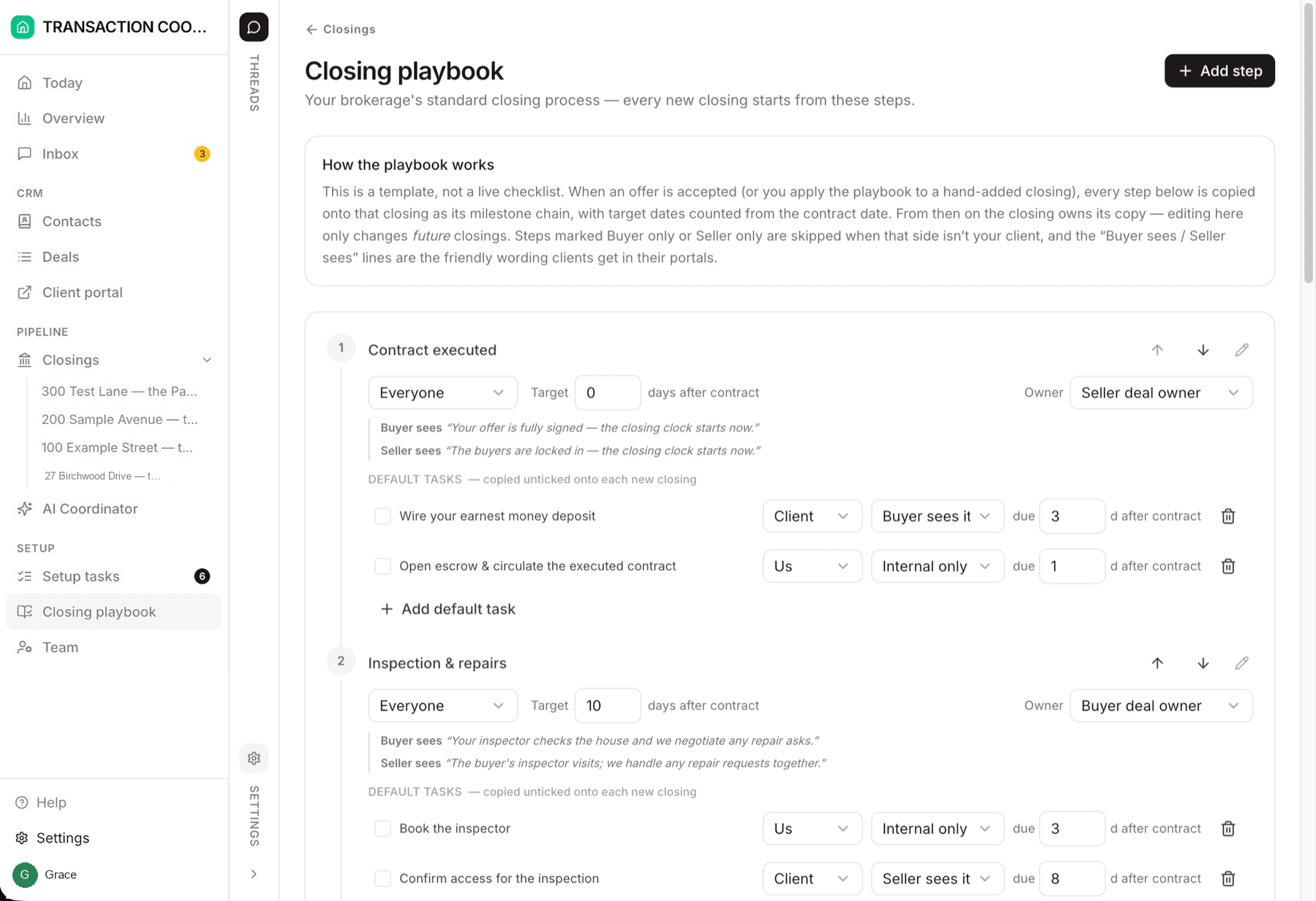
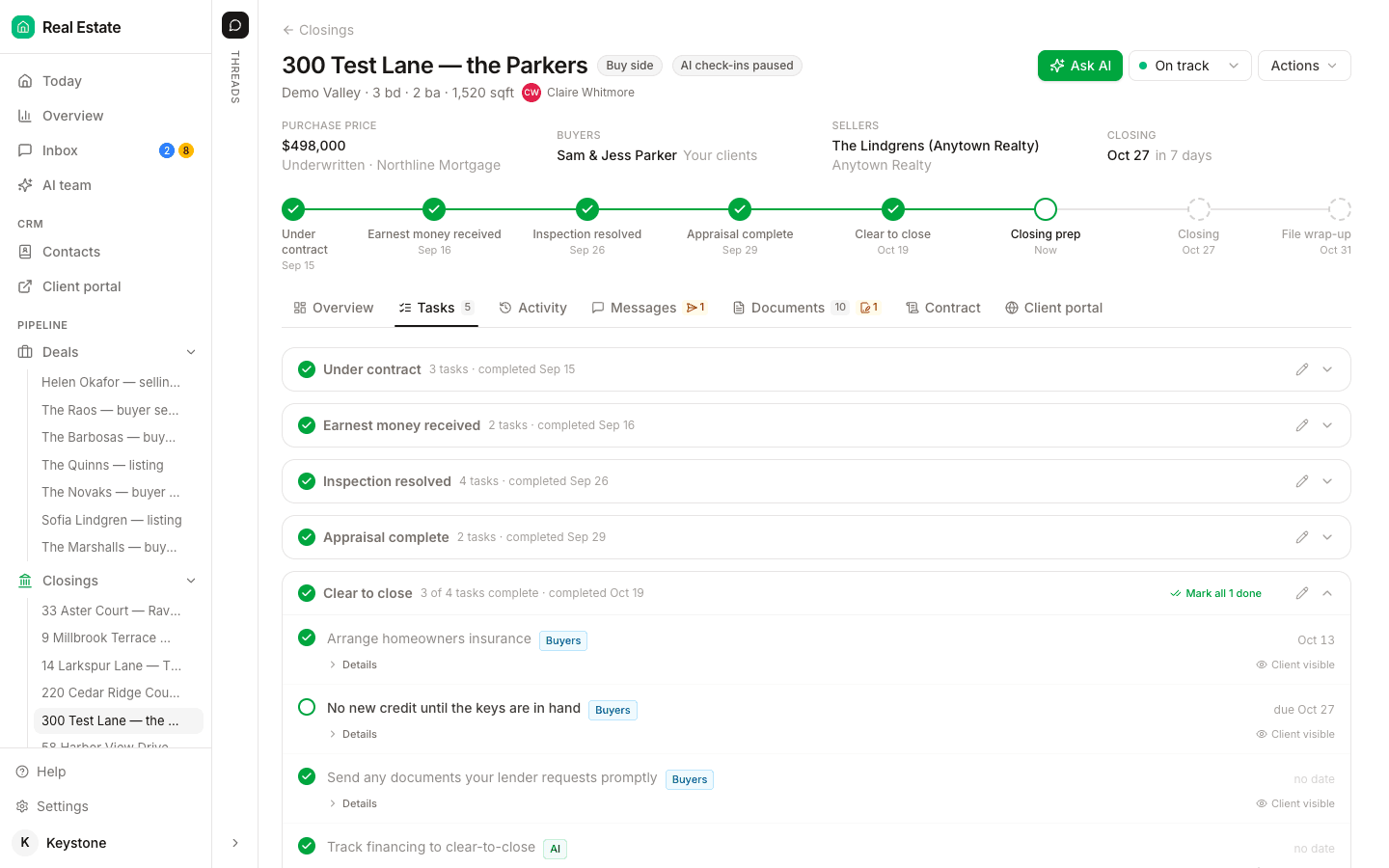
Open the closing on the Buy side and upload the contract, and DeedSpring reads the property, parties and dates off it. Hand it to the AI thread instead and it shows you what it found before it builds the record. The buy-side playbook arrives with financing and inspection already on the chain, each task counted from the contract or closing date (10 days after contract date, for instance) and each naming who does it: Deal owner, Client, External party or AI. Mark a task Client visible and the buyer sees it in their portal, with the internal notes and risk flags filtered out. The coordinator will not mark a milestone done without evidence in writing. A lender saying it should be fine on the phone is not clear to close.
Starter is $15 a month for one closing a month. Standard is $25 a closing, less at volume, with unlimited agents and teammates and unused closings rolling over. Both are month to month, on the pricing page.