
Template · Transaction coordinator operations
Transaction coordinator checklist: the 37 items from executed contract to closed file
The 37 items a transaction coordinator checks on a purchase file, in six phases, each with the TREC 20-19 or C.A.R. RPA paragraph that sets its clock. Download the CSV, delete what your contract lacks, and run it on the next file.
What goes on a TC checklist?
Your own work, in the order the deal forces it, which Paperless Pipeline's template post rightly separates from the buyer's and seller's milestone lists. It assumes a residential resale with a lender. A cash deal drops the financing phase. Where an item names a form paragraph, the number is that form's pre-printed default or blank, so check your executed copy. Where it names none, the timing is ours and your brokerage's policy wins.
Transaction coordinator checklist
CSV · 19 KB · No sign-up required · Preview every row
Day 0 to day 1: intake and file setup
- Get the complete executed contract the same day: every page, every addendum ticked in ¶22, all counteroffers, every signature and initial. Send an incomplete one back and calculate nothing from it.
- Record the Effective Date (TREC) or Acceptance (C.A.R. ¶30A) in the file header with the page it came from. A blank or disputed date goes back to the agent to confirm in writing.
- Note the form ID and revision and copy its day-counting rule into the file notes (TREC ¶5A(2), C.A.R. ¶30F to H). Flag an attorney-drafted or builder form for review.
- Create the file in the brokerage's system by the next business day with every required field filled. SkySlope holds it at Incomplete until the required tabs are done.
- Build the deadline calendar from the contract and get the agent's written sign-off on it.
- Send the introduction email with the timeline to the client, co-op agent, lender and title or escrow.
- Deliver the executed contract to title and get a receipt. In Texas the 20-day title commitment clock in ¶6B runs from the day title receives it.
- Make the first compliance submission, or have the agent do it where the system requires, and log who submitted.
Days 1 to 10: money and the option period
- Confirm earnest money, and the option fee where the form has one, reached the escrow agent, and file the receipt. TREC ¶5A gives three days after the Effective Date, rolled forward off a weekend or legal holiday. C.A.R. ¶3A gives three business days after Acceptance.
- Calendar the end of the Option Period or investigation contingency with its cut-off time: 5:00 p.m. local time under TREC ¶5B, 11:59 p.m. on day 17 under C.A.R. ¶14B(1) and ¶30G. Set a two-day warning and a same-day call.
- Confirm inspections are booked at least five days before the period ends, so repairs can be negotiated inside it.
- Track the repair request or amendment to full signature before the cut-off and deliver the executed copy to title and lender. The agent decides the terms.
- Recompute every downstream date the same day an amendment moves one, re-send the timeline and note which amendment changed it.
- Record the date the buyer received the Seller's Disclosure Notice. TREC ¶7B(2) gives the buyer seven days from receipt to terminate. C.A.R. ¶14A gives the seller seven days after Acceptance to deliver it.
- Confirm the lead-based paint disclosure is signed on any pre-1978 home and note the buyer's 10-day inspection window. A missing one goes to the broker the same day.
- Order the HOA package and calendar the buyer's window. TREC addendum 36-11 gives the buyer three days after receiving the subdivision information. C.A.R. ¶7F gives the seller seven days to disclose an HOA and three to request the documents.
Days 1 to 25: financing, appraisal and insurance
- Confirm the buyer applied for the loan and the lender holds the executed contract. The Loan Estimate is due within three business days of the application.
- Calendar the Buyer Approval or loan-contingency deadline and check lender status three days before it. TREC addendum 40-11 ¶2A leaves the number of days blank. C.A.R. ¶3J(3) prints 21 in the 12/18 sample, reportedly 17 in later revisions, so read your copy.
- Track the appraisal order, receipt and value. Under 40-11 ¶2B the buyer's Property Approval cut-off is the third day before closing. C.A.R. ¶3I gives 17 days after Acceptance.
- Confirm homeowners insurance, and flood cover if required, is bound and proof is with the lender about a week before closing.
- Log conditional approval, cleared conditions and clear to close as they land. No clear to close five days out means an agent-and-lender call.
- Get the written agreement on who pays lender-required repairs. Under TREC ¶7E the contract terminates with no agreement, and above 5% of the price the buyer may terminate.
Days 1 to 25: title, survey and curative work
- Log the date the title commitment and exception documents reached the buyer. TREC ¶6B gives 20 days from title's receipt, extended automatically by up to 15 days if late.
- Confirm the seller furnished the existing survey and T-47 or T-47.1 affidavit inside the ¶6C window, or that a new survey is ordered.
- Calendar the buyer's objection deadline under ¶6D: the blank number of days after the buyer receives the commitment, exceptions and survey, then a 15-day seller cure period.
- Confirm title has ordered the Schedule C requirements and the seller's payoff a week before closing. An unreleased lien, probate or power of attorney goes to the agent and title the same day.
The last ten days
- Request the commission disbursement authorization once the file passes compliance review, seven to ten days out, and deliver the approved copy to title.
- Collect repair receipts and transferable warranties before the Closing Date. TREC ¶7F lets the buyer extend closing up to five days for unfinished repairs.
- Record the date the buyer received the Closing Disclosure. It must arrive at least three business days before consummation, and a change to the APR, the loan product or a prepayment penalty restarts the three days.
- Review the settlement statement against the contract and the disbursement authorization with the agent two days out, and have title correct any mismatch before signing.
- Schedule the final walk-through. C.A.R. ¶15 gives five days before close of escrow. TREC has no walk-through paragraph, so in Texas the date is yours to set.
- Send the buyer the wire-verification protocol: call a number you already had before sending any funds, and stop if the instructions change.
- Set the closing appointment and send the what-to-expect email covering ID, funds, keys and utilities.
Closing day and close-out
- Confirm funding and recording, and release keys only as the possession paragraph allows (TREC ¶10).
- Upload the final closing documents and submit the file for final brokerage review the next business day.
- Deliver the client's copy of the file and remind the agent of the post-closing tasks.
- Confirm the brokerage record is complete for the retention period: four years in Texas and Colorado, three in California, five in Florida. Upload anything that lives only in email before you archive.
When does each clock start?
On the day the form says, counted the way the form says, and the two big forms disagree on both. TREC 20-19 counts calendar days and rolls a last day off a weekend or holiday only for the earnest money and option fee, and its option period ends at 5:00 p.m. local time. C.A.R.'s RPA moves the last day of any performance off a weekend or holiday (¶30F) and ends the day at 11:59 p.m. The same 17 days lands on different dates under each.
The clock each form sets
| Deadline | TREC 20-19 (Texas) | C.A.R. RPA 12/18 (California) |
|---|---|---|
| Earnest money | ¶5A: 3 days after the Effective Date. | ¶3A: 3 business days after Acceptance. |
| Option or investigation period | ¶5B: a blank number of days. Notice by 5:00 p.m. local time. | ¶14B(1): 17 days after Acceptance, ending 11:59 p.m. (¶30G). |
| Seller disclosures | ¶7B(2): buyer may terminate within 7 days of receiving the notice. | ¶14A: seller has 7 days after Acceptance. |
| Loan contingency | Addendum 40-11 ¶2A: a blank number of days after the Effective Date. | ¶3J(3): 21 days in the 12/18 sample. Later revisions reportedly 17. |
| Appraisal | Addendum 40-11 ¶2B: terminate on or before the 3rd day before closing. | ¶3I: 17 days after Acceptance. |
| Title commitment | ¶6B: 20 days after title receives the contract. | ¶13A: preliminary report within the ¶14 time. |
| HOA documents | Addendum 36-11: terminate within 3 days of receiving the subdivision information. | ¶7F: 7 days to disclose an HOA, then 3 days to request the documents. |
| Final walk-through | No paragraph. You set the date. | ¶15: within 5 days before close of escrow. |
Miscounts are what coordinators get blamed for. A buyer served with a Notice to Perform in one r/RealEstate thread learned that a 14-day contingency from July 3 had been due on Thursday the 17th. The other recurring failures are a contingency counted from the day the file flipped to pending instead of the day the last party signed, and a deadline computed from the shared-drive copy instead of the executed contract. The second and third intake items exist for those.
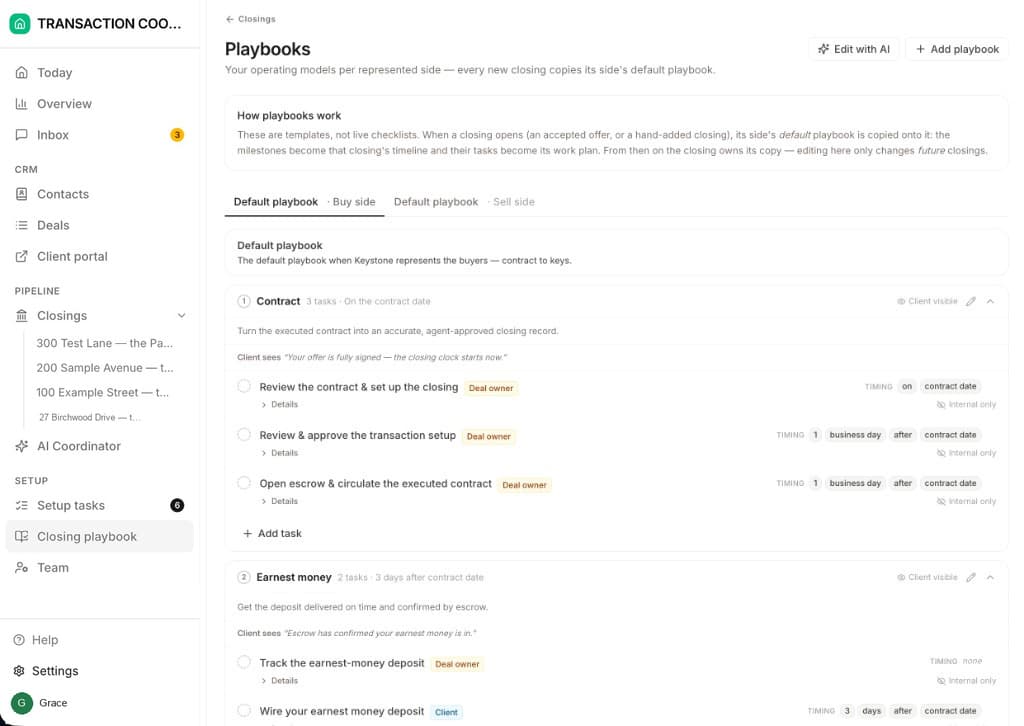
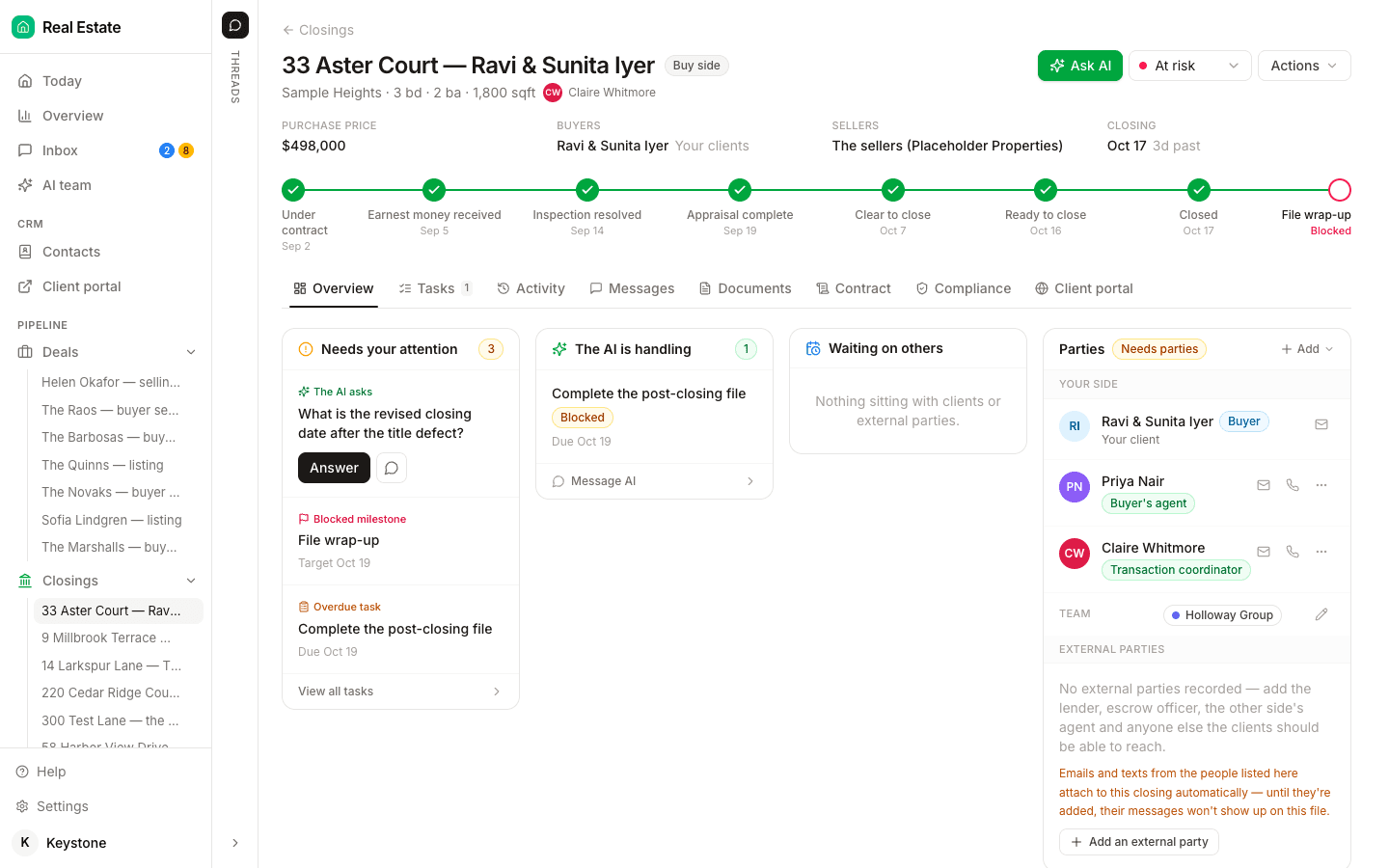
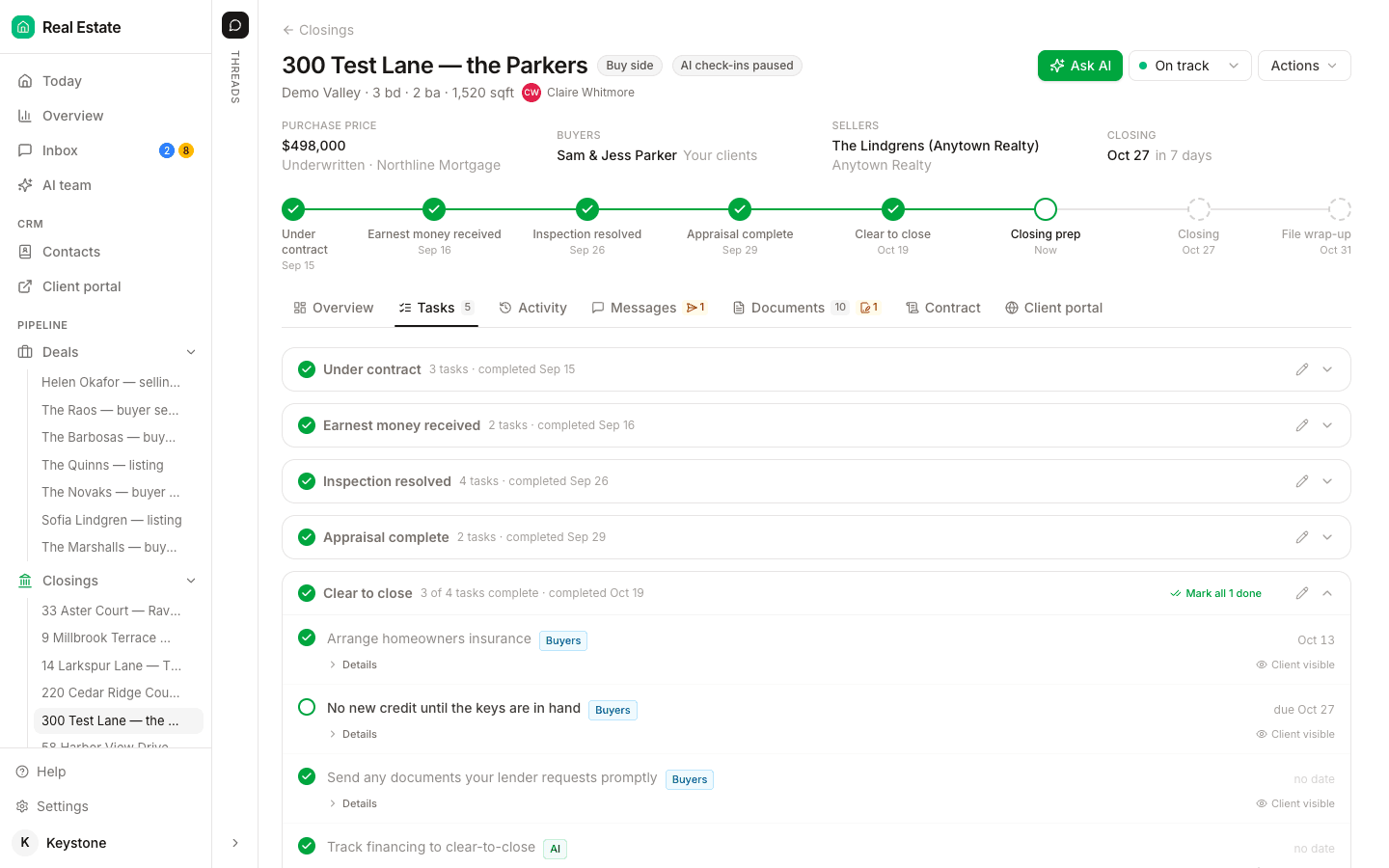
A checklist on paper does none of this watching. It does not know that title received the contract on Tuesday, or that an amendment moved the closing, and it does not call the lender. A DeedSpring playbook is this list with the clocks wired in: each task names its owner and counts from the contract or closing date, and the AI coordinator checks every open file every hour and chases whoever is late.
What do you do when an item is missing?
On the due date, check the file and not the calendar. If the proof the item needs is there, mark it done with the date and your initials. If it is not, the item is an exception the moment the date passes. Write down what is missing, which clause and date are at risk, and who owns the next move. Then send the reminder and make the call.
“I generally give the agent a 2-day warning email and a call/text the morning of the midnight deadline.”
The agent decides what happens next: extend by written amendment, terminate, or proceed. You present the clause, the date and the options, and you stop there. In Texas, TREC's guidance says an unlicensed assistant cannot review a contract or facilitate a transaction. Any termination or extension, and any miss that hands the other side a right, goes to the broker before anything is sent. Late earnest money is the standing example: under TREC ¶5C the seller may terminate until the buyer delivers it. Once an amendment moves a date, recompute everything downstream the same day and re-send the timeline.
How do you adapt it to your state and brokerage?
Edit it before the first file. Four items are Texas mechanics: the title clock from title's receipt, the survey affidavit, the ¶6D objection window and the 5% cap on lender repairs. Delete or replace them outside Texas. The loan and appraisal defaults need your own form, because TREC's addendum leaves Buyer Approval blank and C.A.R. pre-prints numbers that have changed between revisions.
Three timings come from your brokerage: when the file must exist, who may submit it, and when the disbursement authorization is released. eXp Commercial's disbursement policy wants the file within two business days of execution and the authorization out seven to ten days before closing. One Texas TC business's step list orders it in the same window. In dotloop a TC added On my team cannot submit for the agent. SkySlope's Limited TC role can. Retention is state statute, so confirm yours before the first file is archived.
What runs the checklist for you?
DeedSpring. Upload the executed contract and it reads the price, deposits, contingencies and dates into deadlines on the file, the first five items above before you open a spreadsheet. The playbook carries the rest: every task names who does it and counts from the contract or closing date, and the coordinator checks every active file every hour, flags what is slipping, and chases until the item is confirmed in writing. Anything negotiable (money, terms, a date that moves) waits as a draft for you. It will not mark a milestone done without evidence in writing, which is the rule this checklist runs on.
Starter is $15 a month for one closing a month. Standard is $25 a closing, less at volume, with unlimited agents and teammates and unused closings rolling over. Both are month to month, on the pricing page.