
Workflow · Transaction coordinator operations
How to count days in a real estate contract: TREC 20-19, the C.A.R. RPA and FAR/BAR Standard F
Day one is the day after the Effective Date in Texas and Florida, or after Acceptance in California, and every calendar day counts. TREC 20-19 moves only the earnest money, option fee and additional earnest money off a weekend or holiday, the C.A.R. RPA moves every deadline after Acceptance to 11:59 pm of the next permitted day, and FAR/BAR Standard F moves everything except the time for acceptance and the Effective Date.
The three rules side by side
How each form counts a day, starts the clock, moves a deadline and ends it
| Rule | TREC 20-19 (Texas) | C.A.R. RPA (California) | FAR/BAR AS IS (Florida) |
|---|---|---|---|
| What a day is | Not defined in the form. Texas REALTORS: calendar days. | ¶25J: calendar days. Delivery of the deposit to escrow runs in business days. | Standard F: calendar days, based on where the Property is located. |
| Day one | The day after the Effective Date, the date of final acceptance on page 10. | ¶25I(1): the event day is Day 0. Day 1 is the next full calendar date. | Periods run in days after the Effective Date defined in ¶3(b). |
| What moves off a weekend or holiday | Only ¶5A(2): the earnest money, option fee and additional earnest money. | ¶25I(4): after Acceptance, any Scheduled Performance Day, including Close Of Escrow. | Standard F: every period or date except time for acceptance and Effective Date. |
| Holiday list | Tex. Gov't Code §662.003(a), (b)(4) and (b)(6): eleven dates. No Columbus Day. | Civil Code §§7 and 7.1 plus Gov Code §6700, which include every Sunday and every Saturday. | 5 U.S.C. §6103(a): eleven federal holidays, plus the days they are observed. |
| Time of day | ¶5B option notices by 5:00 p.m. local time where the Property is located. No time elsewhere. | 11:59 pm under ¶25I. The ¶3C offer expiration is 5PM, before Acceptance. | None stated. |
To see the three rules on a whole file, the closing timeline simulator lays out every deadline on any of the three forms and lets you make one run late to see what moves. Outside these three the defaults thin out: of the 15 state purchase contracts posted publicly, only 5 print a default inspection period, according to our Contract to close, 2026 research.
When is day one, and do weekends count?
On the Texas contract the clock starts at the Effective Date, which the broker writes into the execution block on page 10 as the date of final acceptance. Texas REALTORS puts day one on the day after it. The same page works an example: effective January 22 with a 10-day option, the notice is due by 5 p.m. local time on February 1.
The C.A.R. RPA writes the rule into ¶25I(1): the first Day after an event is the first full calendar date following the event, ending at 11:59 pm. The form gives its own example. A Notice to Buyer to Perform delivered at 3 pm on the 7th makes the 7th Day 0 and the 8th Day 1. The trigger is Acceptance for the contingencies and Close Of Escrow, and Delivery for a notice.
On the Florida form the Effective Date in ¶3(b) is the date when the last of Buyer and Seller signed or initialed and delivered the offer or final counter-offer, and the contract's periods run in days after it. Standard F leaves the time for acceptance and the Effective Date out of its weekend and holiday extension.
Weekends and holidays count as days on all three forms. TREC 20-19 never defines a day, and Texas REALTORS reads the contract as calendar days. The RPA's ¶25J says Day or Days means calendar day or days, with one exception: delivery of the deposit to escrow is based on business days, which the form does not define. Standard F of the FAR/BAR contract uses calendar days, based on where the Property is located. A contract that goes effective on a Friday has its day one on Saturday. Whether the last day can sit on a weekend is a different question, and the forms answer it three ways.
Which deadlines move off a weekend or holiday?
Texas moves three. ¶5A(2) of TREC 20-19 provides that if the last day to deliver the earnest money, option fee or additional earnest money falls on a Saturday, Sunday or Legal Holiday, the time to deliver is extended until the end of the next day that is none of those. Texas REALTORS puts the rest plainly: “The rest of the contract deadlines do not change if the final day falls on a weekend or holiday.” The option period in ¶5B runs a stated number of days after the Effective Date, and ¶5E makes time of the essence for that paragraph.
California moves everything after Acceptance. ¶25I(4) provides that if the Scheduled Performance Day for any act required by the Agreement, including Close Of Escrow, lands on a Saturday, Sunday or Legal Holiday, the performing party may perform on the next day that is none of those, the Allowable Performance Day, ending at 11:59 pm. Under ¶25I(5), if the county Recorder, the lender or the Escrow Holder is closed on the day, Close Of Escrow moves to the next day all three are open. The offer expiration in ¶3C, 3 calendar days after all Buyer signatures at 5PM, sits before Acceptance, and ¶25I(4) opens with the words after Acceptance. The form states no extension for the offer. All of ¶25I applies “unless Otherwise Agreed”.
Florida moves everything except the start. Standard F extends any time period or date in the contract, whether preprinted, handwritten, typewritten or inserted, that ends on a Saturday, Sunday, a national legal public holiday under 5 U.S.C. §6103(a), or a day on which such a holiday is observed because it fell on a Saturday or Sunday, to the next calendar day that is none of those. The only exceptions are “time for acceptance and Effective Date” under Paragraph 3.
Which holidays count?
Each form points at a different list, and the lists part company on two autumn dates. TREC defines Legal Holiday by Texas Government Code §662.003 subsections (a), (b)(4) and (b)(6). That is eleven dates: the nine national holidays in subsection (a), Emancipation Day in Texas on June 19, and the Friday after Thanksgiving. Columbus Day is not in §662.003, and the section's text has no rule moving a holiday that lands on a weekend.
FAR/BAR uses the federal list in 5 U.S.C. §6103(a): eleven holidays, Columbus Day among them, and no Friday after Thanksgiving. Standard F's own words add the day on which a holiday is observed because it fell on a Saturday or Sunday.
The RPA's Legal Holiday is any holiday or optional bank holiday under Civil Code §§7 and 7.1 and any holiday under Government Code §6700. Section 6700 lists 20 items, including every Sunday, Lincoln Day, Admission Day on September 9, Good Friday from noon to 3 p.m., and any day appointed by the President or Governor. Civil Code §7.1 adds every Saturday, the Monday after a Sunday January 1, February 12, July 4, September 9, November 11 or December 25, and the Friday before a Saturday July 4, September 9 or December 25.
In 2026 that plays out like this. Friday 27 November is a TREC Legal Holiday and an ordinary day under FAR/BAR. Friday 3 July is the observed federal Independence Day, so a FAR/BAR period skips it, while under TREC it is not a Legal Holiday. Open To Close's Date Calculation help offers a Weekend Roll, a Federal Holiday Roll and a Skip Federal Holidays switch, and names no state list. The federal list is the Florida list.
What if the last day lands on a holiday?
Three 2026 contracts, each hitting its own list. Texas first: a contract effective Tuesday 16 June. The earnest money and option fee are due within 3 days, which lands on Friday 19 June, Emancipation Day, so ¶5A(2) moves them to the end of Monday 22 June. A 7-day option period ends Tuesday 23 June, notice by 5:00 p.m. local time, and nothing moves it. Had the contract gone effective Wednesday 10 June with a 10-day option, the option would end Saturday 20 June at 5:00 p.m. and stay there.
California: Acceptance on Friday 21 August at 2 pm. The 17-Day contingencies land on Monday 7 September, Labor Day, so the Allowable Performance Day is Tuesday 8 September at 11:59 pm. A 30-Day Close Of Escrow lands on Sunday 20 September and moves to Monday 21 September, provided the Recorder, the lender and escrow are open that day. The 3-business-day deposit is due Wednesday 26 August if business days mean Monday to Friday, which the form leaves undefined.
Florida: Effective Date Wednesday 11 November, which is Veterans Day and sits outside Standard F's extension. The 3-day deposit lands on Saturday 14 November and moves to Monday 16 November. The 15-day Inspection Period lands on Thanksgiving, Thursday 26 November, and moves to Friday 27 November, which is not a federal holiday. The 30-day Loan Approval Period ends Friday 11 December and stays.
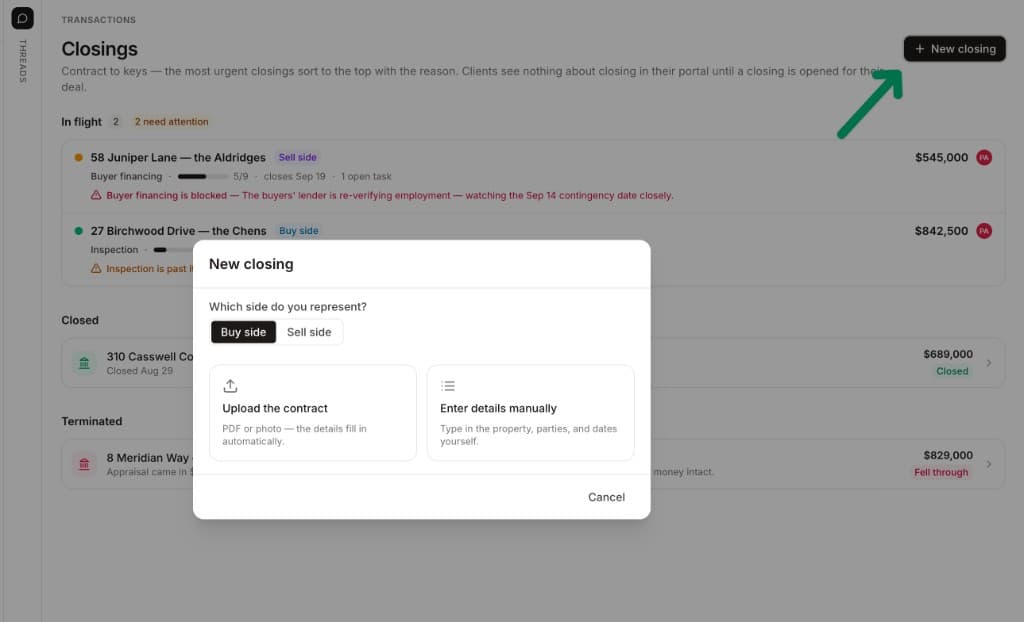
Every row above is the same four questions: what the trigger was, how many days, whether this form moves this deadline, and which list applies. DeedSpring answers them from the contract. Upload the executed contract when you open the closing and it reads the price, deposits, contingencies and dates, shows you what it found, and sets the deadlines on your confirmation. Its deadline math applies business-day rules and state rules and traces each date to the clause it came from.
What time does a deadline expire?
Texas states one clock. Notices under the option paragraph, ¶5B, must be given by 5:00 p.m. local time where the Property is located, and ¶5E makes time of the essence for that paragraph. The form states no other clock time, and the ¶5A(2) extension runs to the end of the next day that is not a Saturday, Sunday or Legal Holiday.
California deadlines end at 11:59 pm: ¶25I(1) for day one, ¶25I(3) for the Scheduled Performance Day and ¶25I(4) for the Allowable Performance Day. The 5PM in ¶3C belongs to the offer expiration, before Acceptance. Florida states no time at all. The strings 5:00 and p.m. do not appear in the current AS IS contract, so if the copy in your file carries a 5 p.m. cutoff, check the form name and revision in its footer.
Which revision are you reading?
TREC 20-19 is dated 05-04-2026 and effective July 1, 2026. The C.A.R. counting rules live in ¶25I, Counting Days, and ¶25J, Day. An explainer that quotes ¶30 (Days, Days After, Days Prior) is describing the 12/18 form. C.A.R.'s list of standard forms shows RPA-CA 2024-12, a local association's June 2026 release summary lists the RPA as revised in that release, and a zipForm print headed Revised 6/26 exists. ¶25J and ¶25I(1) to (3), (5) and (6) are word for word the same across the 12/22, 7/24, 12/24 and 6/26 copies. The 6/26 print opens ¶25I(4) with “Consistent with California Civil Code § 11,” and changes nothing else in the clause. The Florida form is Rev. 2/26, and its Standard F is identical to the 12/24 text. Read the clause in the copy in your file.
What DeedSpring does with these dates
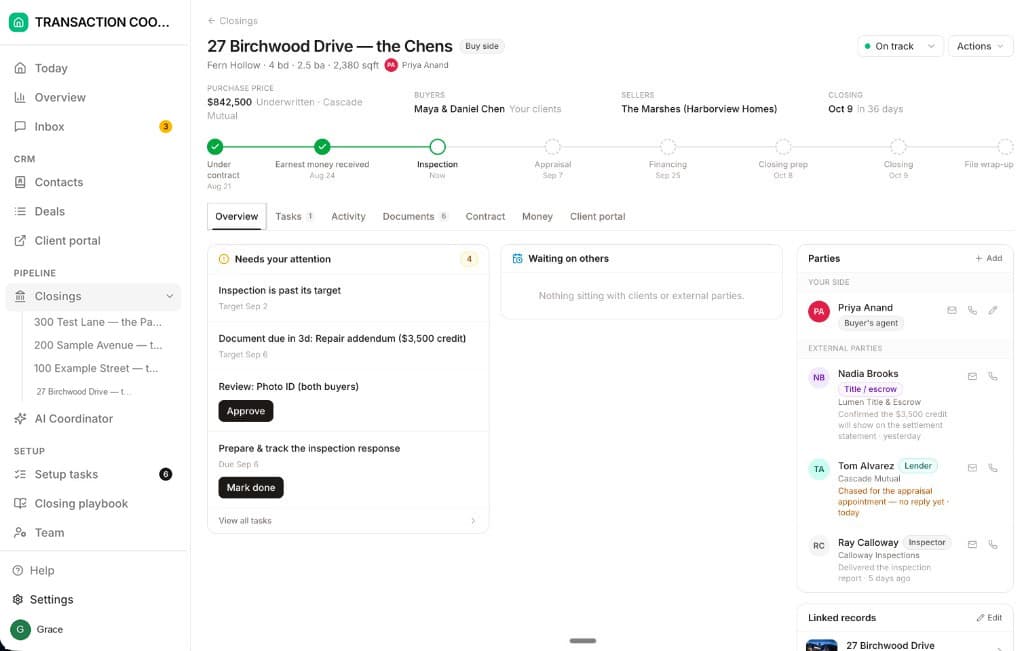
DeedSpring is the coordinator that turns the contract into the calendar. Upload the executed contract and it reads the price, deposits, contingencies and dates into deadlines on the closing, each shown for you to confirm. From then on it checks every open closing every hour, flags anything slipping on Today and on the closing's Overview, and drafts the chases for you to send. Move a date and the countdown and the client's timeline follow it.
Starter is $15 a month for one closing a month. Standard is $25 a closing, down to $19 at volume, with unlimited agents and teammates and unused closings rolling over. Both are month to month.