
Template · Transaction coordinator operations
Real estate transaction intake form template: what a transaction coordinator asks the agent for, and what the contract already says
A four-section intake form for opening a transaction file: nine fields only the agent knows, six that depend on the deal, four that belong on the agent's profile, and the ten the coordinator reads off the executed contract instead of asking.
What does the agent know that the contract doesn't?
Less than most intake forms assume. The Texas TREC 20-19 contract carries the parties, the property, the price, the earnest money and option fee with the escrow agent who holds them, the title company, the closing date, the ticked addenda, the notice emails for both sides, and on its last page the other agent's name, email, phone and license number. The California RPA carries nearly the same set under different paragraph numbers. All of it is on a form the agent is about to send you anyway.
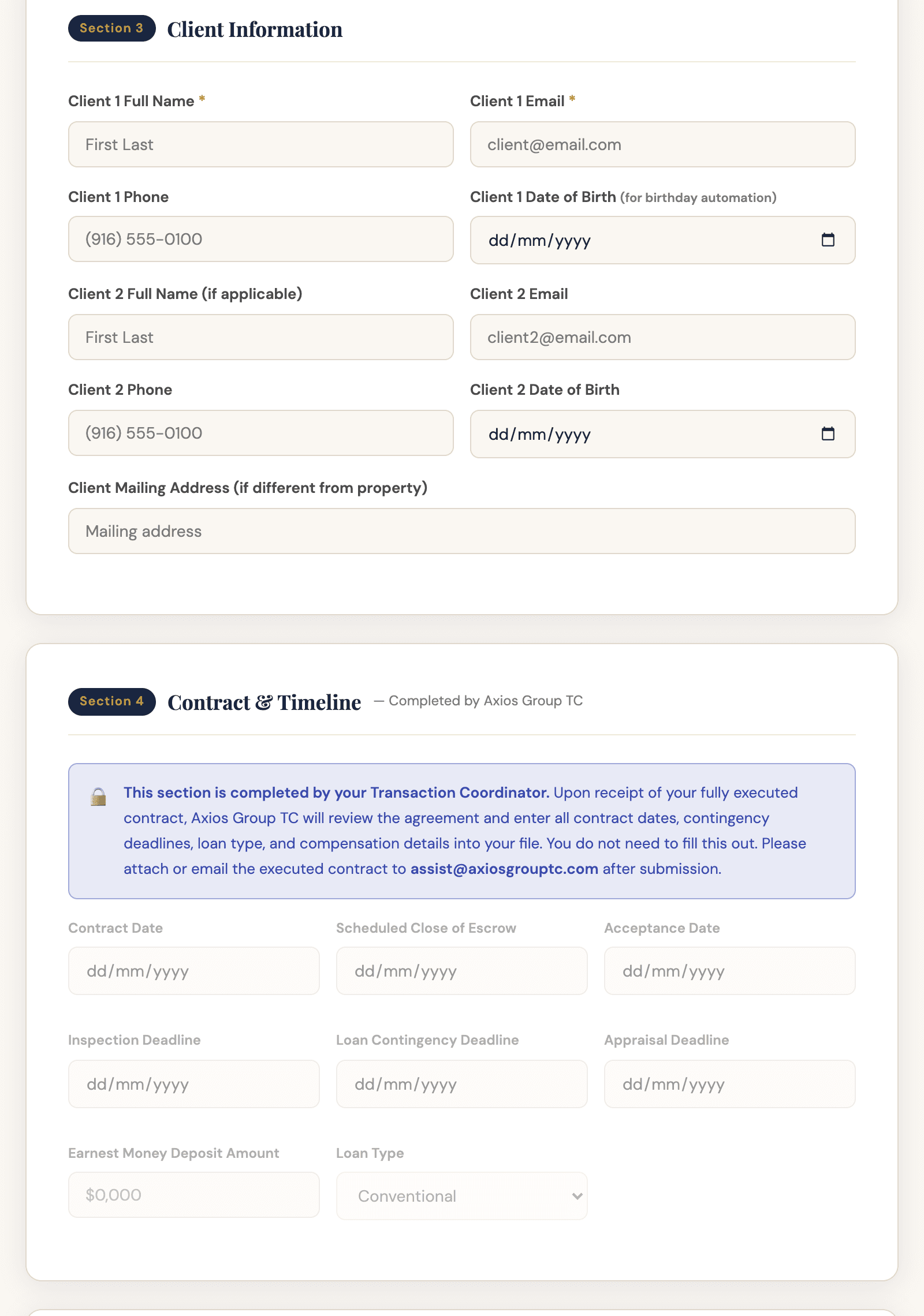
What the contract does not carry is the lender, the client's mobile number, how to get into the house, whether the other side has a coordinator, who pays your fee, and what the agent is worried about. That is the form. One California service, Axios Group TC, has built its intake this way: the agent fills in the agent, the property and the clients, and the Contract & Timeline section is locked with a note that the coordinator will enter the dates, deadlines, loan type and compensation from the executed contract. A Florida coordinator's Cognito form goes the other way and makes the agent type the effective date, the closing date, the commission and who pays it, with the contract attached underneath. The second form asks the agent to transcribe a PDF they are attaching.
What do other intake forms ask for?
Two transaction coordination services, one TC software vendor's form builder, and DeedSpring. Open To Close ships with seven fields required on every intake form and lets the coordinator add the rest by condition. Its own example is a Buying Commission field that appears only when the client type is Buyer.
What four intake forms require before a file opens
| What the form asks for | Axios Group TC | DeedSpring | Nina Berrios Transactions | Open To Close |
|---|---|---|---|---|
| Who fills it in | The agent, on the website. The coordinator fills the contract section. | You or the agent: pick the side, upload the contract. | The agent, within 24 hours of the effective date. | The agent, in a free portal. The coordinator approves it. |
| Side and property | Representation type, address, county and price required. | Buy side or Sell side. The property is read off the contract or typed. | Client type, property type and address, all required. | Client type, address, city, state and ZIP are required on every form. |
| Contract dates and money | Locked. The coordinator enters dates, deadlines, loan type and compensation. | Read off the contract: price, deposits, contingencies and dates. | Effective date and closing date required. | Not a default. Added or removed by a condition, for example the loan amount on a cash deal. |
| Client contacts | Name and email required. Phone and date of birth optional. | Parties read off the contract or typed. A client's email opens their portal. | First buyer's name, email and phone required. | A Contacts page the admin switches on, with required roles. |
| Commission and fees | Compensation entered by the coordinator from the contract. | A commission rate on the deal. The Commissions page computes the statement from it. | Buying-side commission, who pays it, and who pays the TC fee: all required. | By condition, for example Buying Commission % when the client is a buyer. |
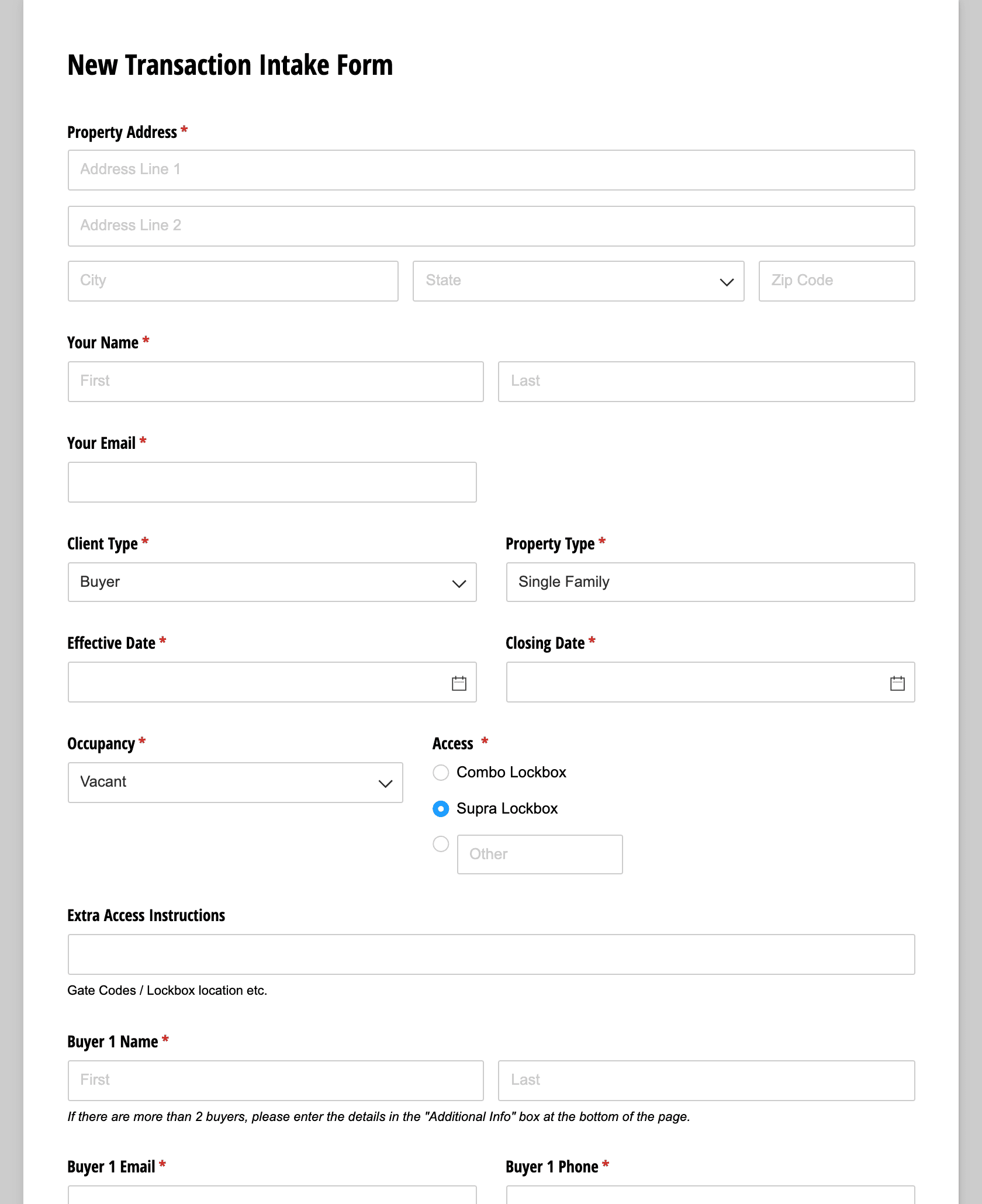
The intake form
This is a template. Replace every [placeholder] and put it wherever your agents will actually fill it in: a Cognito or Google form, your TC software's intake builder, or a page on your site. Sections 1 to 3 are the agent's. Section 4 is yours.
Section 1. The agent fills this in on every file
- Side you represent: [Buyer / Seller / Both]Every intake asks it. It decides the checklist, the roles and the fields that follow in Open To Close, SkySlope, dotloop and DeedSpring.
- Property: [street, unit, city, state, ZIP] and [MLS number]The one field every intake form requires. The MLS number lets SkySlope and dotloop pull the listing's details with one search.
- The executed contract: [upload every page, every addendum, every counteroffer]Everything in section 4 comes from it. One Texas service starts a file only once it has the form, document access and the parties' contacts.
- Your name and email: [agent name], [agent email]Routes the file to the right agent and the right reply address.
- Each client: [name], [email], [mobile], [prefers text / email / call]The Texas contract's notice block lists a phone and email per party, not which number the client answers or whether they prefer text. Name, email and role is the minimum one service accepts.
- Occupancy and access: [vacant / owner / tenant], [lockbox type and code], [gate code]Neither contract carries this. Without it nobody can schedule the inspection.
- Who pays the TC fee: [agent / client at closing / team]Required on a TC business's form. Delete it if you are in-house.
- Where the client will sign: [in town / mail-out / remote / not sure]One Florida form asks on intake: in town, mail-out or not sure. Title needs it weeks ahead.
- Anything unusual: [free text]The one box every form keeps. Divorce, estate, relocation, a nervous first-time buyer.
Section 2. Only when the deal has it
- If financed: lender [company], loan officer [name], [email], [phone]The Texas financing addendum carries the loan type and the approval days, and a lender's name only for a loan outside its listed types.
- If the other side has one: their TC [name], [email]Copy them on everything. One Florida form makes this a required yes or no.
- If you order inspections: [which inspections], [preferred inspector]Only when the coordinator schedules them. One Florida form treats a filled-in inspection block as the go-ahead to order.
- If a referral or team split is due: [referring agent], [company], [percentage]The contract will not tell you who gets paid out of your side.
- If the property has one: HOA [management company, contact], [septic / well]The Texas contract flags an HOA with a checkbox in paragraph 6E and an addendum box in paragraph 22. It names no management company.
- If the brokerage system needs it to open the file: [commission %], [office], [year built]SkySlope's required transaction information includes office, property type, MLS number and year built, and its Commission tab asks for sale and listing commission.
Section 3. Ask once and keep on the agent's profile
- Brokerage: [name], [office address], [your license number], [team name]
- Where the brokerage keeps files: [SkySlope / dotloop / Transact / other] and [how to give the TC access]
- Preferred vendors: [title or escrow company], [home warranty company], [inspectors]
- How you want updates: [email / text / weekly call] and [what you never want sent without asking]
Section 3 is why Nina Berrios sends new agents to a New Agent Intake before their first transaction, and why Fast Track Transactions shows its transaction forms only to agents holding an access code. Brokerage and license number do not change between files.
Section 4. The coordinator fills this in from the contract
- Effective date or Acceptance, with the page it came fromTexas: the execution block on page 11, marked “BROKER: FILL IN THE DATE OF FINAL ACCEPTANCE.” California: paragraph 30A defines Acceptance as accepted in writing and delivered to and personally received.
- Parties, exactly as writtenTREC paragraph 1. On the RPA, the Buyer in paragraph 1A and the Seller's printed name under paragraph 32.
- Sales price and how it is paidTREC paragraph 3, with the financing addendum boxes ticked in 3B. RPA paragraph 3G.
- Earnest money, option fee and who holds themTREC paragraph 5A names the Escrow Agent and both amounts. The RPA names the initial deposit in 3A and the Escrow Holder in 7C.
- Title company and survey positionTREC paragraph 6A names the Title Company and 6C says whether an existing survey is coming.
- Closing dateTREC paragraph 9A. RPA paragraph 1D, as a date or as days after Acceptance.
- Every contingency and its clockThe option period in TREC paragraph 5, the approval days on the financing addendum, the 17 and 21 day defaults in RPA paragraph 3.
- The other broker and agent, with email and phoneBroker Contact Information on the last page of the Texas contract carries the associate's name, email, phone and license number. The RPA's Real Estate Brokers block carries the same.
- Notice addresses and emails for buyer and sellerTREC paragraph 21, page 9.
- Which addenda are attachedThe checkbox list in TREC paragraph 22. A ticked box with no pages behind it goes back to the agent.
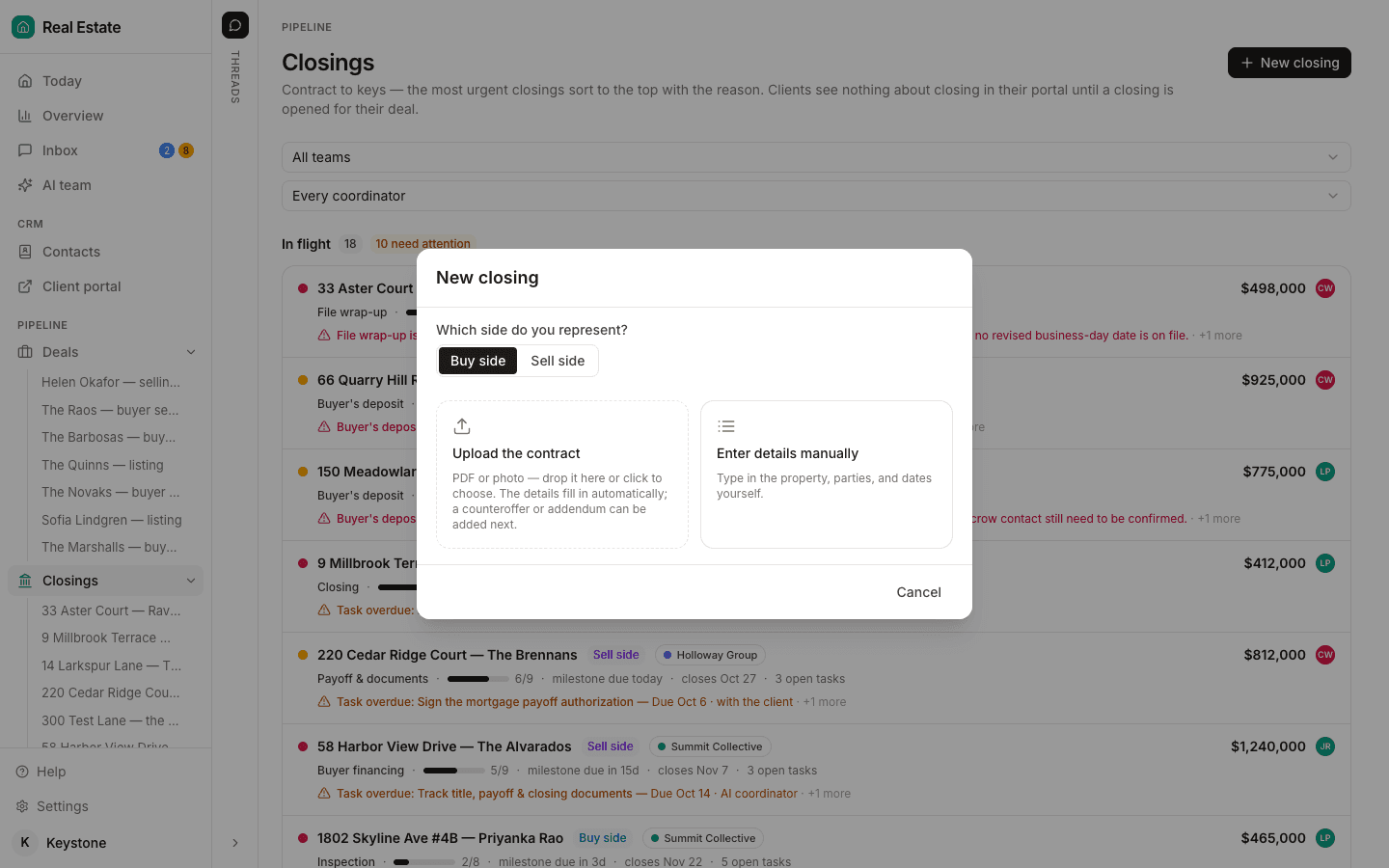
Section 4 is the step DeedSpring runs for you. Open a closing, pick Buy side or Sell side, and upload the contract. The AI coordinator's first task on every file is to read it, extract the price, deposits, contingencies and dates, and set the deadlines. You confirm what it found and the record is built.
What should the form never collect?
Social Security numbers, dates of birth, bank account numbers, copies of ID and anything to do with wiring money. None of it is needed to open a file. The lender collects what the loan needs on the loan application, and title collects what the closing needs. The FTC's guide for business puts the rule in one line: “If you don't have a legitimate business need for sensitive personally identifying information, don't keep it. In fact, don't even collect it.”
Birthdays are the live example. Axios asks for each client's date of birth for its post-close birthday emails, and its service agreement commits the agent to providing it. That is a business reason, decided on purpose. If you do not run birthday campaigns, delete the field. Wire instructions never go on an intake form, in an email, or anywhere the coordinator keeps them.
What does a finished intake look like?
Demonstration: a buy-side Texas file on TREC 20-19
Placeholder data, not a real transaction. The agent answers section 1 in nine lines. Buyer. [Address] with [MLS number]. A 12-page contract PDF plus the Third Party Financing Addendum. [Agent name and email]. [BUYER_A] and [BUYER_B] with mobiles, both preferring text. Tenant-occupied, Supra lockbox. The agent pays the TC fee. Both buyers sign in town. Nothing unusual. From section 2 come the loan officer's details and a home and termite inspection to order, no preferred inspector.
The coordinator fills section 4 from the PDF: the Effective Date from the execution block on page 11, the price from paragraph 3, the earnest money, option fee and escrow agent from 5A, the title company from 6A, the closing date from 9A, the approval days from the financing addendum, the listing agent's email and phone from Broker Contact Information on page 12, and the addenda ticked in paragraph 22. The agent typed none of it.
How do you adapt it?
Three things change the form. The contract: section 4 is written against the Texas and California forms, so rewrite its locators for the form your agents use, and expect an attorney-drafted contract to have no paragraph numbers at all. The brokerage system: SkySlope's Create a Transaction asks for office, property type, MLS number and year built, and dotloop's transaction type decides which roles and Loop Details fields exist, so whatever the system demands at creation goes into section 2. And whether you run a TC business: who pays the TC fee belongs on a service's form and nowhere on an in-house one.
Build it with conditionals if your tool has them. Open To Close's intake forms add and remove fields, contacts and documents as the agent answers, so a cash deal never shows a loan amount field. The vendor's pitch for the feature is that you get the information you need and nothing else. Then set a deadline. The Florida coordinator wants the intake within 24 hours of the effective date, and anything after 2:30 pm may start the next business day.
What does DeedSpring do with the form?
It replaces section 4, then works the file. Open a closing with the side and the executed contract. The coordinator reads the price, deposits, contingencies and dates into deadlines on the file, you confirm them, and the playbook for that side lays out the milestones and tasks. The client email from section 1 opens the buyer or seller's portal, by magic link, no password. From then on it checks every active file every hour, flags what is slipping, and drafts the chases and client updates for you to send, with anything sensitive or negotiable always waiting for a person.