
Workflow · Transaction coordinator operations
How to track contract contingencies from acceptance to removal
Track each contingency as a row: the clause, the deadline and its cut-off, the document that closes it, and who decides. A passed date is never a removal. The Texas and Florida forms end or convert the right on their own; the California form keeps it open until a written removal or cancellation is delivered.
Which contingencies are in the contract?
Start with the form in front of you. The Texas One to Four Family contract carries the termination option in ¶5B, and the Third Party Financing Addendum adds Buyer Approval in ¶2A and Property Approval in ¶2B. The seller's disclosure window in ¶7B(2) has the same shape, a right with a clock and a notice, so it gets a row too. The C.A.R. Residential Purchase Agreement puts the loan, appraisal and investigation periods in one grid at ¶3L and gives the seller a row of its own, the Notice to Buyer to Perform. The Florida AS IS contract has an Inspection Period in ¶12(a) and a Loan Approval Period in ¶8(b). One row per right, with the paragraph beside it.
The contingency register: clause, clock and the document that closes the row
| Contingency | Clause | Clock | What closes the row |
|---|---|---|---|
| Texas: termination option | TREC 20-19 ¶5B, ¶5D, ¶5E. Notices ¶21 | The days written in ¶5B after the Effective Date. Notice by 5:00 p.m. local time. | Terminated: 38-8 box 1. Extended: 39-11 box 7. Waived: 39-11 box 8. Lapsed: no form. File note. |
| Texas: Buyer Approval (financing) | TREC 40-11 ¶1, ¶2A. TREC 20-19 ¶3B | The days written in ¶2A after the Effective Date. | Terminated: 38-8 box 2 with the lender's written statement. Date moved: 39-11 box 9. Lapsed: no longer subject to Buyer Approval. |
| Texas: Property Approval | TREC 40-11 ¶2B | On or before the 3rd day before the Closing Date. Runs off closing. | Terminated: 38-8 box 3 with the lender's written statement. Lapsed: Property Approval is deemed to have been obtained. |
| Texas: Seller's Disclosure Notice | TREC 20-19 ¶7B(2) | 7 days after the buyer receives the notice, or before closing, whichever is first. | Terminated: 38-8 box 5. Never received: terminate any time before closing. Lapsed: file note. |
| California: investigation | RPA ¶3L(3), ¶8C, ¶14B(1), (3), (4), ¶25A | 17 Days after Acceptance by default (¶3L(3)). | Removed: CR-B. Buyer cancels: CC. Seller: NBP, then CC under ¶14C(1). No lapse: ¶14B(4) keeps the right open. |
| California: loan and appraisal | RPA ¶3L(1), (2), ¶8A, ¶8B | 17 Days after Acceptance each, by default. | Removed: CR-B. Cancelled: CC. Seller: NBP, then ¶14C(1). Loan removal is not deemed removal of the appraisal contingency (¶8A(4)). |
| California: Notice to Buyer to Perform (seller side) | RPA ¶14E, ¶14C(1), ¶14G | At least 2 Days after Delivery. Not earlier than 2 Days prior to the Scheduled Performance Day. | The buyer's CR-B or CC. No answer: the seller's CC under ¶14C(1). Extension: mutual written agreement (¶14), on the ETA. |
| Florida: Inspection Period | ASIS-7x ¶12(a). Effective Date ¶3(b). Notices Std O | 15 days after the Effective Date if the blank is empty. | Terminated: written notice before the period ends, by a Standard O method. Lapsed: acceptance of the physical condition (¶12(a)). |
| Florida: Loan Approval Period | ASIS-7x ¶8(b), ¶8(b)(iii) to (v) | 30 days after the Effective Date if the blank is empty. | Satisfied: ¶8(b)(iii) notice. Terminated: ¶8(b)(iv) notice. Silence: treated as if ¶8(a), cash, were checked. Seller may terminate within 3 days. |
The clock column is where files go wrong. The Texas option and both Florida periods count from the Effective Date, which Florida's ¶3(b) fixes as the day the last of buyer and seller signed or initialed and delivered the offer or final counter-offer. The California periods count from Acceptance, which ¶25A defines as the final offer fully executed in writing and Delivered. Texas Property Approval counts backwards from the Closing Date, and the Texas disclosure window counts from the day the buyer received the notice, so the delivery log is the evidence. One more Texas check before you start the clock: under ¶5D the option right exists only if an option fee is stated and delivered on time.
What does a passed date do on each form?
On the Texas forms the right ends by itself. ¶5B gives the buyer an unrestricted right to terminate within the days written in, with notice by 5:00 p.m. local time where the property is, and ¶5E makes time of the essence for the paragraph. When the period ends with no notice, the form names no document and provides for nothing further. The financing addendum spells out its own endings. If the buyer does not terminate under ¶2A, “the contract shall no longer be subject to the Buyer obtaining Buyer Approval”, and if the buyer does not terminate under ¶2B, Property Approval is deemed to have been obtained.
On the California form nothing ends. ¶14B(3) has the buyer deliver a removal of the applicable contingency or a cancellation, on C.A.R. Form CR-B or CC. ¶14B(4) then says that even after the time in ¶3L has run, and before the seller cancels under ¶14C, the buyer “retains the right, in writing, to either (i) remove remaining contingencies, or (ii) cancel this Agreement”. The seller's route is a Notice to Buyer to Perform, then cancellation under ¶14C(1). One r/realtors commenter, asked about an inspection contingency that had expired, said that on the standard RPA it “stays in place until formally removed in a CR form”.
Florida converts. Under ¶12(a) the buyer may terminate by written notice before the Inspection Period expires, and unless the buyer does, “Buyer accepts the physical condition of the Property”. Under ¶8(b) the buyer gives written notice before the Loan Approval Period ends, either that Loan Approval was obtained (¶8(b)(iii)) or that the buyer terminates (¶8(b)(iv)). Silence is the case to watch. ¶8(b)(v) has the buyer proceed “as though Paragraph 8(a), above, had been checked”, and ¶8(a) is the cash box. It also lets the seller terminate by written notice within 3 days after the period expires. Florida Realtors describes the result the same way: the deal converts to a cash transaction when the Loan Approval Period expires, and the seller gets a three-day window to cancel.
When is a contingency removed?
When the document the form names is on file with proof of delivery. Nothing else closes a row, and a date passing is no document. In Texas a termination is the Notice of Buyer's Termination, TREC 38-8, which has a box for the option (box 1), for Buyer Approval (box 2, with the lender's written statement attached), for Property Approval (box 3) and for the disclosure notice (box 5). Extending or waiving the option is the Amendment, TREC 39-11: box 7 extends it for an additional option fee, box 8 waives it, and box 9 moves the Buyer Approval date. Every notice must be in writing under ¶21. Texas REALTORS® tells a buyer's agent giving the Paragraph 5 notice to use the promulgated form, and warns that a signed Release of Earnest Money alone may not satisfy the notice requirements.
In California the buyer's instruments are CR-B to remove and CC to cancel, and the seller's is the NBP before any cancellation. C.A.R.'s June 2026 forms list carries all three plus the Extension of Time Addendum, the ETA, for a date moved by mutual written agreement. In Florida the instrument is a written notice by a Standard O method, mail, facsimile, personal delivery or email, delivered before the period ends. The AS IS form names no removal document, so the notice and its delivery record are the proof.
Lapsed is the state you record when the date passed and nothing came in. Its proof is the delivery log showing nothing was delivered by the cut-off, plus a dated file note. You record that the date passed. The agent reads what the lapse did to the right.
What do you do the day before it expires?
Check that the client can decide. An inspection contingency needs the report in hand. A financing contingency needs the lender's written position. If the evidence will not arrive in time, the agent asks for an extension before the date, and only a fully executed amendment moves it. Texas REALTORS® says it in one line: “Without a fully executed amendment, the original contract remains in effect as written.” The same holds in California, where ¶14 lets the time periods change only by mutual written agreement. Until the signatures are on file, the original deadline stays live on your calendar. Once the amendment is executed, re-enter the date and keep the old one in the row's history.
On the listing side in California, the last day of the period is the day you look for a CR-B. ¶14E lets the seller deliver a Notice to Buyer to Perform no earlier than 2 Days prior to the Scheduled Performance Day, and the notice must give the buyer at least 2 Days after Delivery. Whether to send it is the listing agent's call. Your job is to have the date and the delivery record ready when they ask.
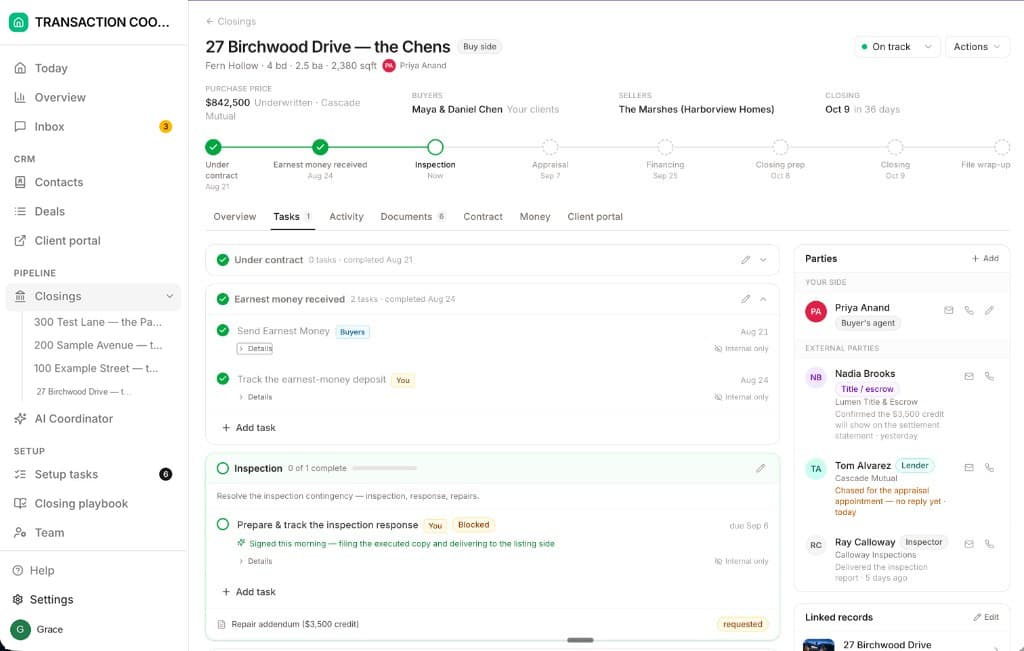
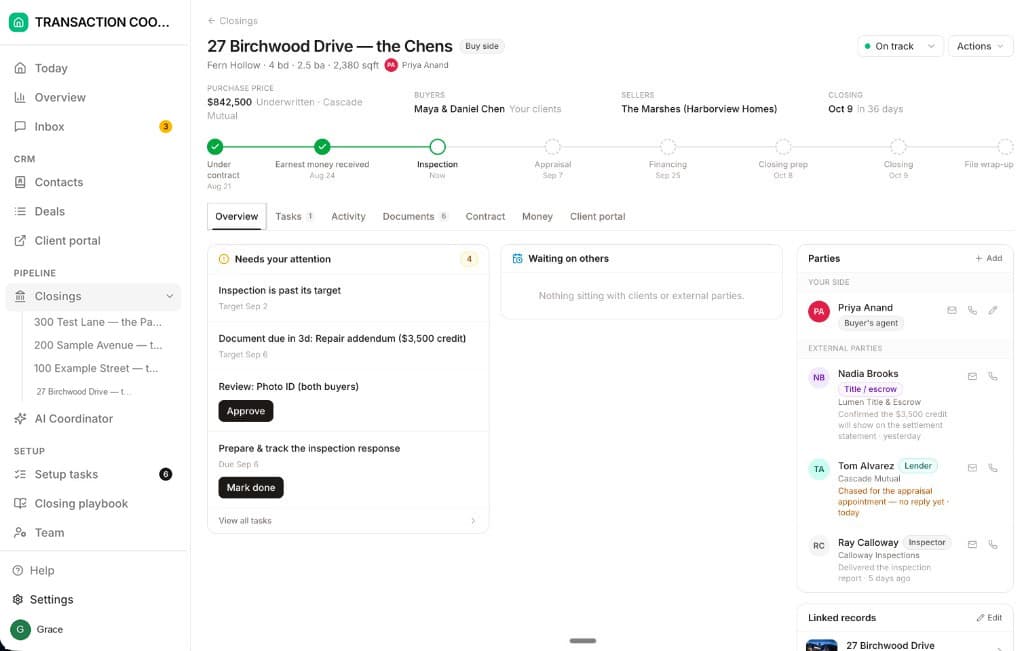
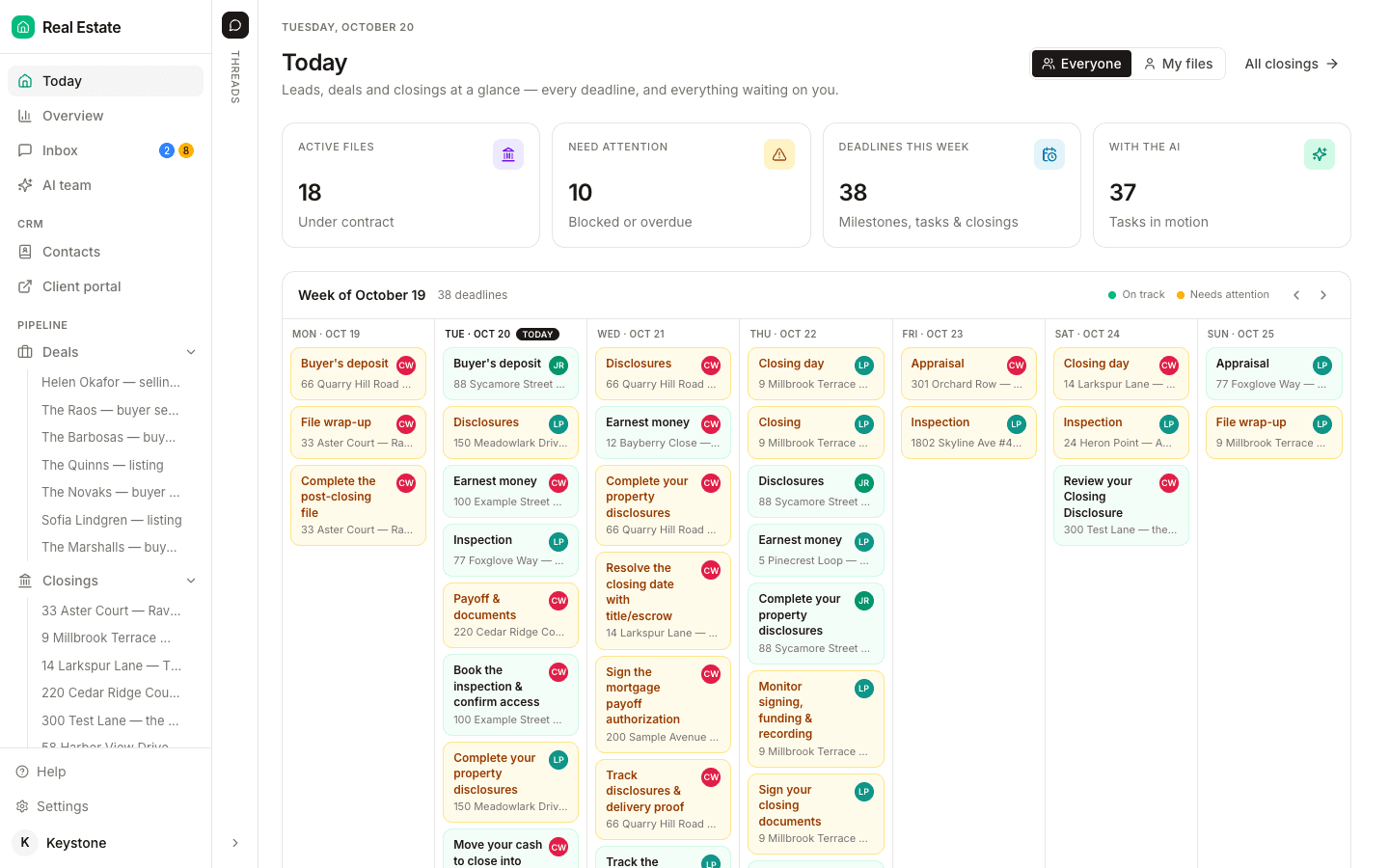
This watching is what DeedSpring does for you. Upload the executed contract and the contingency dates are read from it and watched from there, with reminders before anything is late. The AI coordinator checks every active file every hour, flags a milestone past its target on Today and on the closing, and will not mark a milestone done without evidence in writing. Anything about a deadline that moves is a draft for a person to send.
What happens when the date passes and nothing has arrived?
Mark the row lapsed and unverified, send the agent the delivery log the same day, and leave removed and waived alone. On the Texas forms the agent reads what the lapse did: the option period ended with no document to file, the contract is no longer subject to Buyer Approval under ¶2A, and Property Approval is deemed to have been obtained under ¶2B. In California the passed date opens the seller's NBP route rather than ending the buyer's contingency, so the listing agent has a decision to make the next morning.
“Unless I had a damn good reason, you’d have a notice to perform the morning after the expiration.”
In Florida the passed Loan Approval Period opens the seller's 3-day election under ¶8(b)(v). Track it as a row of its own, because it belongs to the other side and it closes in three days. A notice that arrives after the cut-off is logged with its timestamp and escalated the same day. It is never recorded as timely and never back-dated.
What does the software record?
The six main transaction tools model a contingency as a date, a task, or both. Open To Close flags a date as contingent on another with a Make it contingent box. SkySlope gives a task a due date or a dependent due date and never uses the word contingency. dotloop's public API exposes an Inspection Date and no financing, appraisal or option field. ListedKit's Ava extracts contingencies from the contract and tells you to pay extra attention to contingency deadlines. Trackxi auto-calculates contingency and closing dates and flags missing signatures and contingency dates. Paperless Pipeline anchors a task to the option period, the contingencies or closing.
None of the six records the disposition or the proving document as a field of its own. A completed task and a removed contingency look the same on the screen, so those two columns live in the task's notes or a custom field, and the task is done only when the document is attached.
How DeedSpring tracks a contingency
Open a closing, pick the side and upload the executed contract. The AI coordinator reads the price, deposits, contingencies and dates, shows you what it found, and sets the deadlines on the closing when you confirm. Each contingency sits on the milestone chain with its date, the Tasks tab holds the work under it, and the Contract tab keeps the extracted terms. The coordinator checks every active file every hour, flags anything past target on Today, and chases the parties, noting who said what, until the item is confirmed in writing. It will not mark a milestone done without that evidence, and anything about a deadline that moves is a draft for you to send. Move a date and the countdown, the client's timeline and the attention list follow it.
Starter is $15 a month for one closing a month. Standard is $25 a closing, down to $19 at volume, with unlimited agents and teammates and unused closings rolling over. Both are month to month.