
Research · Transaction coordinator careers, pay and licensing
Can an unlicensed transaction coordinator do that? What 19 state regulators allow, state by state
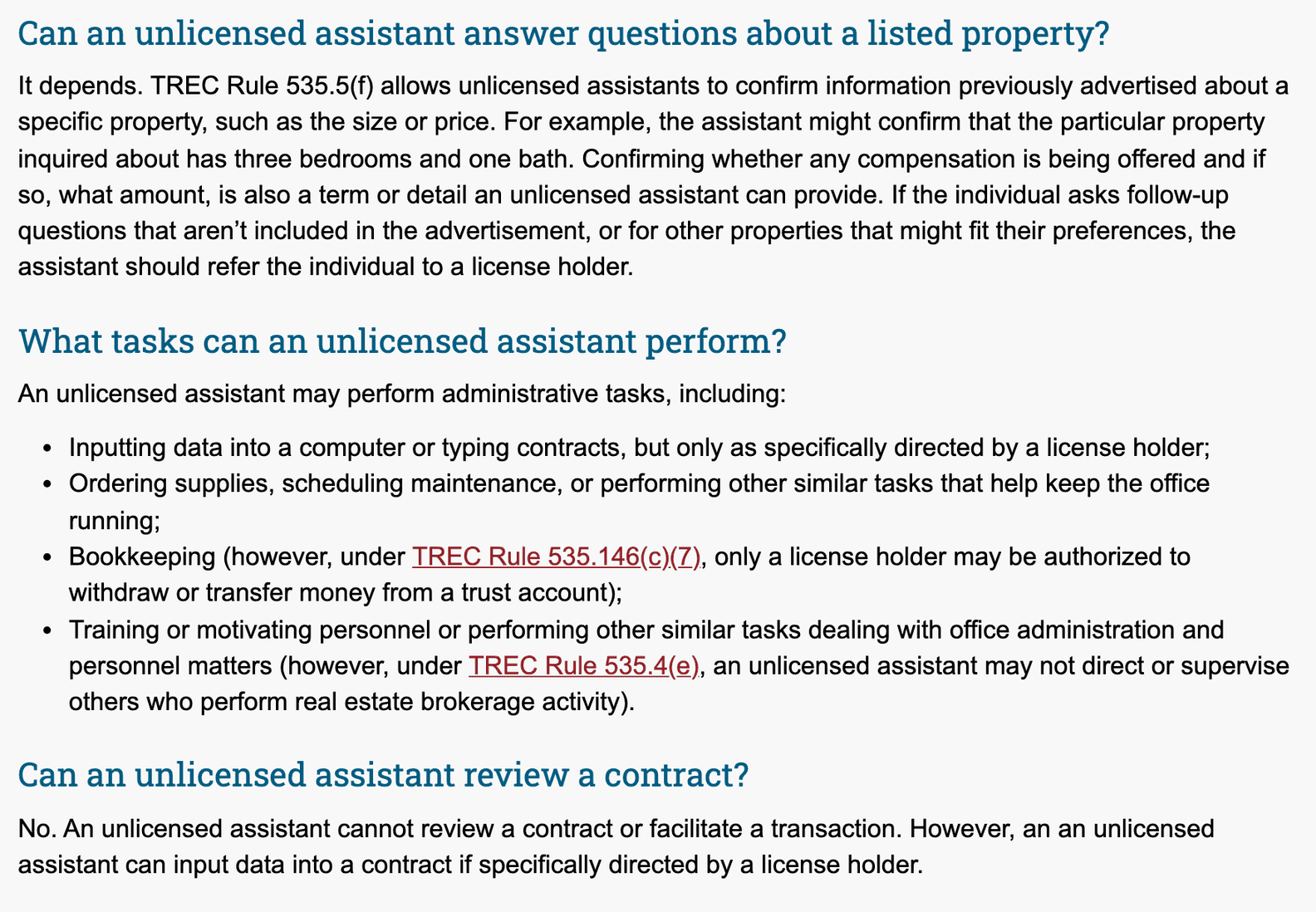
Twelve of the 13 states that publish a list let an unlicensed TC type the contract as directed. The line, wherever a list draws one, is explaining the contract, showing property and pay per closing. Each state's text with its section number, plus the six states that publish nothing.
What an unlicensed assistant may do in the 13 states that publish a list
| State | Fill in the contract as directed | Explain the contract to a party | Status updates and scheduling | Order inspections | Show property or host an open house | Paid per closing |
|---|---|---|---|---|---|---|
| California | Yes. Prepare documents under the licensee's supervision, reviewed before they reach a party (p. 3) | No. Delivering a document may not include discussing its content or significance with a party (p. 3) | Yes. Tell a party or provider when reports or services will be delivered (p. 3) | Yes. Arrange and order pest, roof, title, appraisal and credit reports (p. 2) | In part. Greet, hand out materials, set appointments. Only a licensee shows (p. 2) | List is silent. B&P §10137 bars compensating an unlicensed person for licensed acts |
| Texas | Yes. Input data or type contracts, only as specifically directed by a license holder | No. Cannot review a contract or facilitate a transaction | In part. Arrange showing appointments. Clerical staff may confirm advertised size, price and terms (§535.5(g)) | List is silent. Only office supplies and maintenance are named | No. Cannot host an open house. Showing requires a license (§535.4(c)) | List is silent. No commission sharing with an unlicensed person doing licensed acts (§535.147) |
| Florida | Yes. Only type the contract forms for approval by licensee and supervising broker (p. 1) | List is silent. No prohibited column. May answer objective questions from approved printed information (p. 2) | In part. Follow up on loan commitments. Schedule showing appointments (p. 1) | Yes. Order surveys, termite and home inspections with the employer's approval (p. 1) | In part. Be at an open house for security or to hand out brochures (p. 2) | List is silent. §475.25(1)(h) disciplines paying a fee or commission to the unlicensed |
| New York | Yes. Type contract forms for approval by the broker | Not on the list. The page permits only office activities not specified in Article 12A §440 | In part. Follow up on loan commitments. Arrange appointments by telephone | In part. Order repairs as directed by the broker. Inspections not named | Not on the list. May schedule appointments for licensees to show listed property | No, per closing. Pay on a completed-transaction basis requires a license. Hourly or salaried suggested |
| Illinois | Yes. Complete forms with factual information at a licensee's direction ((b)(10)) | No. Explaining or interpreting a contract for or with anyone ((c)(4)) | In part. Follow up after signing ((b)(3)). Schedule appointments ((b)(15)). Quote published information ((b)(16)) | List is silent. Nothing beyond following up on a transaction | No. Hosting open houses ((c)(1)) or showing property ((c)(2)) | No. Compensation cannot be transaction based ((a)) |
| North Carolina | Yes. Type offer, contract and lease forms with information from brokers | No. Only brokers discuss or explain offers, listings or leases with outsiders | In part. Confirm appointments, forward calls, answer basic questions from promotional materials | In part. Order routine repairs at a broker's direction. Inspections not named | No for sales. Only brokers show properties for sale. May show managed rentals | List is silent. §93A-6(a)(9) disciplines paying for acts that violate the chapter |
| Georgia | Yes. Type contract forms as directed by the firm or licensee ((6)(e)10) | No. Discuss or explain a contract or lease with anyone outside the firm ((6)(f)7) | In part. Check loan-commitment status ((e)3). Schedule appointments ((e)16). Arrange closing dates ((e)18) | Arrange only. Arrange dates and times for inspections ((6)(e)17) | No. Host open houses ((f)2) or show real estate ((f)4). May attend for security ((e)20) | No, per the July 2024 newsletter. The rule itself requires only broker approval of the arrangement ((6)(d)2) |
| New Jersey | Yes. Type contract forms for approval of a licensee | No. Discuss or explain a contract, listing or lease with anyone outside the firm | In part. Follow up on loan applications. Schedule showings. Monitor files and report to a licensee | Yes. Order items or inspections as directed by a licensee | No. Show property, or host an open house without a licensee present | Should not be based on the success of the activity, such as a percentage of commission |
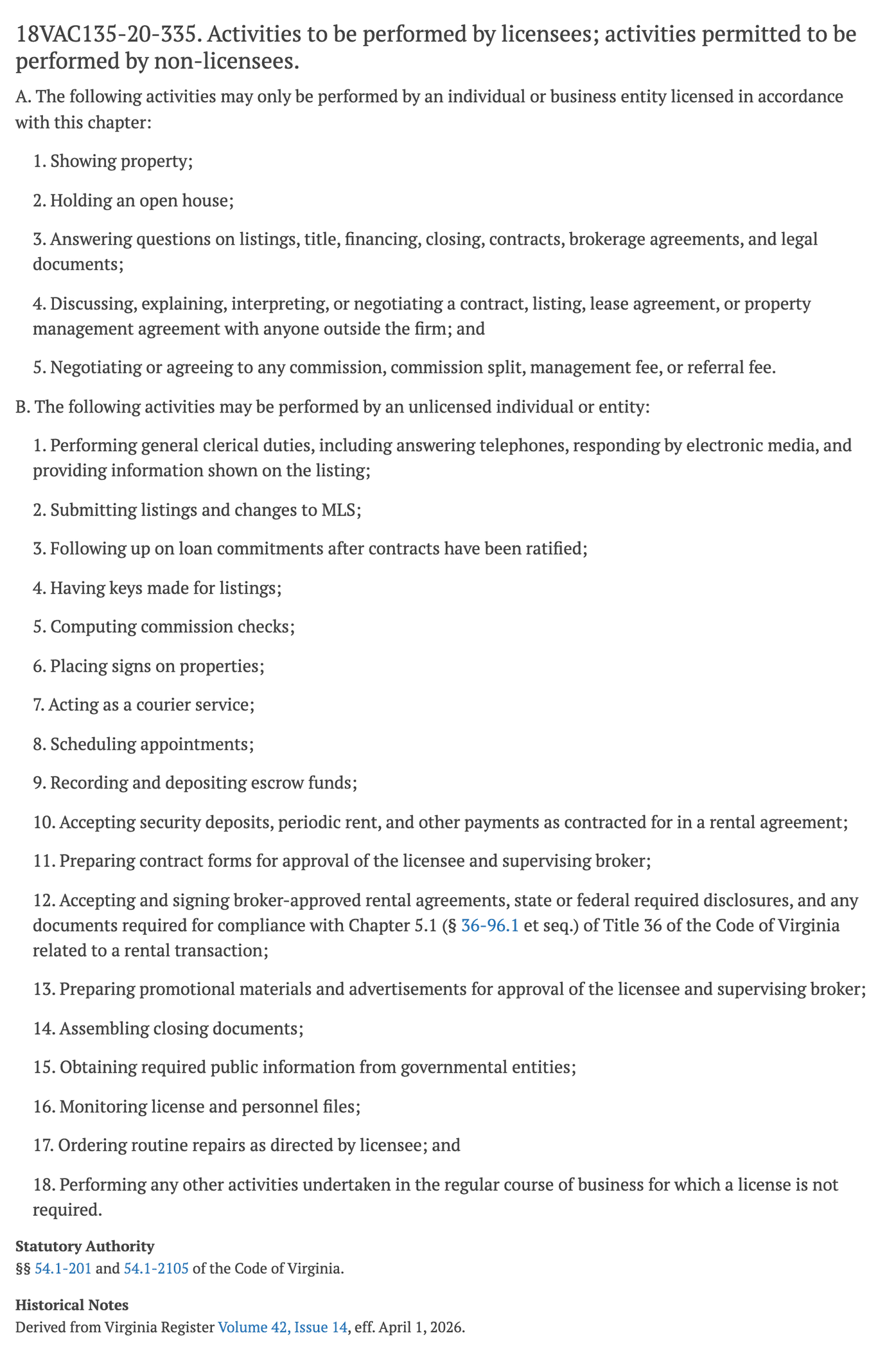
| Virginia | Yes. Prepare contract forms for approval of licensee and broker (B.11) | No. Licensee-only: discussing, explaining, interpreting or negotiating a contract (A.4) | In part. Give listing information (B.1). Follow up on loan commitments (B.3). Schedule (B.8) | In part. Order routine repairs (B.17). Assemble closing documents (B.14). Inspections not named | No. Licensee-only: showing property (A.1), holding an open house (A.2) | The rule does not address compensation |
| Arizona | No to originating documents (p. 1). Filling in a form as directed is not addressed | No. Provide advice or negotiate regarding a property or transaction (p. 1) | In part. Answer phones, forward calls, transcribe callers' information (p. 1) | Not on the list. The permitted tasks are clerical: filing, copying, mailing, scanning, phones (p. 1) | List is silent. Statute exempts clerical employees doing no licensed act (§32-2121(A)(9)) | List is silent. §32-2155(C) bars paying an unlicensed person for a broker's acts |
| Tennessee | Yes. Type contract forms for approval by licensee and principal broker (MAY #9) | No. Discuss or explain listings, offers or contracts with outsiders (MAY NOT #4) | In part. Follow up on loan commitments (#3). Disclose current sales status (#19) | In part. Order repairs as directed by the licensee (#13). Inspections not named | No. Show properties for sale or lease (MAY NOT #2). Host open houses (#3) | No. Compensation dependent on or directly related to a transaction (MAY NOT #7) |
| Colorado | Yes, as a scrivener. Complete forms as directed by a broker, never independently (item 1) | No. No opinions, advice or interpretations of forms (item 1) | Yes. Send disclosure documents to parties (item 7). Collect due-diligence documents (item 9) | Yes. Order title commitments (item 8). Schedule repairs and services (item 14) | Yes, if the seller or listing broker authorizes it. Conduct showings or open houses (item 4) | Caution. Payments contingent on closing may violate RESPA (p. 3) |
| Maryland | Yes. Type contract forms as directed by, and for approval of, licensee and broker | No. Discuss or explain a contract, listing or lease with anyone outside the brokerage | In part. Follow up on loan commitments. Web-chat clients for a listed task, naming the broker | Arrange only. Set dates for home, termite and well/septic inspections, and settlement | No to showing. May schedule an open house and accompany a licensee for security | No. Pay based on real estate activity, such as a percentage of commission |
Can an unlicensed TC fill in the contract?
Yes, in twelve of the 13 states that publish a list, and every one of them attaches a condition: as directed by the licensee, and in most of them for the licensee's approval too. New Jersey's wording is typical: type contract forms for approval of a licensee. Texas allows inputting data or typing contracts, but only as specifically directed by a license holder, and TREC's November 2024 article adds that an unlicensed assistant can input data into a contract when a license holder specifically directs it. Colorado is the most careful. Under Commission Position 20 the assistant completes forms as a scrivener, as directed by a broker, and cannot independently complete a standard form such as a listing contract. Arizona is the exception. Its policy statement bars an unlicensed assistant from originating documents and says nothing about filling one in as directed.
Can an unlicensed TC explain the contract to a client?
No, wherever a list speaks to it. Eleven of the 13 lists bar it, most in one formula. New Jersey's 2015 list bars discussing or explaining “a contract, listing, lease agreement or other real estate document” with anyone outside the firm, and Georgia, Maryland, North Carolina, Tennessee and Virginia use the same verbs. Virginia's 18VAC135-20-335, in effect since April 1, 2026, adds interpreting and negotiating to the licensee-only side. Texas says an unlicensed assistant cannot “review a contract or facilitate a transaction.” Arizona bars advice or negotiation about a property or transaction. California lets the assistant deliver a document for signature but not discuss its content or significance with a party. Florida and New York publish only permitted lists, and neither names explaining a contract.
This is the line an AI-drafted client message can drift across. DeedSpring's coordinator keeps it for a person: anything about money, contract terms, a deadline that moves or bad news is always a draft you send, whatever the sending settings say.
Can an unlicensed TC send status updates and chase the lender?
This is most of the job, and only two regulators describe it as such. California's guidelines say an unlicensed assistant can tell a party or service provider when reports or other information will be delivered and when services will be done. Colorado lists sending disclosure documents to the parties and collecting due-diligence documents to help the broker comply with the contract. Everywhere else the nearest text is narrower: following up on the loan after the contract is signed in seven states, confirming or arranging appointments, quoting published information, and in Tennessee disclosing a listing's current sales status. Texas lets clerical staff identified as such confirm the advertised size, price and terms of a property under §535.5(g). TREC's article cites that as §535.5(f). The amendment effective November 26, 2025 moved it to (g).
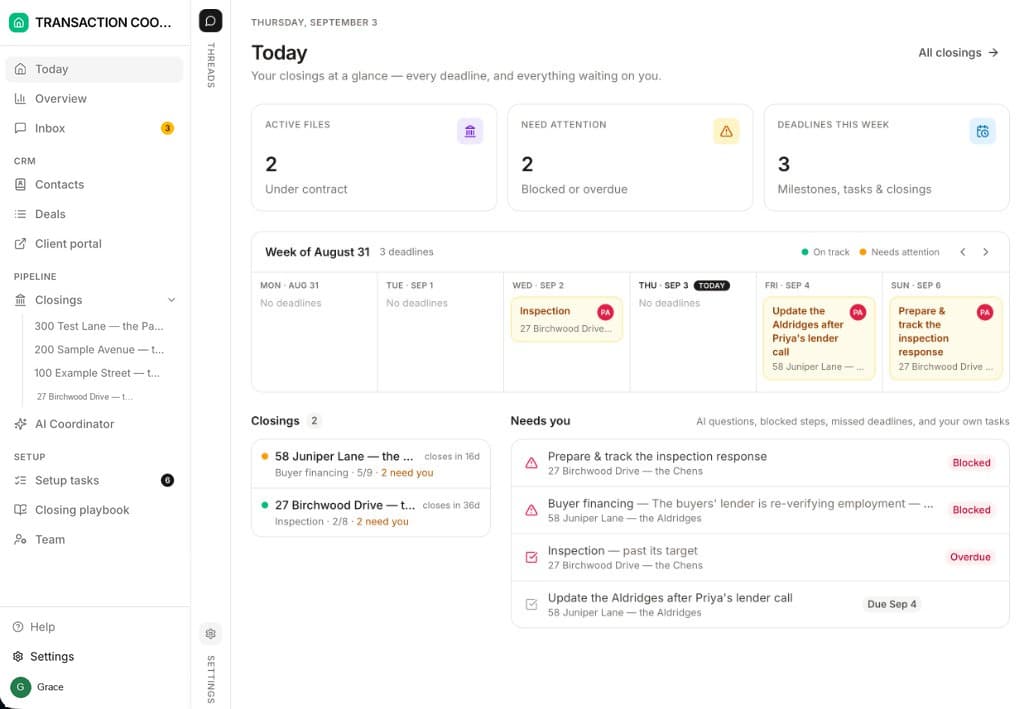
The chasing itself is what DeedSpring automates. It checks every open closing every hour, flags the milestone that is slipping and drafts the chase to the lender or title company for you to send.
Can an unlicensed TC order the inspection?
It turns on one verb. California, Florida, New Jersey and Colorado say order, and California goes furthest, naming pest, roof, title, appraisal and credit reports. Georgia and Maryland say arrange the date and time. New York, North Carolina, Virginia and Tennessee name only repairs, ordered at the licensee's direction. The Texas and Illinois lists do not reach it, and Arizona's permitted tasks are clerical only. New Jersey adds one more line: an unlicensed person should not be present at an inspection without a licensee.
Can an unlicensed TC show the property or sit an open house?
No in eight states, and one state says yes. Texas (§535.4(c)), Illinois, North Carolina, Georgia, New Jersey, Virginia, Tennessee and Maryland put showing on the licensed side, and all but North Carolina name open houses too. What is left is the door: greeting the public and handing out materials in California, sitting an open house for security in Florida, Georgia and Maryland, unlocking the property at a licensee's direction in Tennessee. Colorado is the outlier. Item 4 of Commission Position 20, revised August 4, 2026, lets an unlicensed assistant provide access to the property and “conduct showings or open houses” if the seller or listing broker authorizes it. New York's list has no prohibited side and allows scheduling appointments for licensees to show.
Can an unlicensed TC be paid per closing?
Not where a regulator has spoken to it. Illinois is the bluntest, in rule text amended effective July 7, 2025: “Compensation for unlicensed assistants cannot be transaction based.” Tennessee bars any pay dependent on or directly related to a transaction. Maryland bars pay based on real estate activity, such as a percentage of commission. New Jersey says pay should not be based on the success of the activity. New York's Department of State page makes it a licensing trigger: an assistant paid on a “completed transaction basis” must be licensed, and pay is best handled hourly, per activity or salaried. Colorado warns that payments contingent on closing may violate RESPA. Georgia's July 2024 newsletter lists being compensated based on the level of real estate activity as prohibited, but the rule it summarizes has no such item and requires only broker approval of the arrangement.
Six states reach pay only through statutes that bar paying an unlicensed person for licensed acts: Texas §535.147, Florida §475.25(1)(h), California Business and Professions Code §10137, Arizona §32-2155(C), North Carolina §93A-6(a)(9) and Washington RCW 18.85.301(1). West Virginia's only text is the exemption itself, which covers an employee in a noncommissioned secretarial or clerical capacity. Arizona's policy statement, revised February 14, 2025 and marked advisory only, has no compensation rule. Virginia's rule does not address pay.
Which states publish no list at all?
Pennsylvania, Michigan, Ohio, Washington, West Virginia and Oregon. In these six the statute is the only text, and it defines the licensed job rather than listing the unlicensed one. Pennsylvania's Department of State licensure guide gives the broker and salesperson definitions and stops. The Commission guideline on assistants that circulates in CE brochures is on no pa.gov page. Michigan is the same shape: MCL 339.2501 defines the licensed roles, and the excerpt an MLS attributes to the state is not on michigan.gov. Ohio publishes a rule for residential-rental staff, effective February 10, 2019, and nothing for sales. Its statute's definition of a broker includes one who directs or assists in procuring prospects or negotiating a transaction (ORC 4735.01(A)(7)).
Washington has statute only. Office personnel are exempt from licensing only if they do none of the brokerage services defined in RCW 18.85.011, which include advising, counseling or consulting buyers and sellers, and negotiating (RCW 18.85.151(5)). West Virginia's §30-40-5(c)(10) exempts an employee in a noncommissioned secretarial or clerical capacity and names what that person may do, including handing out the brokerage's preprinted sales information and making appointments with buyers and sellers for the broker. Oregon's Commissioner's column is about licensed brokers acting as coordinators, and the definition it reproduces from ORS 696.010 makes assisting or directing in the negotiation or closing of a transaction professional real estate activity. In these six, the statute above is the text to work from.
Does any regulator recognize the job title?
Three of the 19 texts use the words. TREC's article lists the titles in use, “unlicensed assistant, administrative assistant, office manager, and transaction coordinator are popular,” and says license status, not title, determines what the person may do. Oregon's Real Estate Commissioner, Steve Strode, wrote in June 2026 that the TC “does not exist in statute or rule,” so the Agency judges it like any other self-ascribed title, by the activity performed. Colorado alone names the role in a commission position: Commission Position 20 lists “transaction coordinators/managers or short sale coordinators” among Real Estate Administrative Professionals, or REAPs. Florida never uses the words. FREC's list, approved September 15, 2009, defines its subject as support staff for a real estate corporation or other licensed individuals, and the whole thing is a two-page scan.
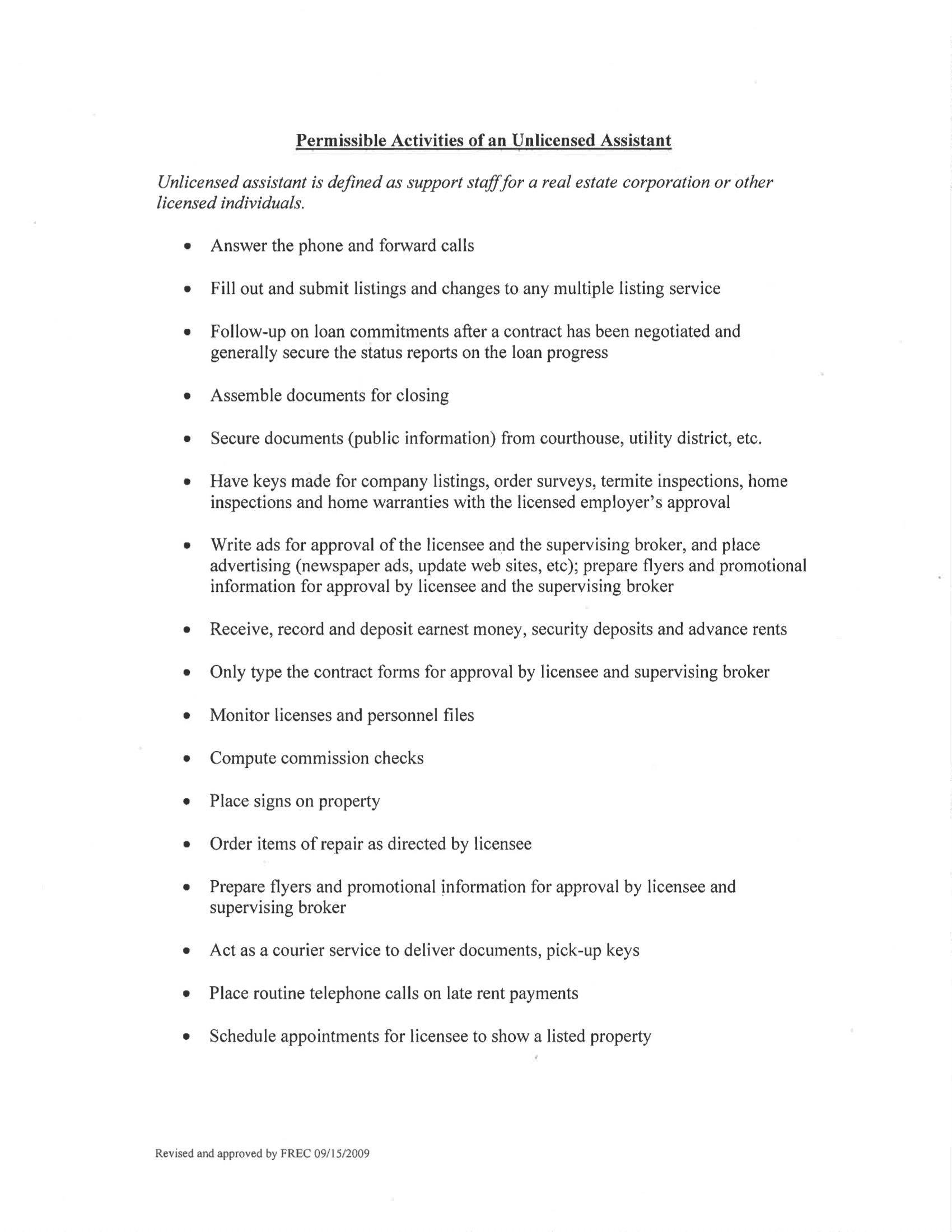
Six lists have been revised since 2024: Colorado (August 4, 2026), Virginia (April 1, 2026), Illinois (July 7, 2025), Arizona (February 14, 2025), Texas (November 17, 2024) and Georgia (July 2024). Five are more than a decade old: North Carolina (2012), Tennessee (2011, repeated word for word in a Commission FAQ updated August 28, 2026), Florida (2009), New Jersey (2015) and Maryland (1995, republished). California's date from 2018 and New York's page carries no date. The 19 states are the 15 largest by housing units plus Colorado, Maryland, Oregon and West Virginia.
For one state in full, with its contract deadlines, closing model and TC fees beside the licensing rule, see the Texas transaction coordinator page, part of our TCs by state section.
The work the lists allow
Strip the table to what most lists permit and you get the coordinator's week: type the forms as directed, set the appointments, follow up on the loan, order or arrange the inspection, keep the file moving. That is the work DeedSpring does. Upload the executed contract and it reads the price, deposits, contingencies and dates into deadlines on the file. It checks every open closing every hour, flags what is slipping, and drafts the chases and client updates for you to send. Anything about money, contract terms or a date that moves is always a draft a person sends.
Starter is $15 a month for one closing a month. Standard is $25 a closing, less at volume, with unlimited agents and teammates and unused closings rolling over. Both are month to month.