
Explainer · Transaction coordinator careers, pay and licensing
Is a transaction coordinator a 1099 contractor or a W-2 employee? What the IRS has ruled
A TC the firm pays by the hour, trains, schedules and seats at its own desk is a W-2 employee, and the IRS has said so twice. Here is the control test the IRS uses, why a real estate license does not change the answer, and which state regulators say an unlicensed assistant's pay cannot ride on the closing.
What test does the IRS actually use?
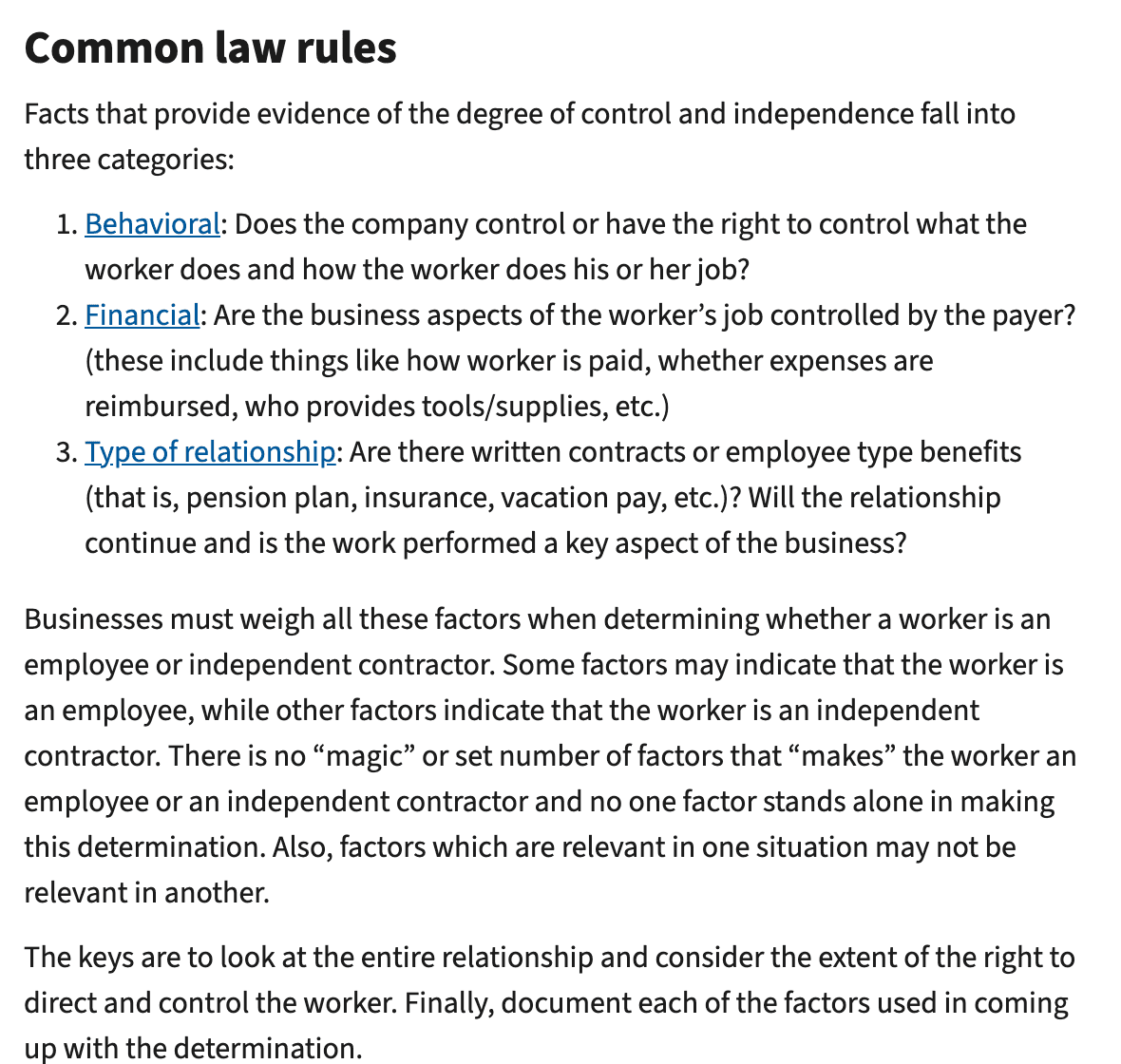
There is no TC-specific rule. The IRS applies its common-law test and sorts the evidence into three piles. Behavioral control: does the firm control what the worker does and how she does it? Financial control: who sets the pay, who buys the tools, who gets expenses reimbursed? Type of relationship: is there a written contract, are there benefits, will the work continue, and is it a key part of the business? No single factor decides.
Either the firm or the worker can ask the IRS to rule on a specific job by filing Form SS-8. The answer takes at least six months, and a determination letter applies only to the worker who asked for it. The IRS publishes the letters, redacted, in a searchable database. Two of them are about real estate transaction work, and both ended with the Employee box marked.
What did the IRS say about a transaction coordinator?
The first letter, dated September 28, 2017 in the IRS database, concerns a company that helped real estate agents complete transactions. It “engaged the worker as a transaction coordinator” with no written agreement. It trained her, gave her the assignments and decided how they should be done. She worked Monday to Friday, filed weekly and monthly reports, emailed the owner when she arrived and when she left, and was paid hourly and on commission. The firm supplied the office and the equipment and set the rate the customers paid. In her emails her title was Licensed Transaction Coordinator.
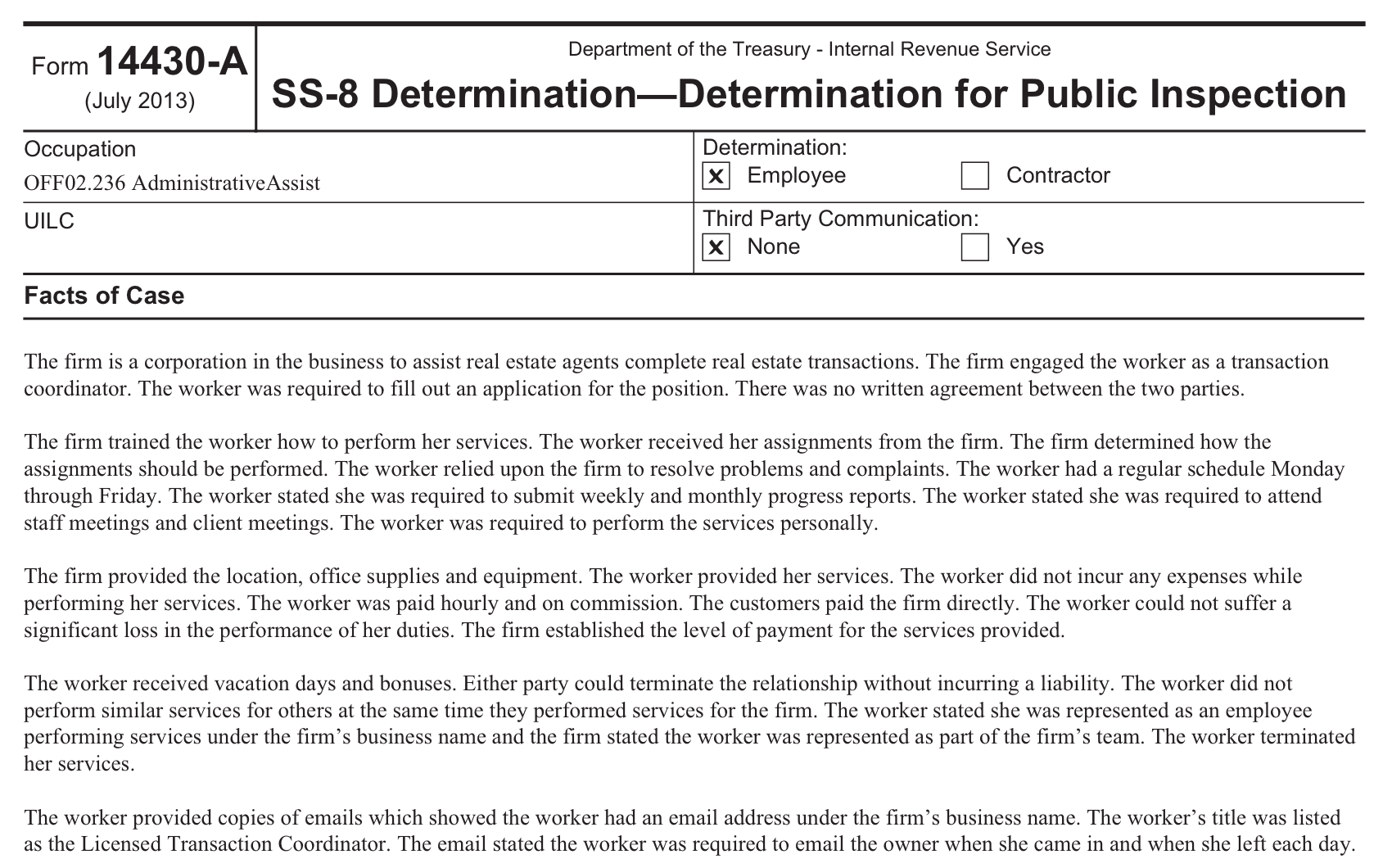
The IRS analysis is short. Assigning the work, deciding the method and requiring her to do it personally showed the firm cared how the work was done and about the result. The reports showed control. The firm carried the investment and the risk of a customer not paying. Vacation days, bonuses and being presented as part of the team pointed the same way. The finding: “an employee according to common law”. The letter never mentions the licensed-agent carve-out, even though she held a license and was partly paid on commission.
Does a real estate license make a TC a 1099 contractor?
No. The second letter, dated October 13, 2022 in the database, is the clearest statement on the point. The firm sold real estate. The worker held a license but was hired as its director of operations to complete transaction paperwork and show property when needed. She was paid by the hour, got a 2017 Form 1099-MISC, and had no written agreement. The IRS wrote down where the two sides disagreed, on training, methods and who set the rate, and weighed the facts both agreed on: an hourly rate, no benefits, the firm's office and credit card against her own laptop, phone and car.
The analysis opens with the license. She did not meet the criteria of Internal Revenue Code section 3508, which the letter summarizes as being paid commissions and performing under a written agreement that stated the worker will be treated as an independent contractor for federal tax purposes. Then the sentence every licensed TC should read:
“The fact that she had a real estate license did not make her self-employed when she was not selling real estate as the agent or paid commissions for such.”
The statute itself, on the books since 1982, says a qualified real estate agent is not treated as an employee for federal tax purposes and sets three conditions. The individual is a licensed real estate agent. Substantially all of the pay for services as a real estate agent is directly related to sales or other output rather than to hours worked. And the services are performed under a written contract saying the individual will not be treated as an employee for federal tax purposes. The IRS's statutory nonemployees page lists the last two as bullets under its heading for licensed agents. Pay by the hour is exactly what the second condition excludes, and both letters record no written agreement at all, so neither worker could have met the third.
What did the IRS weigh in each case?
Read the two columns side by side and the pattern is the same: the firm supplied the desk, set the hours and paid for time. Where the parties disagreed, the IRS recorded both versions and cited the evidence each side produced of direction and reporting: a daily task list, the hours she submitted, a firm-issued credit card.
What the IRS recorded in each letter
| Factor | The transaction coordinator (2017) | The licensed agent doing paperwork (2022) |
|---|---|---|
| Written agreement | None. | None. She was sent a 2017 Form 1099-MISC. |
| How she was paid | Hourly plus commission. The firm set the rate. | Hourly. Each side said the other set the rate. |
| Who directed the work | The firm trained her, handed out the assignments and decided the method. | Assignments came by phone, email or text. The two sides disagreed on how much instruction. |
| Schedule and reporting | Monday to Friday. Weekly and monthly reports, staff meetings, a check-in email every day. | The firm said she submitted hours. She said she sent a task list each day. |
| Workplace and tools | The firm's office, supplies and equipment. She had no expenses. | The firm's office, desk, supplies and credit card. Her own laptop, phone and car. |
| Other clients | None at the same time. | Yes, under a verbal agreement not to conflict. |
| Benefits | Vacation days and bonuses. | None. |
| Result | Employee under the common law. | Employee. The §3508 carve-out did not apply. |
Who buys the tools is one of the IRS's financial-control questions, and the easiest one for a TC business to answer: buy your own. DeedSpring's software is priced for a business that works files rather than seats. Starter is $15 a month for one closing a month, Standard is $25 a closing and less at volume, and there is no per-agent fee, so a coordinator working for three brokerages pays for the closings she opens.
Can an unlicensed TC be paid per closed file?
The IRS letters settle the federal tax question. State real estate regulators also have a say in how an unlicensed assistant may be paid, and a fee charged per closed file is pay that depends on a closing. New Jersey's Real Estate Commission guidelines, updated January 2015, say a personal assistant's compensation “should not be based on the success of their activity”, such as a percentage of commission, and should be tied to the duties performed. That is the shape to assume in New Jersey: pay for the duties, whether or not the deal closes.
Arizona's text has moved. Substantive Policy Statement 2017.01, effective June 9, 2017, and its successor SPS 2022.03, revised September 28, 2022, each said: “An unlicensed assistant cannot be compensated on any basis that relies on the ultimate sale or closing of a property.” The 2022 version also added a heading pointing readers to the IRS on 1099 versus W-2 classification.
The statement the department's policy-statement index now lists as current, SPS 2025.02, revised February 14, 2025, contains neither. It keeps one line in its purpose paragraph naming how the individual is paid as an aspect to consider. Maryland's commission guidelines, first issued in 1995, say an unlicensed employee may not “be paid on the basis of real estate activity, such as a percentage of commission, or any amount based on listings, sales, etc.” Georgia's commission, in its July 2024 newsletter on Rule 520-1-.07(6), says an unlicensed assistant may not be compensated based on the level of real estate activity. All four are guidelines or advisory statements rather than statutes.
What should a TC business take from this?
Three facts sat in both letters: no written agreement, pay by the hour, and a firm that supplied the workplace and tools. They line up with the IRS's own piles. The written contract is a type-of-relationship question. How the worker is paid and who provides the tools are financial-control questions. Those are the facts a TC business can change: put the engagement in writing, own the laptop, the phone and the software the files run on, and in New Jersey, Maryland or Georgia tie an unlicensed assistant's pay to duties rather than to the closing. A license on the wall does none of that work for you. The carve-out needs sales-based pay and a written contract, and the IRS has said so in as many words.
What does an independent TC run her files on?
DeedSpring is built for a coordinator who works for herself. Upload the executed contract and it reads the price, deposits, contingencies and dates into deadlines on the file. It checks every open closing every hour, flags what is slipping, and drafts the chases and client updates for you to send. Your buyers and sellers get a portal. Switch on Teams and each client brokerage becomes a team on your roster, with its own agents and its own files.
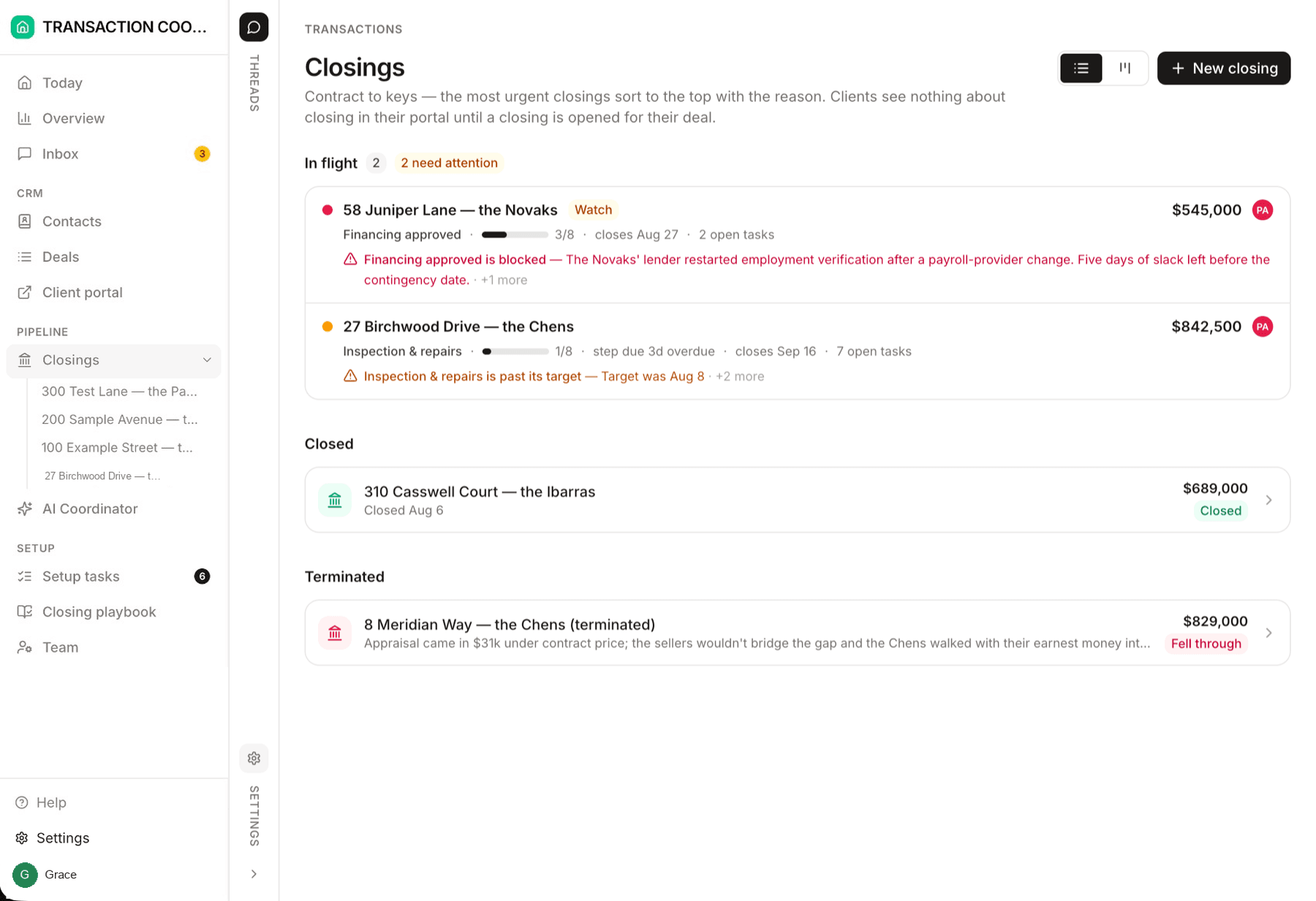
Starter is $15 a month for one closing a month. Standard is $25 a closing for up to four a month, $22 from five, $20 from ten and $19 from twenty, with unlimited agents and teammates and unused closings rolling over. Both are month to month.