
Explainer · Transaction coordinator careers, pay and licensing
Oregon is deciding whether to regulate transaction coordinators. Here is what the Agency actually said
Oregon has no statute or rule on transaction coordinators and has proposed none. Here is what the Real Estate Agency's June 2026 column, its 133-response survey and three Real Estate Board agenda items actually say, and which existing rules already bind a TC today.
What did the Agency actually say?
The Agency's position is one column, written by Real Estate Commissioner Steve Strode for the June 2026 issue of the Oregon Real Estate News-Journal and edited in August once the survey closed. Its thesis is in the first section: the TC “does not exist in statute or rule,” so the Agency treats it like any other self-ascribed job title, such as sales associate or consultant, and judges it by the activity being performed. The Agency neither approves nor disapproves new business models, and it cannot give legal advice on how to set one up.
When a complaint about a coordinator comes in, the first question is jurisdiction: does the activity fall inside the statutory definition of professional real estate activity? If it does, the Agency has authority to investigate when there are reasonable grounds to believe a licensing violation may have occurred. The Commissioner's column then reproduces that definition in full.
The definition the Agency applies: ORS 696.010(18)
Professional real estate activity means any of fourteen listed actions “when engaged in for another and for compensation or with the intention or in the expectation or upon the promise of receiving or collecting compensation.” Of the fourteen, the three that mention negotiation, prospects and closing: (c) negotiates, offers, attempts or agrees to negotiate the sale, exchange, purchase, rental or leasing of real estate; (j) assists or directs in the procuring of prospects, calculated to result in the sale, exchange, leasing or rental of real estate; and (k) assists or directs in the negotiation or closing of any transaction calculated or intended to result in the sale, exchange, leasing or rental of real estate.
The column does not say which coordinator tasks fall inside item (k), and it publishes no list of permitted or prohibited tasks. Whether scheduling the inspection or coordinating a repair counts as assisting in the closing is the question the Agency has opened without answering.
Which rules already apply to a TC in Oregon?
The column describes two ways coordination is being done by licensees. In the first, a broker coordinates files only inside their own registered business name. In the second, a broker coordinates for licensees at several RBNs and separates the work that needs a license from the work a non-licensee may do, to stay clear of the ban on working under two RBNs at once. Whether a broker may do outside work of any kind is, the Agency says, a matter for the managing principal broker's company policies.
The ban itself is in OAR 863-014-0095(10), amended with effect from January 1, 2026. Except as provided in OAR 863-014-0085 and the section itself, no real estate broker or principal broker may engage in professional real estate activities under more than one registered business name. A managing principal broker may, if the business entity is an affiliated or subsidiary organization. The column quotes the prohibition without its opening exception clause, so read the rule rather than the summary.
Four more items from the column apply now. Money: under ORS 696.290(3), a managing principal broker may not pay the broker of another managing principal broker except through the managing principal broker that broker is associated with. Confidentiality: licensees are expected to keep it for sellers and buyers even after the agency relationship ends, under ORS 696.805, 696.810 and 696.815, and a licensee hiring a coordinator needs the confidentiality requirements understood by all parties and addressed in writing. Email: a coordinator working for several outside clients cannot use addresses or signatures that leave a consumer confused about which RBN administers the transaction. Insurance: a broker employed as a coordinator should talk through risk management and errors-and-omissions cover with their managing principal broker before starting.
One line of statute names the unlicensed assistant. ORS 696.237, enacted in 2025, requires a managing principal broker's written policies, procedures and systems to manage usage of unlicensed assistants by associated brokers. It does not apply to a managing principal broker who maintains a single office and is not associated with other licensees.
If you coordinate for several brokerages, the practical consequence is separation: whose file it is, whose name is on the email, whose policy you are working under. DeedSpring handles the file side of that split with its Teams switch, where each client brokerage is a team on your roster with its own agents and its own files.
What did the survey find?
The August 3 Board packet carries the results: 133 responses, 93 of them brokers or principal brokers, 23 coordinators who hold a broker or principal broker license, 10 unlicensed coordinators or assistants, and seven others.
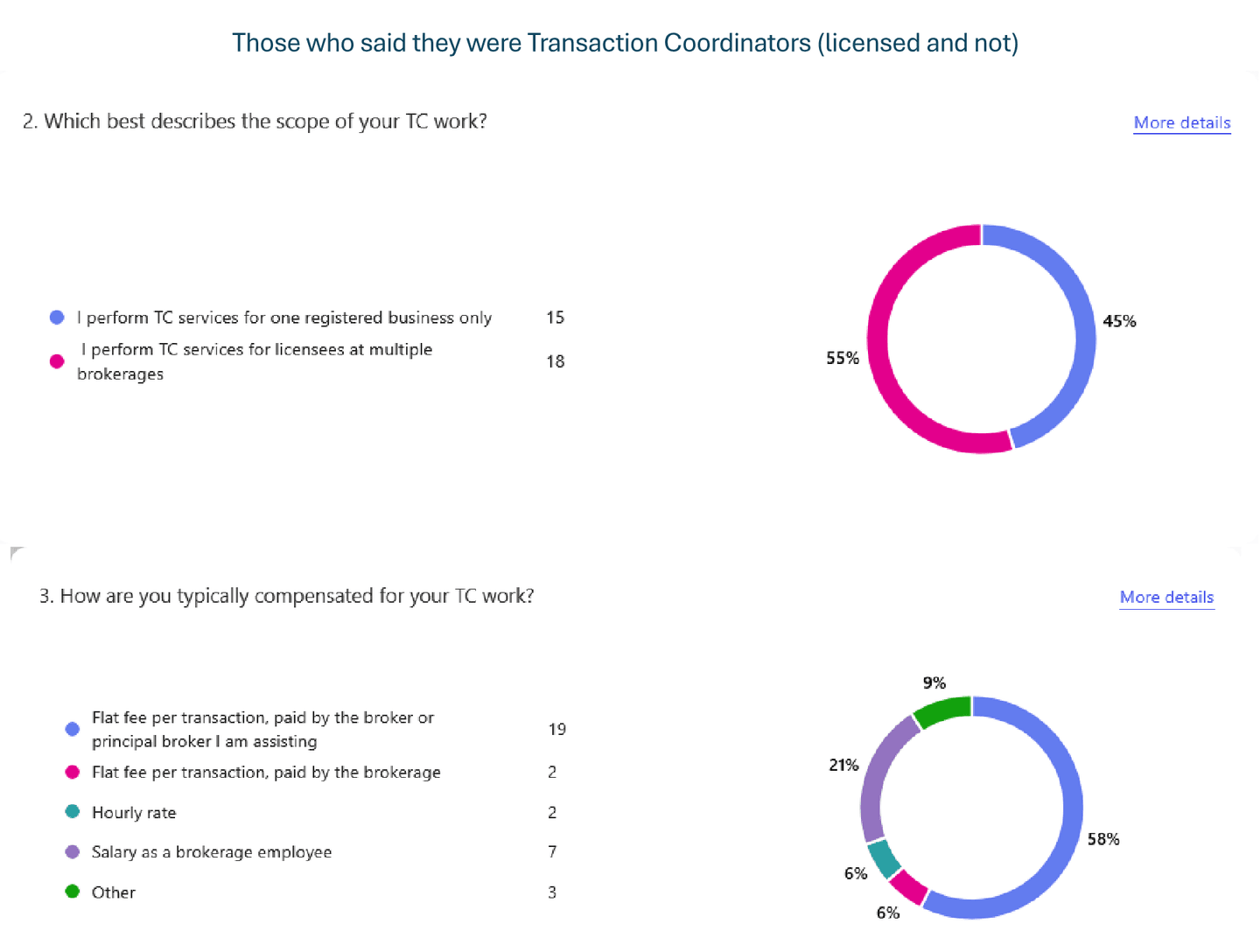
Of the 33 who said they were coordinators, 18 work for licensees at multiple brokerages and 15 for one registered business only. Nineteen are paid a flat fee per transaction by the broker they assist, seven draw a salary as a brokerage employee, two are hourly, two are paid a flat fee by the brokerage, and three answered other. The multi-brokerage model the column describes is the majority model among the coordinators who answered.
The brokers describe the same market from the other side. Sixty-three of the 93 use a coordinator regularly and eight occasionally. Asked about the coordinator they use most, 37 said one licensed with their own RBN, 23 one licensed with a different RBN, and 23 an unlicensed person. Fifty-nine pay that coordinator a flat fee per transaction themselves, and nine said theirs is a salaried brokerage employee. For a coordinator outside their own RBN, the Agency coded 32 mentions of paid at closing against 14 of a flat fee or invoice and five of a partial fee when a deal dies. Asked whether that coordinator is still paid if the transaction fails, seven said no and four said yes.
With a coordinator outside the RBN, confidentiality is handled by contract more than by technology: 32 mentions of confidentiality clauses, 16 of signed service agreements, 16 of working only with licensed coordinators, six of secure systems. And the consumer confusion the column raises is not what most respondents see. Of all 133, 104 said the coordinator's role has been clear to the parties, 16 said confusion happens often and nine said a few times. Where it did happen, people mistook the coordinator for the agent or did not know what the coordinator could do. Fifty respondents said they would join a work group.
Where is the process now?
The column said the Agency had been asked to explore the matter further, make it a future Board agenda item, and “form a work group if necessary.” The agenda item has now happened three times. The Board's agendas page lists the documents, and the minutes for June 1 and August 3 record the item as a heading with no motion, vote or action under it. What was said in the room is not on the public record.
Step 1: June 1, 2026
Coordinators are on the Real Estate Board agenda under New Business, at an online meeting.
Step 2: June 2026
The Commissioner's column runs in the June News-Journal and opens the survey.
Step 3: July 10, 2026
The survey closes. The column is later edited to say so.
Step 4: August 3, 2026
The Board meets in Salem with “Transaction Coordinators - OREN-J article and survey results discussion” under Board Advice/Action. The packet carries the survey results.
Step 5: October 5, 2026
The Board meets with “Transaction Coordinators - August board meeting follow-up” on the agenda. The packet attaches no paper to the item, and the minutes are not yet posted.
Step 6: December 7, 2026
The next Board meeting, by videoconference. Its agenda is not yet published.
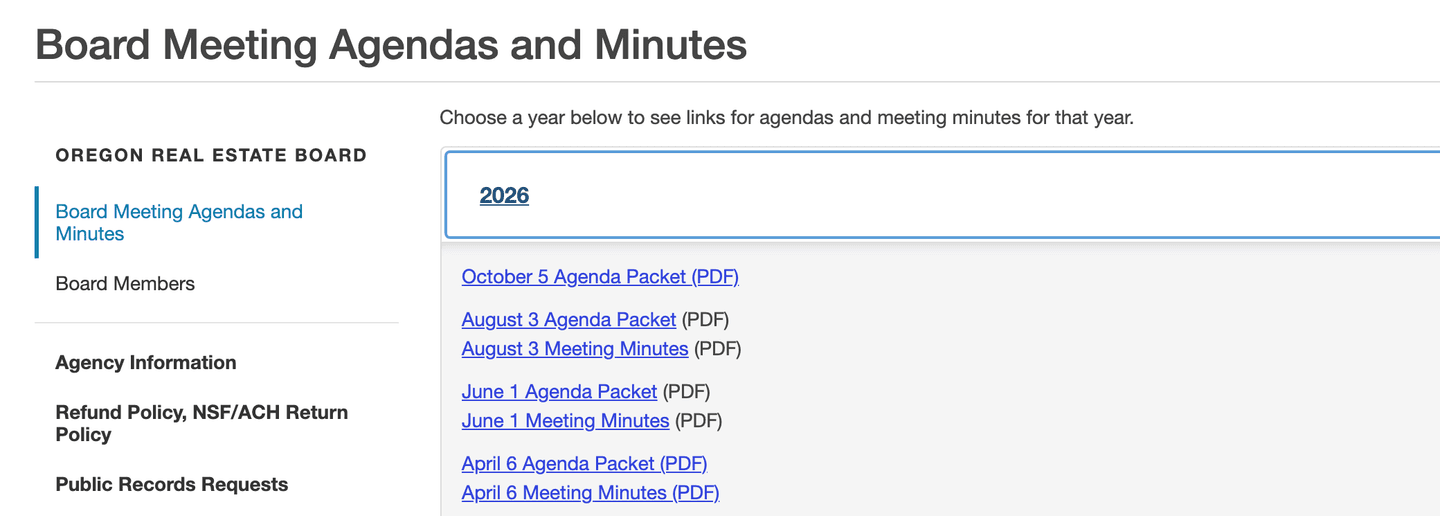
Two absences matter as much as the three agenda items. The Agency's rulemaking page, which lists every proposed, temporary and permanent rule in process, has nothing on coordinators. The September 2026 News-Journal carries eight articles, none about coordinators. The October 5 agenda names the next meeting as December 7, 2026, by videoconference.

Is Oregon going to regulate coordinators?
The column tells you how the Agency decides. Guidance and education through existing statutes and rules is, in its words, always most efficient whenever viable, and it seeks to create new obligations only when there is clear evidence of a problem and the most appropriate remedy includes a new statute or rule. Set that test beside its own survey, in which 104 of 133 said the coordinator's role has been clear. The Agency has not said what it concluded. Since the column, its Board materials add three agenda lines and the survey results, and its rulemaking page adds nothing. A rule would show up on the rulemaking page as a notice of proposed rulemaking.
What should an Oregon coordinator do now?
Work to the rules that exist. If you hold a license and coordinate for more than one RBN, get your managing principal broker's company policy on outside work in writing, take any payment from another brokerage through your own managing principal broker, and make sure your email address and signature leave no doubt which RBN administers the file. Put confidentiality in the agreement with each client brokerage. Ask about E&O cover before the first file.
If you are unlicensed, the definition is what you are working against. Item (k), assisting or directing in the negotiation or closing of a transaction for another and for compensation, is the one that mentions closing. The Agency has not said where routine coordination sits against it, and a managing principal broker who supervises other brokers is supposed to have a written policy on how those brokers use unlicensed assistants. Ask to see it. Then watch two pages: the Board's agendas page for the December 7 meeting and the October 5 minutes, and the rulemaking page for any notice.