
Explainer · Transaction coordinator careers, pay and licensing
Does TC certification matter? What the only REALTOR®-association credential actually requires
No state requires a transaction coordinator to be certified, and the one credential a REALTOR® association issues, C.A.R.'s Certified Transaction Coordinator, is five online courses, about 18 hours, $349 to $735, expiring after two years. Buy it if you coordinate California files or want C.A.R.'s directory listing.
Does any state require a TC to be certified?
No. State regulators license activity, not job titles. California, the state the credential comes from, is the clearest case. The Department of Real Estate's page on unlicensed administrative assistants says they can perform a variety of activities to assist licensees in transactions but may not perform any activity which requires a real estate license, and that Business and Professions Code section 10137 makes it unlawful for a broker to compensate an unlicensed person for performing licensed acts. Its four-page guidelines list what an unlicensed assistant can do with the broker's knowledge and consent: prepare and complete documents under the licensee's supervision, review transaction documentation for completeness or compliance as instructed, and tell a party when a report will be delivered. Neither document asks the assistant to hold any certificate.
Oregon's Real Estate Commissioner, Steve Strode, wrote in June 2026 that the TC “does not exist in statute or rule,” so his agency judges the title like any other self-ascribed one, by the activity performed. The National Association of REALTORS® lists 17 designations and 14 certifications on its credentials page, from Accredited Buyer's Representative to Smart Home. Transaction coordination is not among them. ListedKit, which sells TC software, and Freedom Real Estate Services, a Texas coordination company that sells a course, both say flatly that no state requires one.
What does the C.A.R. Certified Transaction Coordinator actually require?
The Certified Transaction Coordinator is a program of transaction management courses for all real estate licensees and unlicensed transaction coordinators. You earn it by completing the listed courses and passing each exam. There are two tracks. Licensees take Fundamentals of Transaction Coordination, Transaction Coordination 2: Beyond the Contract, All About Disclosures, Risk Management and the California Residential Purchase Agreement and Related Forms. Non-licensees swap the RPA course for Real Estate Law Dos and Don'ts for the Non-Licensee, which C.A.R. calls the required course for every unlicensed TC in the program. Courses can be taken in any order, online anytime, live or by webinar, and anything passed in the previous twelve months counts.
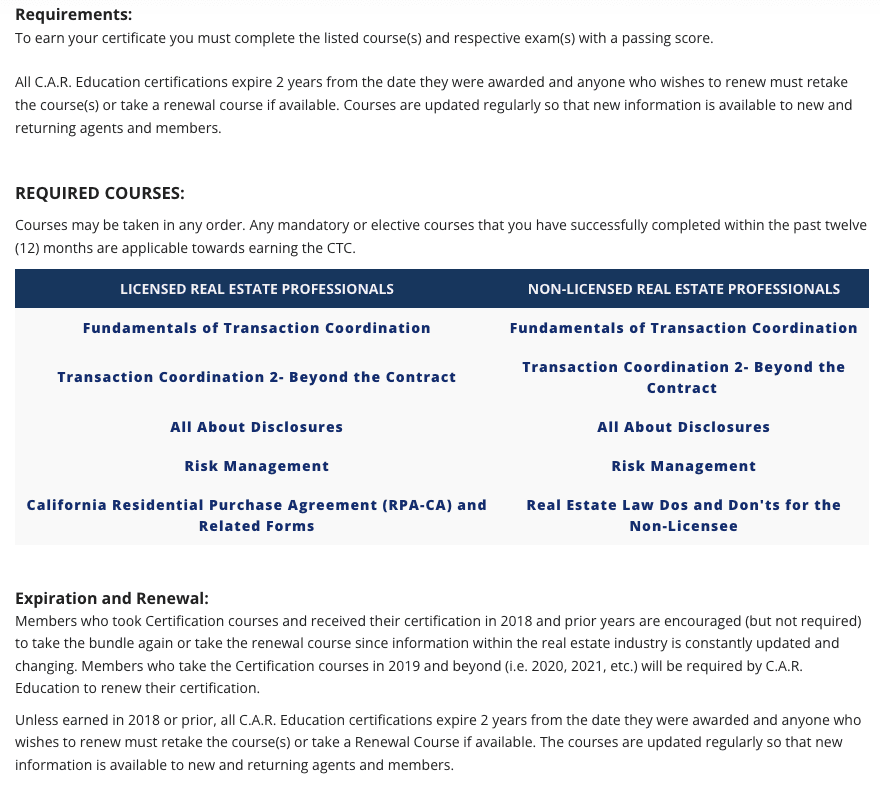
C.A.R. calls it a 17-plus-hour program. The store pages for the licensee courses add up to 18: Fundamentals is five hours, Beyond the Contract three, Disclosures three, Risk Management three and the RPA guide four. On the non-licensee track the four shared courses add up to 14 hours, and the Dos and Don'ts page gives no length. The disclosures, risk management and RPA courses say they carry no continuing education credit. When you finish, the certificate and a logo arrive by email, and you have a year from purchase to complete an online bundle.
The credentials and courses, side by side
What each TC credential or course asks of you and gives you
| Program | Hours and format | Price | Expires | What it gets you |
|---|---|---|---|---|
| C.A.R. Certified Transaction Coordinator, licensee track | Five online courses, 18 hours by the course pages. Also live or webinar. | $698, or $349 for C.A.R. members. | Two years from award. | Certificate and logo by email. Eligibility for the C.A.R. TC Directory. |
| C.A.R. Certified Transaction Coordinator, non-licensee track | Five online courses, 14 hours on four course pages plus Dos and Don'ts, which lists no length. | $735. No member price shown. | Two years from award. | The same certificate, logo and directory eligibility. |
| C.A.R. CTC renewal course | Two online courses, 8.5 hours, both exams. | $250, or $125 for members. | Extends the certification. | Keeps the CTC and the directory listing alive. |
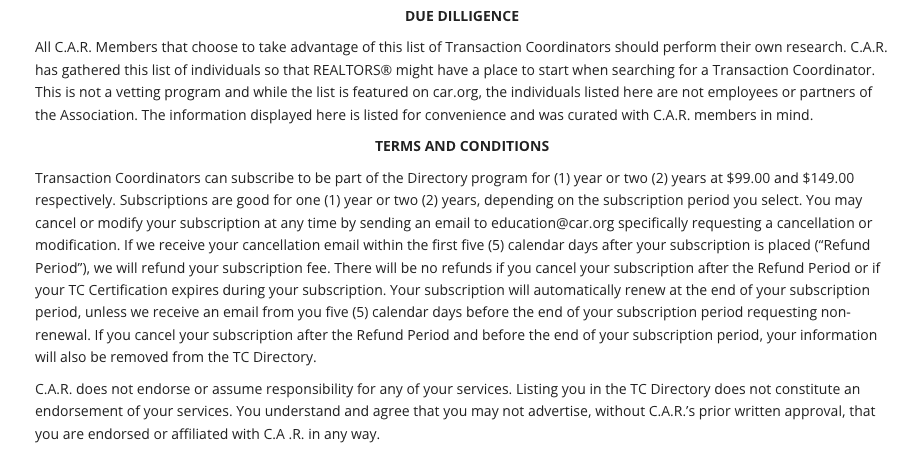
| C.A.R. TC Directory listing | No course. Requires a current CTC. | $99 a year or $149 for two. | Auto-renews. No refund if the CTC expires mid-term. | A listing on car.org, emailed to all members monthly. |
| Transaction Coordinator Academy, TC Essentials | 6 hours of on-demand video. | $188. | Not stated. Assume it does not expire. | Certificate of completion. |
| Transaction Coordinator Academy, TC Business | More than 10 hours of on-demand video. | $228. | Not stated. Assume it does not expire. | Certificate of completion. |
| Freedom Real Estate Services, TC Startup Guide | Self-paced, lifetime access, templates included. | $295. | Lifetime access. | Templates, from a team that coordinates hundreds of transactions a year. |
| Atlas TC Collective (Skool) | Private community, weekly live trainings. 54 members. | $197 a month after a 7-day free trial. | Runs while you pay. | Investor-deal training, templates, a community. |
What does it cost, and what does renewal cost?
The licensee bundle is $698, or $349 for a C.A.R. member. The non-licensee bundle is $735, and the store shows no member price on it. Buying the five courses one at a time costs $870 at non-member prices, so the bundle is the cheaper route either way.
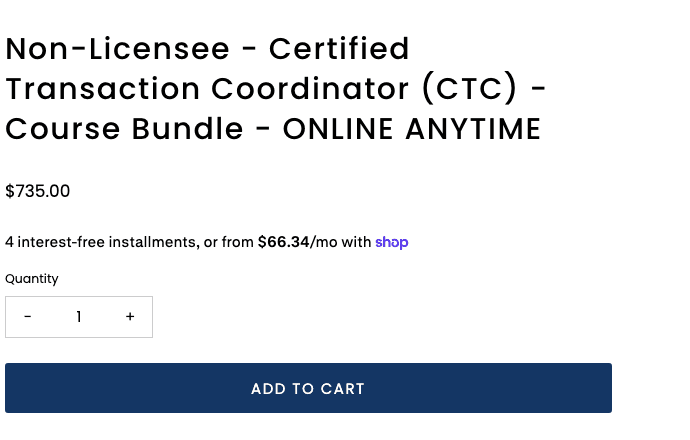
Then it expires. Unless it was earned in 2018 or earlier, every C.A.R. Education certification lapses two years from the date it was awarded, and anyone certified in 2019 or later must renew. The renewal course is the two TC courses again, 8.5 hours with both exams, at $250 or $125 for members. Over six years a non-member licensee pays $698 plus two renewals, $1,198. ListedKit says most private certificates never expire, and counts renewal as the one recurring cost only the C.A.R. credential has.
What does the CTC unlock?
One thing C.A.R. gates on it: a place in its Transaction Coordinator Directory. To be listed you show you have completed or renewed the CTC, have a website or other online presence, and name the transaction software you use. A California license and E&O insurance are asked for only if available. The listing costs $99 for a year or $149 for two, renews automatically, and there is no refund if your certification expires partway through. C.A.R. emails all members about the directory once a month and says on the same page that it is not a vetting program.
It does not unlock zipForm. Since 2025 a C.A.R. member can invite an assistant or TC into their zipForm account with their own login and whatever permissions the agent sets, and lock or remove that access at any time. The benefit belongs to the agent, and nothing on the page asks whether the TC is certified.
What do the private programs give you?
Training, plus whatever the seller adds. Transaction Coordinator Academy sells TC Essentials, six hours of on-demand video for $188, and Transaction Coordinator Business, more than ten hours on finding clients, sales, marketing and accounting, for $228, each ending in a certificate of completion from the company. Freedom Real Estate Services, a Texas coordination company, sells its TC Startup Guide for $295 with lifetime access and templates. Atlas TC Collective is a private Skool community at $197 a month with weekly live trainings and 54 members, built around investor and off-market deals. None of these is a credential a regulator checks. The one course on this page built on a regulator's guidelines is C.A.R.'s Dos and Don'ts, and the regulator is California's.
Should you get certified?
Yes, if you coordinate California files and are new to the work. The course list is the California purchase agreement, California disclosures and California's unlicensed-assistant rules, and the directory goes to every C.A.R. member once a month. Budget $349 to $735 and the renewal. Outside California, most of that material will not transfer, so take a cheaper course to learn the process or skip straight to files. If you already run files, your file count is the credential. Freedom Real Estate Services puts it bluntly: no agent will ask to see one.
Whichever you choose, the first files cost less to run than the course. DeedSpring reads the executed contract into the file's deadlines and drafts the chases for you to send, at $15 a month for one closing on Starter or $25 a closing on Standard, with no per-agent fee.