
Template · Transaction coordinator careers, pay and licensing
Hiring your first TC: a job description built from regulator “may/may not” lists
Write the duties from your state regulator's permitted list, put the prohibited list in the same document, and in Georgia sign it. A copyable job description for an unlicensed transaction coordinator, with the Florida, Georgia, Texas and New Jersey text behind every line.
Why build the job description from a regulator's list?
Because the title protects nobody. TREC's November 2024 article says the person's license status, not what you call them, decides what they may legally do, and it names transaction coordinator among the titles in use. In Texas an unlicensed person who does brokerage work, and the broker or agent who employs them, each commit a Class A misdemeanor: a fine up to $4,000, up to a year in jail, or both. TREC can also discipline the broker who pays or associates with them. Georgia's rule makes the firm and the affiliated licensee responsible for the acts of their support personnel, who may perform only ministerial duties, the ones that need no discretion or judgment of their own.
The lists are the cheapest way to stay on the right side of that. Florida's FREC list is 22 bullets approved in 2009. Georgia's rule names 21 permitted and 12 prohibited tasks. New Jersey's 2015 guidelines run a CAN column and a CANNOT column. Texas answers nine questions. Georgia's commission ends its own summary with the hiring advice: before taking on an assistant as an employee or a contractor, review the duties and make sure everyone understands the job description. This page is that document.

Which state makes you put it in writing?
Of these four, Georgia. Rule 520-1-.07(6)(d) says a firm that employs support personnel, or engages them under an independent contractor agreement, must enter into a written agreement with them specifying the duties they may undertake and the tasks they are prohibited from performing. If an agent in the firm is the one using the coordinator, the firm also signs a written agreement with that agent approving any compensation arrangement, and the agent and the coordinator sign a separate one covering duties, prohibited tasks and pay. The commission's July 2024 newsletter put it in one line: “A written agreement must exist between Licensees and their unlicensed assistants.”
Texas stops at advice. TREC tells brokers to establish written guidelines and training telling both their agents and their unlicensed staff what is and is not allowed, and to monitor assistants closely. Florida's list and New Jersey's guidelines say nothing about a written agreement at all. So in all four states the same document does the job: the duties and the exclusions on one page. In Georgia the firm and the coordinator sign it, and if an agent uses the coordinator, the firm signs with that agent too and the agent and the coordinator sign a separate copy.
If you would rather not hire at all, our pages on hiring a transaction coordinator in Texas and Florida set each state's list beside its contract, its closing model and the going rate for a file. What we take on as your coordinator, in any state, is on our real estate transaction coordinator page.
What can go in the duties column?
The table is the regulator's answer for each line of the template. Where a list is silent the cell says so, and that is your cue to leave the duty out.
Each duty on the template against the four regulator lists
| Duty | Florida | Georgia | Texas | New Jersey |
|---|---|---|---|---|
| Type the contract forms | Yes. Only type them, for approval by licensee and broker. | Yes. As directed by the firm or licensee ((e)10). | Yes. Only as specifically directed by a license holder. | Yes. For approval of a licensee. |
| Follow up on the loan | Yes. After the contract is negotiated. | Yes. Check loan-commitment status ((e)3). | Silent. TREC sends licensing questions on financing work to the mortgage regulator. | Yes. After contracts are fully executed. |
| Order or arrange inspections | Order, with the employer's approval. | Arrange dates and times ((e)17). Ordering is not listed. | Silent. | Order as directed. Not present without a licensee. |
| Assemble the closing documents | Yes. | Yes ((e)4). | Silent. | Track and secure documents, report findings to a licensee. The licensee delivers closing materials. |
| Schedule showings | Yes, for the licensee to show. | Yes, for a licensee to show ((e)16). | Yes, for the license holder who will show. | Yes, for a licensee to show. |
| Submit listings to the MLS | Yes. Fill out and submit listings and changes. | Yes ((e)2). | Silent. | Yes. Process and submit listings and changes. |
| Record and deposit earnest money | Yes. | Yes ((e)9). | Bookkeeping yes. Trust withdrawals need a license holder. | Yes. |
| Answer questions about a listing | Objective facts from approved printed information only. | Price and amenities the licensee authorized in writing ((f)6). | Confirm the advertised facts. Pass follow-ups to a license holder. | No, not even objective facts. |
| Explain the contract to a party | Silent. No prohibited column. | No ((f)7). | No. Cannot review a contract or facilitate a transaction. | No. |
| Show property or host an open house | Attend an open house for security or brochures. | No ((f)2, (f)4). Attend for security ((e)20). | No. Unlocking the door counts as showing. | No showing. No open house without a licensee present. |
| Negotiate or give advice | Silent. | No fees or splits ((f)8). No advice ((f)12). | No. Cannot facilitate a transaction. | No fee or split on a licensee's behalf. |
| Pay tied to the closing | Silent. | Newsletter: no. Rule: the firm approves the arrangement ((d)2). | Silent. | Should not ride on success, such as a share of commission. |
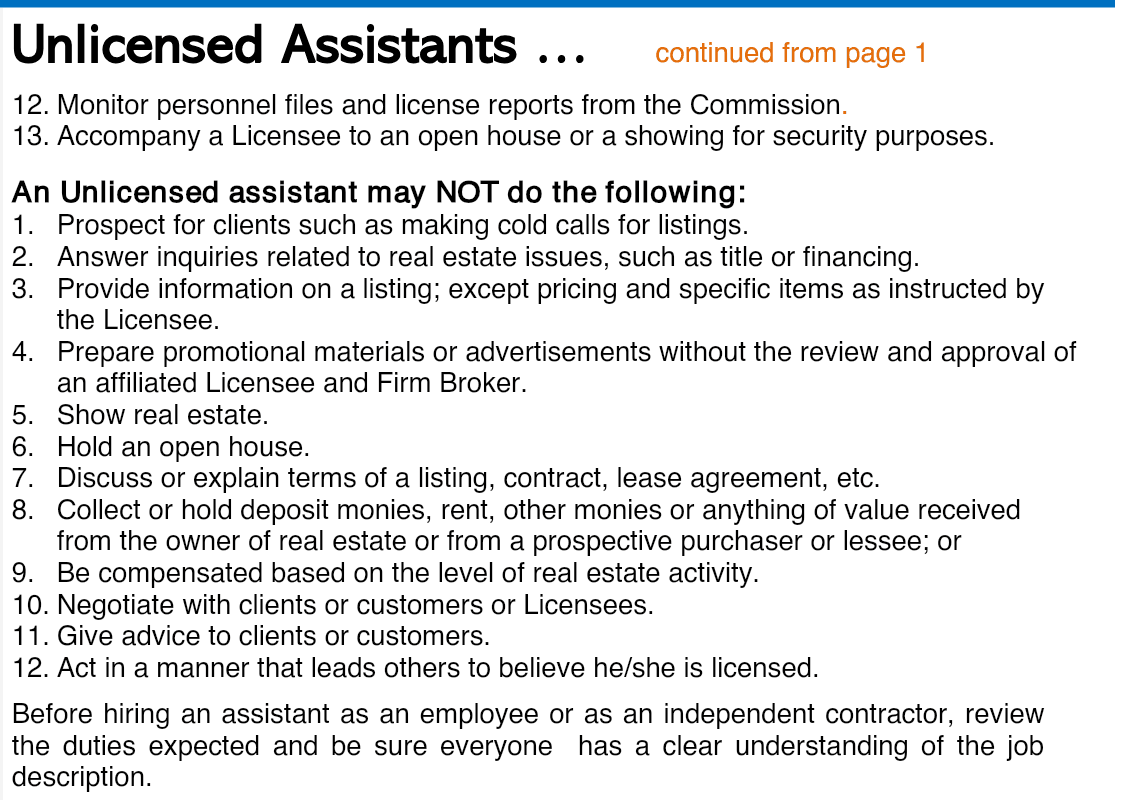
The job description template
Copy it, replace every bracket, and delete any duty whose row in the table reads silent or no for your state. The tag after each duty names the table row it came from. Duty 8 is ours.
TemplateTransaction coordinator (unlicensed): job description and written agreement
Replace every [placeholder]. Keep the regulator's verbs: type, follow up, arrange, assemble, schedule, record. In Georgia the firm and the coordinator sign it, and an agent who uses the coordinator signs a separate copy.
TRANSACTION COORDINATOR (UNLICENSED) — JOB DESCRIPTION AND WRITTEN AGREEMENT

Firm: [Brokerage legal name]   State: [State]
Reports to: [Broker name], [qualifying/designated broker]
Works for: [Agent or team lead]
License status: Not licensed. Never described to anyone, in writing or in person, as a licensee.
Basis: [W-2 employee / independent contractor]   Hours: [per week], [office / remote]

PURPOSE
Keep every file under contract moving to closing by doing the clerical and scheduling work a licensee assigns.

DUTIES (worded as the [State] list words them)
1. Type and input data into contract forms and addenda only as directed by the agent, for approval by the agent and broker. [row: typing]
2. Follow up on the loan after the contract is signed and note each status report on the file. [row: loan]
3. Arrange dates and times for inspections. Order inspections only where the [State] list allows. [row: inspections]
4. Assemble the closing documents. Deliver documents and keys. [row: closing documents]
5. Schedule showing appointments for a licensee. [row: showings]
6. Submit listing data and changes to the MLS as directed. [row: MLS]
7. Record and deposit earnest money as the broker directs. Never withdraw or transfer trust money. [row: earnest money]
8. Send a weekly status email to the agent and clients: what is done, what is next, what is waiting on whom, using only facts already on the file. [ours]

NOT PART OF THIS ROLE (from the [State] prohibited list)
- Explaining or discussing a contract, listing, lease or other real estate document with anyone outside the firm.
- Answering questions on title, financing or closings beyond the time and place.
- Showing property, unlocking a property for a buyer, or hosting an open house.
- Negotiating anything: repairs, price, fees or splits.
- Giving advice or recommendations to a buyer or seller.
- Cold calling or contacting the public to find clients.
- [Any further item from your state's list]

APPROVALS
Every form this role types is approved by [agent name] and [broker name] before it leaves the firm.

COMPENSATION
[Hourly rate / salary], paid by [the firm / the agent]. Not based on whether a transaction closes or on the volume of real estate activity.

TOOLS
[Transaction software], [MLS login as permitted], [e-signature account], [shared inbox].

SIGNATURES
Firm/broker: ____________________  Date: ________
Coordinator: ____________________  Date: ________

GEORGIA ONLY (Rule 520-1-.07(6)(d))
The firm must have this agreement in writing with the coordinator. Where an agent uses the coordinator, the firm also signs a written agreement with that agent naming the same duties, exclusions and pay arrangement, and the agent and the coordinator sign a separate copy of this document.
Agent using this coordinator (separate copy): ____________________  Date: ________
How do you fill in each field?
Reports to and license status. The broker. In Texas the broker or agent who employs the assistant answers for them, and in Georgia the firm and the affiliated licensee are both responsible. If one agent will direct the daily work, name them on the Works for line. Georgia's rule also bars unlicensed support personnel from holding themselves out, orally or in writing, as licensed, so the license line settles the email signature before it is written.
Duties and approvals. Keep the regulator's verb. Florida and New Jersey say type the contract forms for approval. Texas says input data only as specifically directed by a license holder. Georgia says arrange dates and times for inspections, where Florida and New Jersey say order them. Florida names the licensee and the supervising broker as the approvers of a typed form, so put both names on the page.
Compensation. Georgia's newsletter lists being paid based on the level of real estate activity as prohibited, and the rule has the firm approve the pay arrangement in its written agreement with the agent. New Jersey says pay should not ride on the success of the activity, such as a percentage of commission, and should relate to the duties performed. Florida and Texas say nothing in these texts. Nothing on the table rules out an hourly rate or a salary.
What does a filled-in version look like?
Demonstration: sample values for a Georgia team
Every value below is made up to show the shape. Firm: [Peachtree Example Realty LLC], Georgia. Reports to the qualifying broker. Works for one team lead with six agents. Hourly, paid by the firm. Duties 1 to 8 as written, with duty 3 worded as the rule has it: arrange dates and times for inspections, a mortgage application, a pre-closing walk-through, or a closing. Not part of this role: the twelve items in the rule's (6)(f) list, pasted in full. Signed and dated by the firm and the coordinator, with a separate copy signed by the team lead and the coordinator.
What should the posting ask for?
The lists say what the person may do. For who to look for, take Jessica Souza's Inman column of December 2025. A broker-owner who has hired and trained dozens of coordinators, she names five qualities: organization, clear and proactive communication, emotional intelligence, a strong grasp of contracts and compliance, and adaptability. Quote the compliance one, because she defines it as vigilance: catching missing initials, verifying dates, noticing when a timeline does not line up. Her communication example is a weekly email one coordinator called a Friday flight plan: what is done, what is next, what is waiting on whom. Duty 8 is that email.
How do you check the draft before you post it?
Step 1: Trace every duty to a row
Each numbered duty should point at a table row that reads yes for your state. Cut any duty with no row.
Step 2: Hunt the verbs that creep in from other postings
Review the contract becomes input data as directed, because TREC says an unlicensed assistant cannot review a contract. Negotiate repairs becomes arrange the inspection and deliver the response the agent wrote. Answer buyer questions becomes confirm the advertised facts and pass the rest to a licensee.
Step 3: Read the pay line against the table
If it mentions closings, commission or volume, rewrite it. Georgia's newsletter and New Jersey's guidelines both speak to it, and nothing on the table rules out an hourly rate or a salary.
Step 4: In Georgia, sign before day one
The firm signs with the coordinator. If an agent will use the coordinator, the firm signs with that agent too, and the agent and the coordinator sign a separate copy. Keep the signed copies on file.
Hire the coordinator, or buy the chasing?
Strip the table to its yes cells and the job is typing dates as directed, following up on the loan, arranging the inspection and assembling the closing file. That is the work DeedSpring does on each closing. Upload the executed contract and it reads the price, deposits, contingencies and dates into deadlines on the file. It checks every open closing every hour, flags what is slipping, and drafts the chases and client updates for a person to send. Anything about money, contract terms or a date that moves is always a draft a person sends. If you hire anyway, the coordinator gets a Transaction coordinator role on the roster and a Coordinator field on every closing they run.
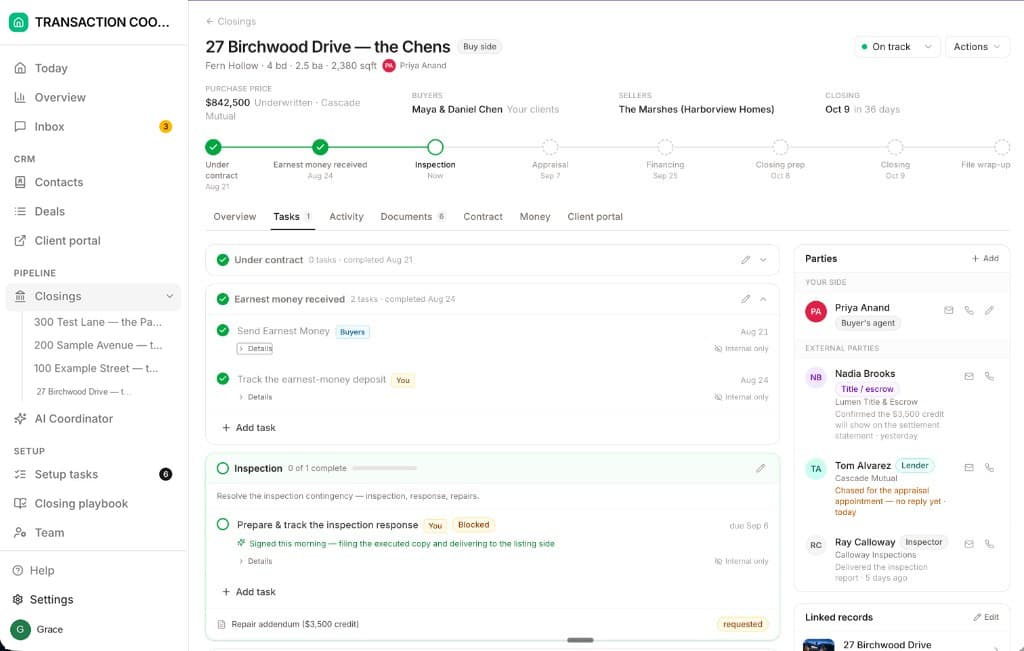
Starter is $15 a month for one closing a month. Standard is $25 a closing, less at volume, with unlimited agents and teammates and unused closings rolling over. Both are month to month.