
Workflow · Listing and closing workflows
How to track seller disclosures in transaction software
One row per disclosure: the form and its revision date, who fills it in, the day it is due, the day it was delivered and the buyer's signed copy. Open the rows at listing intake, pull the current form every time, and close a row only on the signed acknowledgment, with what dotloop, SkySlope, Lone Wolf and DeedSpring each do for you.
When does disclosure tracking start, and when is it done?
It starts at listing intake, because the clocks run from the contract and the seller needs time to fill the form in before there is one. Texas puts it plainly: the notice shall be delivered by the seller to the purchaser on or before the effective date of the contract. California wants the Transfer Disclosure Statement delivered as soon as practicable before transfer of title, and the C.A.R. purchase agreement gives the seller 7 Days after Acceptance to deliver every disclosure in paragraph 11A. Thefederal lead-paint rule wants the pamphlet, the known information and the Lead Warning Statement in the buyer's hands before they sign the contract at all.
It is done when the buyer's signed copy is on the file. Not when the PDF was emailed, and not when the buyer's agent said they had it. The Texas form ends with a line reading The undersigned purchaser hereby acknowledges receipt of the foregoing notice, and the C.A.R. form has the buyer return Signed Copies of every statutory and lead disclosure within the paragraph 3L(5) period, or 5 days after delivery if that is later. That signature is the evidence. Everything before it is a status.
Who does what?
The seller fills in the notice. Texas requires it completed to the best of the seller's belief and knowledge as of the date it is signed, with Unknown written where the seller does not know, and the Texas REALTORS® legal FAQ tells agents not to help sellers fill it out because doing so can increase their liability. The listing agent signs the agent sections and answers the buyer's questions about what the seller wrote. The buyer's agent delivers the pack to the buyer and sends back the signed copies. You, the coordinator, own the register: which form, which version, who has it, and what is still open. You do not explain a disclosure answer to anyone. If the buyer's agent asks what the seller meant by a roof note, the row says Open question, agent answering, and you chase the agent.
Which form, and which version?
The form is set by the state and the contract. The version is set by the publisher, and it changes without telling you. TREC's current notice is Form 55-1, dated 05-04-2026 on the form and effective 05/28/2026 on TREC's page, for contracts entered on or after September 1, 2023. The old file name, OP-H, still downloads from TREC's site and still says 09-01-2019 in the corner. A file copied from a 2025 listing, or a browser bookmark, hands the seller a superseded form. In Texas the seller can also use the Texas REALTORS® notice, TXR 1406, which the association says adds provisions beyond the statutory minimum. Either one complies.
Our Houston page goes through the flood section of the Texas notice and the city floodplain rules that sit beside it.
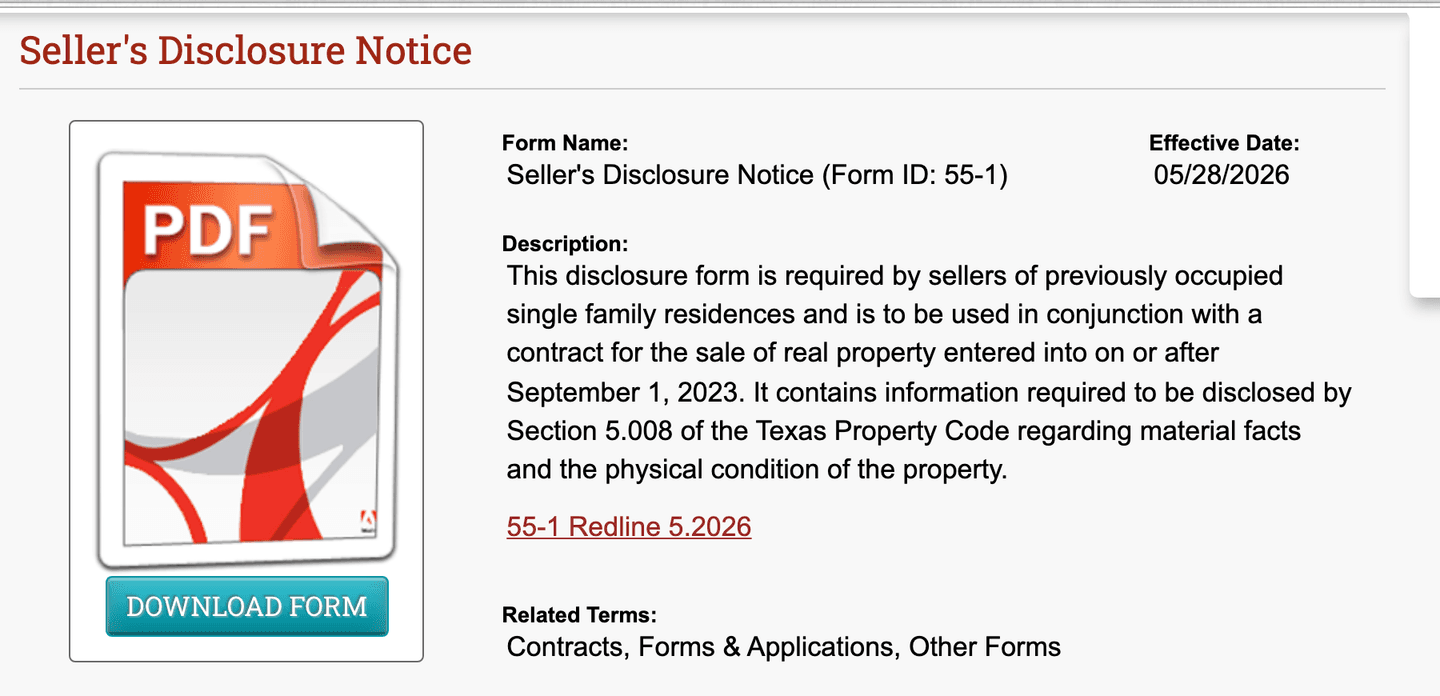
The matrix below is the register's first four columns for the disclosures most listing files carry. Add your city's local option statement, the HOA documents and anything the MLS requires as rows of their own.
The disclosures a listing file carries, who provides them, and what closes each row
| Disclosure and form | Who fills it in | When it is due | If it is late | What closes the row |
|---|---|---|---|---|
| Texas Seller's Disclosure Notice, TREC 55-1 (05-04-2026) or TXR 1406 | The seller, to the best of their belief and knowledge. | On or before the effective date of the contract. | Buyer may terminate within 7 days of receiving it, or any time before closing if never received. | The purchaser's signed acknowledgment of receipt on page 4. |
| California TDS and Seller Property Questionnaire | The seller answers and signs the seller sections. The seller's agent signs the agent's section. | 7 Days After Acceptance on the C.A.R. form. | Buyer gets 3 days in person, 5 by mail or electronic record, to terminate in writing. | Signed Copies returned by the buyer within the ¶3L(5) period, or 5 days after delivery if that is later (¶11G). |
| California Natural Hazard Disclosure Statement | The seller. The contract's checkbox says who pays for the report. | Same 7 Days After Acceptance. | Buyer may cancel after first delivering a Notice to Seller to Perform. | Signed Copies returned by the buyer. |
| Federal lead-based paint disclosure, homes built before 1978 | Seller and agent: pamphlet, known information, records, Lead Warning Statement. | Before the buyer signs the contract. | Buyers get a 10-day inspection period. The parties may lengthen or shorten it in writing. | A signed copy kept for three years after the sale. |
How do you run it, step by step?
Step 1: Open a row for every disclosure at listing intake
Before the listing goes live, list each disclosure the state, the contract and the property call for, and add the lead-paint row for any home built before 1978.
Step 2: Pull today's form from the publisher and record its revision
Download it from TREC, C.A.R. or the association, and write the form number and the date on page one into the row.
- If it fails
Never copy last deal's file. Lone Wolf added a warning to Transactions when you copy a transaction, because copying does not update form versions and can leave outdated forms in the file.
Step 3: Send it to the seller and get it back signed
The seller answers every question, and Unknown is an answer the Texas statute accepts. You do not fill it in for them, and Texas REALTORS® tells its agents not to help.
- Owner
- Seller
Step 4: Deliver it and log the delivery
Date, channel and recipient go in the row the moment it leaves. In Texas that is on or before the effective date. In California the seller has 7 Days after Acceptance on the C.A.R. form to deliver everything in paragraph 11A.
- If it fails
If it goes out late, write the new clock on the row: 7 days after the buyer receives it in Texas, 3 days in person or 5 by mail or electronic record in California.
Step 5: Chase the signed copy back
Two business days after delivery, ask the buyer's agent for the signed acknowledgment on the same thread, and keep asking until it is on the file.
- If it fails
A question about an answer goes to the agent and the seller, never to you. Log who is answering and when.
Step 6: Treat every amendment as a new row
When the seller learns something new, the amended disclosure gets its own delivery date, and in California a material amendment starts the 3- or 5-day window again.
Step 7: Close the row on the signed copy, filed on its line
The buyer's signature on the publisher's receipt line closes it. For lead paint, the signed copy stays on file for three years after the sale.
The failure that reaches brokers is the row nobody opened. In May 2025 a Florida buyer's agent posted on r/FloridaRealEstate almost two weeks into a contract: the flood, lead and insulation disclosures had never arrived, they had asked three times, and the listing side's coordinator was asking the buyer to sign a waiver. One reply named the cause.
“This is usually a disconnect between the listing agent and the TC thinks you've already gotten the disclosures off the MLS”
A Delivered column with a date, a channel and a recipient answers that question. And in California a waiver would not have helped anyone: the C.A.R. form says waiver of the statutory and lead disclosures is prohibited by law.
For Florida flood paperwork at county level, the Tampa coordinator page covers the Pinellas County flood disclosure brochure.
What do the tools do for you?
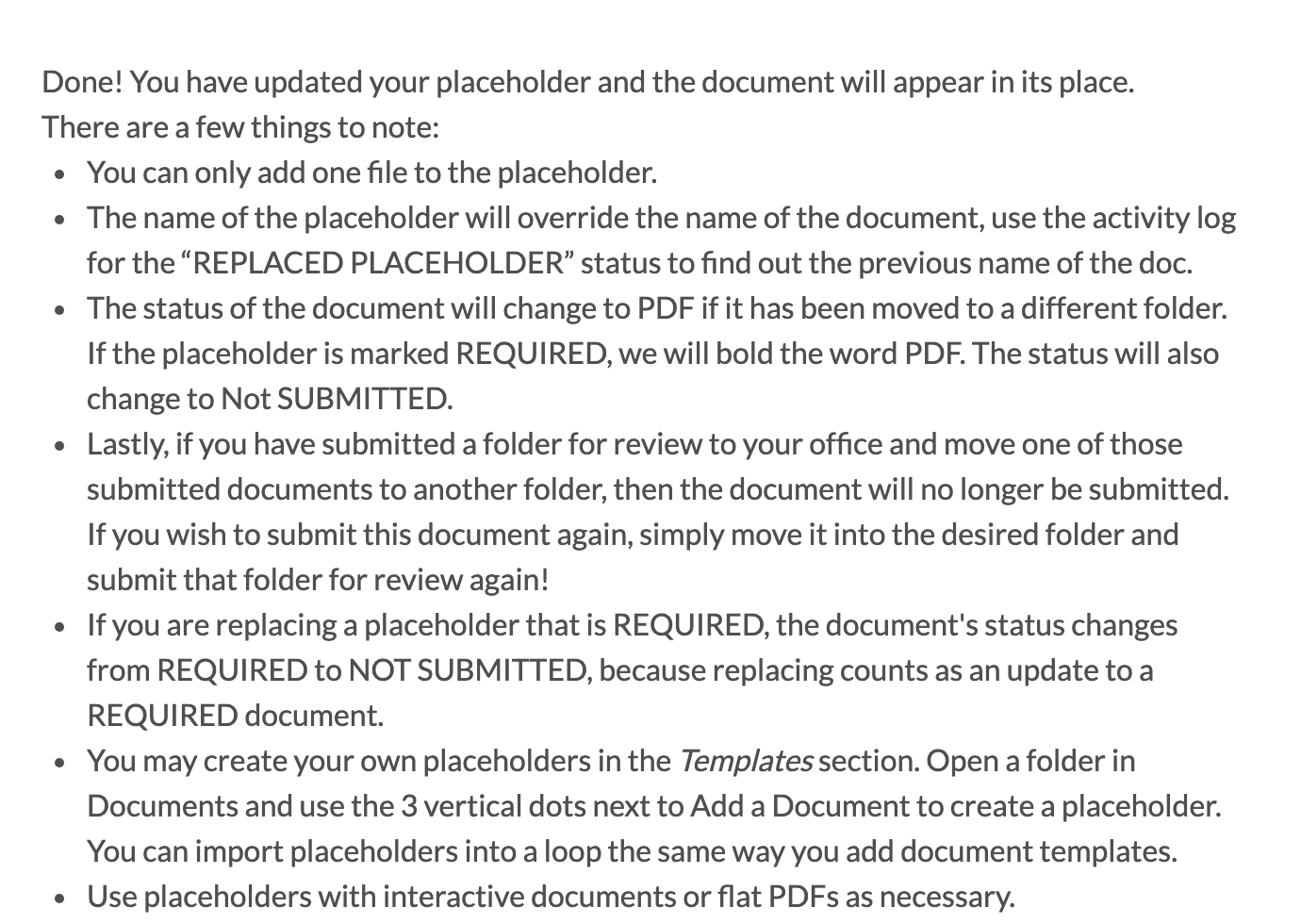
dotloop tracks the slot. A loop template can carry a placeholder for each disclosure, marked Required or Optional, and the document you drop in takes the placeholder's name. Replace a Required document and its status drops back to Not Submitted, and the activity log records a Replaced Placeholder entry. Submitting the folder marks each document Submitted for your broker's review. A coordinator added to the loop as On my team cannot submit for the agent, so you chase the agent to press the button.
SkySlope tracks the checklist. A listing checklist item can be flagged, and the agent on the file gets an email every day until the document is uploaded. The broker then accepts or rejects each document in Quick Audit, a rejection goes back to the agent with a comment, and in California and Arizona Smart Assist pre-checks the signatures and initials. A placeholder in Lone Wolf's Transactions can hold a stack of previous versions, cleared with Unfill Placeholder, and in 2021 the product added a warning when you copy a transaction that its forms may be outdated.
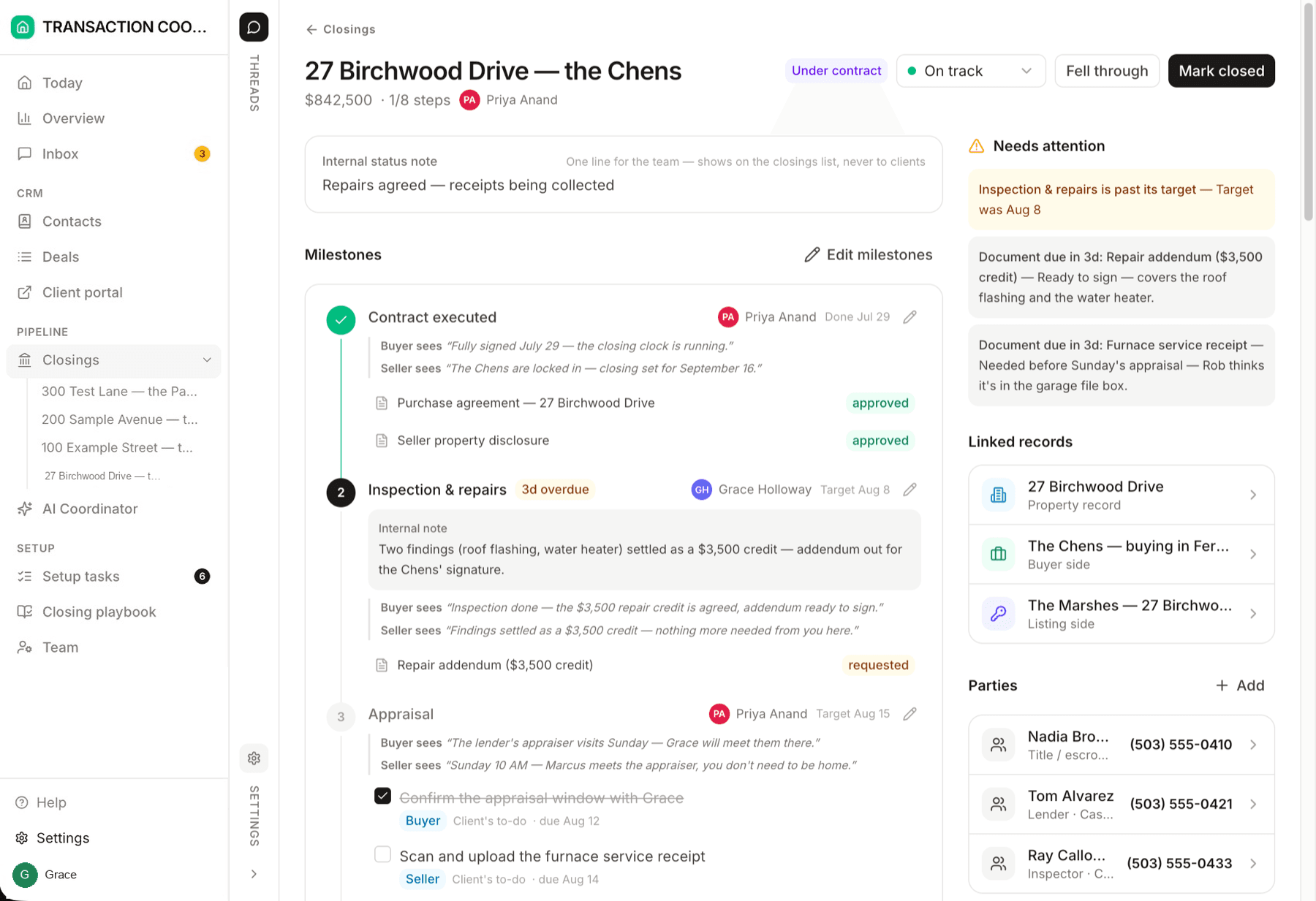
All three know whether a document is in the slot, and dotloop and SkySlope record whether the broker approved it. The chase is still yours: sending the notice to the buyer's agent for signature and asking again on Thursday because Tuesday's reply was a maybe. That chase is the step DeedSpring runs for you. Send the disclosure from the closing and the signed copy comes back through your connected email onto that closing, under Documents. The coordinator checks the signatures and the dates, and if something is missing it nudges you to send the document to the right party. A chase it is assigned keeps going until the item is confirmed in writing.
What goes in the disclosure register?
Eight fields, one row per disclosure and one more per amendment. Keep it where the agent and the broker can read it without asking: a tab on the file, the Documents panel of your software, or a shared sheet.
The disclosure register: one row per disclosure
- DisclosureBy the name on the contract paragraph that calls for it.
- Form and revisionPublisher's form number and the revision date printed on page one, taken from the publisher's site today.
- OwnerThe person who fills it in. The seller for the notice itself, the agent for the agent sections.
- DueThe date and the paragraph it comes from.
- DeliveredDate, channel and the thread or share it travelled in.
- AcknowledgedDate the buyer's signed copy landed on the file, and where it is filed.
- Open questionsAnything the buyer's side asked about an answer, with who is answering it. Never your answer.
- AmendmentsEach later change, its date, and the new clock it started.
How does DeedSpring run this on a listing?
Open the closing on the Sell side and it arrives with the disclosure steps already on the chain, because the sell-side playbook is written with disclosures and payoff in it. Each task names who does it, Deal owner, Client, External party or AI, and whether the client sees it, so the seller's own to-do appears in their portal with the internal notes filtered out. Send the form to the buyer, seller, agent or title company who needs to sign, the signed copy comes back onto the closing under Documents, and a chase assigned to the coordinator keeps going until the acknowledgment is back in writing. Anything negotiable, including a date that moves because a disclosure went out late, is always a draft for you to send.
Starter is $15 a month for one closing a month. Standard is $25 a closing, less at volume, with unlimited agents and teammates and unused closings rolling over. Both are month to month, on the pricing page.