
Retrospective · History, people and the future
The CFPB's 2015 eClosing pilot: early document review beat the e-signature
Borrowers who had their closing documents early and read them felt in control, caught errors before closing and finished the meeting faster. The e-signature itself changed little. What the pilot measured, what it could not prove, and what it means for how you run a closing.
What did the CFPB actually test?
In 2014 the CFPB recruited five technology vendors and seven lenders, from Flagstar Bank to Boeing Employees Credit Union, to close real loans three ways over about four months spanning late 2014 and early 2015. Paper closings were the control. In a base eClosing the borrower signed on the vendor's platform. An advanced eClosing added two things: the full closing package delivered at least three business days before the meeting, and CFPB educational materials inside the lender's closing portal.
The pilot produced 3,292 loans and 1,254 borrower surveys, and two participants issued 70% of the loans. A refinance boom in January 2015 meant most of those loans were refinances, 1,998 against 1,294 purchases, so the purchase results rest on a small group. An eClosing in 2015 also meant a hybrid. Almost every participant still had the borrower ink-sign the promissory note, and between two and more than a dozen documents per closing stayed on paper.
Did eClosing make borrowers understand more?
A little. Pooling both eClosing arms against paper, eClosing borrowers scored 55 against 48 on the report's empowerment composite, 79 against 74 on perceived understanding and 63 against 54 on efficiency, and they got 47% of an eight-question mortgage quiz right against 44%. Director Richard Cordray told the CFPB's eClosing forum that consumers who closed electronically were better off on understanding, efficiency and feeling empowered. The biggest gains between paper and eClosing were among first-time homebuyers and low- to moderate-income borrowers, groups that scored relatively low on understanding and empowerment overall.
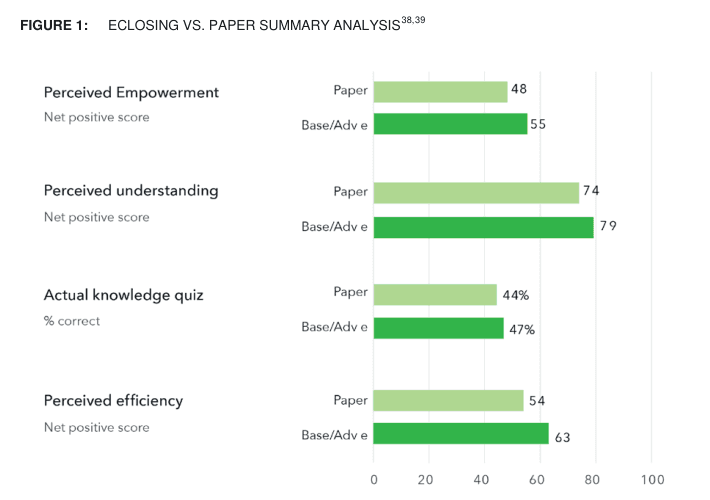
Read those gaps as hints. Borrowers could opt out of eClosing, so the groups were never randomized, and the Bureau wrote that its findings “may not be statistically significant or generalizable”. It never got cost data from the lenders either, and its conclusion says the pilot is no final verdict on eClosing. The clearer result is one level down: who had read the documents before the meeting.
What mattered more than the signature?
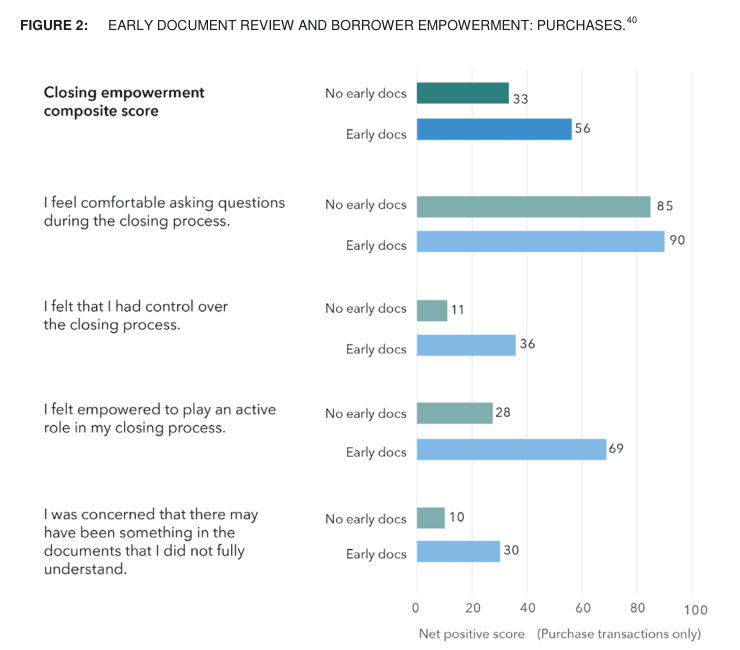
Reading the documents early. The report's early review group was borrowers who said they had received and reviewed their documents before the meeting, and whose lender data showed the HUD-1 settlement statement arrived at least a day before closing. Purchase borrowers in that group scored 56 on the empowerment composite against 33 for those who had not reviewed early. Asked whether they felt in control of the closing, early reviewers scored 36 against 11. Asked whether they felt able to play an active role, 69 against 28. They also answered more quiz questions correctly, 48% against 41%, and on the question about the security instrument, 57% against 40%.
The practical results followed. Of borrowers who found an error in their documents, 79% of early reviewers caught it before closing against 58% of the rest. Purchase closings finished in under 30 minutes for 36% of early reviewers and 11% of the others, and refinances for 56% against 31%. Settlement agents clocked 42% of purchase eClosings at under 15 minutes against 1% of paper closings, and 65% of paper purchase closings ran 30 to 59 minutes against 18% of eClosings. Shorter did not mean hurried: eClosing borrowers scored the same as paper borrowers on feeling rushed.
Early review was a habit the technology encouraged rather than created. A quarter of paper borrowers had reviewed early. In the base eClosing arm, with no delivery requirement, 81% had. And in the arm that required delivery three business days out, only 85% of borrowers qualified. The other 15% did not recall receiving the package or never opened it. That 15% is the gap on a brokerage file too: the disclosure packet sent on time and never read, with nobody whose job it is to notice.
DeedSpring closes that gap. The buyer or seller signs into a portal that shows their documents and their to-dos, every task on the closing names who does it and when it is due, and the AI coordinator sends the chase and keeps going until the item is confirmed in writing.
Where did the extra days come from?
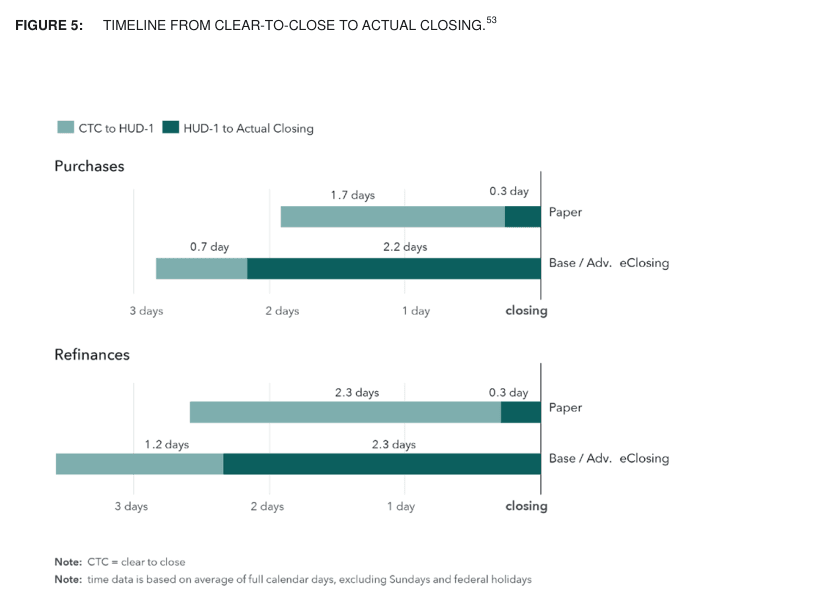
The CFPB timed the last stretch of each loan. On a paper purchase the lender took 1.7 business days to get from clear-to-close to delivering the settlement statement, and the borrower then had it for 0.3 of a day before closing. On an eClosing purchase the lender delivered in 0.7 days and the borrower had the documents for 2.2. Clear-to-close to closing stretched from 2.0 to 2.9 business days in total, so lenders made up about half of the extra review time by moving faster themselves. Refinances show the same shape.
Lenders told the Bureau that the hard part was operational:
“The key…is agreeing to a closing date early in the origination cycle, then managing processes to ensure it takes place when originally scheduled.”
Coordinating settlement agents and real estate agents was hardest on purchases, where, in the report's words, “the realtor drives much of the closing process”. Ten years on, that sentence still describes a TC's week.
What changed since 2015?
Two months after the report, on October 3, 2015, the Know Before You Owe mortgage disclosure rule took effect. The report's own footnote describes it as requiring the Closing Disclosure three business days before closing, one document rather than the full package the advanced arm had delivered. The CFPB's one follow-up, a 2017 blog post, called eClosing promising but not yet universally available or standardized, and gave one number: almost 80% of Americans then lived in counties that allowed eRecording, up from 65% in 2014. The report's landing page lists no later study.
The part of eClosing that grew is the part the borrower never sees. eNotes registered on the MERS eRegistry went from 16,950 in 2018 to about 463,000 in 2020, and eMortgages went from 0.4% of Fannie Mae and Freddie Mac purchases in 2018 to 4.25% by mid-2020. At the table, ALTA's 2021 survey found 46% of title companies offering some form of digital closing in 2020, up from 14% the year before, while nearly 85% of respondents still closed entirely on paper. Remote online notarization went from 35 states with permanent laws in 2021 to California joining 44 other states in 2023.
What does this mean for your next closing?
The pilot ran on lender documents, but its lesson is about coordination, and that is the agent's and the TC's side of the file. Three things carried the result: a closing date fixed early and held, documents in the client's hands days before they were needed, and someone checking they had been read. Be careful what you count as read. A client who says the timeline is clear and a client who can tell you what happens next are different people, and the pilot measured the two separately. Among advanced-arm borrowers, 71% used the CFPB's closing checklist and 69% its document summaries, and those who did reported higher understanding than those who did not, 80 against 67, yet scored lower on the quiz, 46% against 50%.
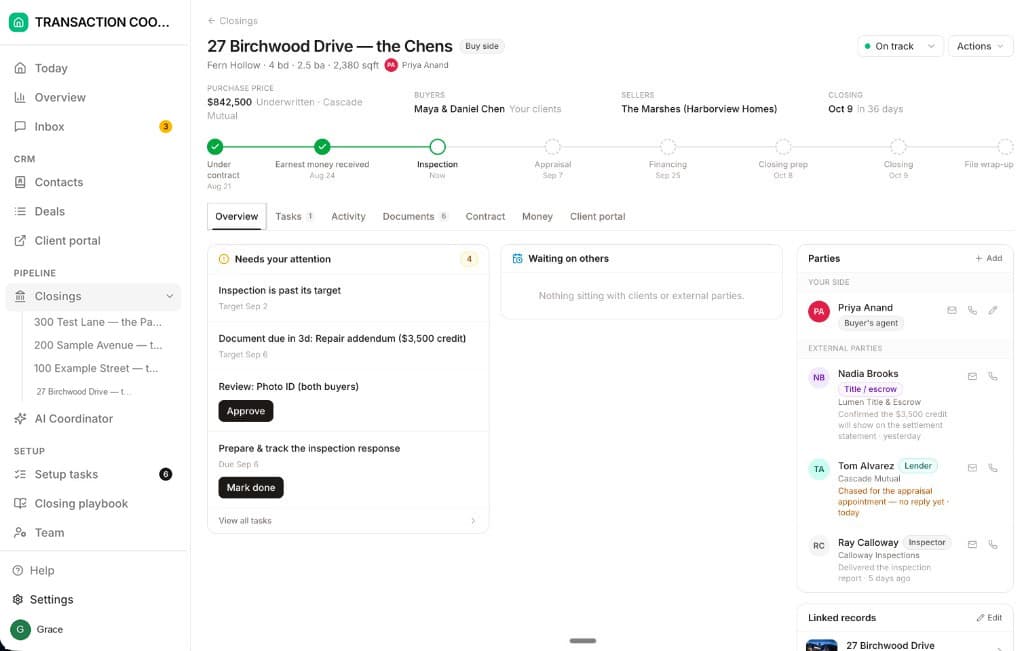
DeedSpring is built for exactly that stretch. Upload the executed contract and the coordinator reads the price, deposits, contingencies and dates into deadlines on the file, counted from the contract or closing date. Every milestone the client should see is on their portal with the documents and to-dos that go with it, and e-signing is built in, so a disclosure or addendum goes out for signature and the signed copy lands back on the closing's Documents tab. The coordinator checks every active file every hour, flags what is slipping, and drafts the chases and client updates for you to send.
Starter is $15 a month for one closing a month. Standard is $25 a closing, less at volume, with unlimited agents and teammates and unused closings rolling over. Client portals are included on every plan. Both are month to month.