
Research · MLS, IDX and listing data
Why your IDX site still shows a sold house: feed latency by MLS rule and by vendor
A sold house can sit on an IDX website for up to 24 hours under NAR's rules, and three days on a VOW. Most vendors say they refresh within the hour. IDX Broker says daily. Here is where the delay happens, what each vendor and portal promises, and what to do when a client sends you the Zillow link.
How stale is an IDX listing allowed to be?
NAR's IDX policy, Policy Statement 7.58, runs two 12-hour clocks. The MLS must refresh the IDX download it serves at least every 12 hours. The broker or vendor displaying that download must refresh it, and every display fed from it, at least every 12 hours as well. Run the two clocks back to back and a status change can take a full day to reach your site with nobody breaking a rule. An MLS that refreshes its feed faster brings that down toward 12.
A VOW is slower by rule. NAR's VOW policy requires the data on a VOW to be refreshed at least every three days. Local rulebooks copy the national numbers: Big Sky Country MLS's 2026 rulebook and the Spokane Association of REALTORS® MLS rules both say 12 hours for IDX and three days for VOW. Expect the same figures in yours.
Vendors know the rule is loose. IDX Broker's own FAQ points out that most MLSs only require a refresh every 12 hours. Everything faster than that is the vendor's choice, and the table is what each one says it does.
How often each party says it refreshes, from the rule down to the portals
| Who | How often it refreshes | Rule or promise |
|---|---|---|
| NAR IDX policy | MLS feed at least every 12 hours. Your display at least every 12 hours. | Rule maximum |
| NAR VOW policy | At least every three days. | Rule maximum |
| MLS Grid (aggregator) | Checks each MLS every minute unless the MLS restricts it. No real-time access. | Vendor's statement |
| Bridge Interactive (aggregator) | Typically every 10 minutes or less, by resource and MLS. | Vendor's statement |
| IDX Broker | Hourly target. Its support article says most MLSs daily. | Vendor's statements, two of them |
| Showcase IDX | New listings as fast as every 15 minutes. Changes up to 3 hours. | Vendor's statement |
| BoldTrail | Most feeds hourly or faster. Some take longer. | Vendor's statement |
| Sierra Interactive | Several syncs a day. A manual refresh of one listing takes 5 to 10 minutes. | Vendor's statement |
| Luxury Presence | About every 15 to 20 minutes. Pulls the feed every 3 minutes. | Vendor's statement |
| Real Geeks | Wait 15 to 30 minutes for the next sync. | Vendor's statement |
| Placester | Publishes no interval. Assume the 12-hour rule. | Nothing found |
| Realtor.com | Receives changes within 15 minutes. Up to 24 hours to show them. | Portal's statement |
| Zillow | 24 to 48 hours in a 2023 article. Shortly after, in two 2025 articles. | Portal's statements, two of them |
| Redfin | Every two minutes. Photos can lag. Escalate after 24 hours. | Marketing claim, then help page |
Where does the delay actually happen?
A status change makes four stops before a visitor sees it. First the MLS has to put the agent's change into the feed it serves. No MLS we read publishes how fast it does that. MLS Grid keeps a per-MLS import-status screen behind a login, so the only public number for this hop is the 12-hour rule.
Second, most vendors never touch the MLS directly. They copy from an aggregator that does. MLS Grid's documentation says it checks its member MLSs for changes every minute unless an MLS restricts it, and that it offers replication rather than real-time access. Bridge Interactive, Zillow's aggregator, says it typically refreshes listing data every 10 minutes or less, depending on the resource and the MLS.
Third, your vendor copies that copy. It asks the aggregator for every record changed since its last request, keyed on a modification timestamp, which is the replication pattern all three aggregators document. How often it asks is the vendor's own decision. Spark's replication guide tells consumers to poll at least once an hour. The vendors in the table run from Luxury Presence's three-minute pull to IDX Broker's daily.
Fourth, your site renders the vendor's copy and caches the page, on the vendor's servers and in the visitor's browser. The rule caps this hop at 12 hours too. BoldTrail lists caching among the reasons a feed looks slow, and Sierra Interactive's first troubleshooting step is to reload the page without the cache. The page in front of your client can be older than the data behind it.
Portals are a fifth stop on their own road. Realtor.com, Zillow and Redfin do not read your website. They take their own feeds from the MLS or from syndication, so a stale portal and a stale website are two separate problems with two separate owners.
Why does my IDX Broker site still show it?
IDX Broker gives two answers. The support article you land on when a listing is missing, Troubleshoot Missing Listings, says: “IDX Broker updates most MLS on a daily basis.” It tells anyone who added a property less than 24 hours ago to wait. The MLS Coverage FAQ says the company strives to refresh hourly, and that the last-refresh time for each MLS is on the coverage page.
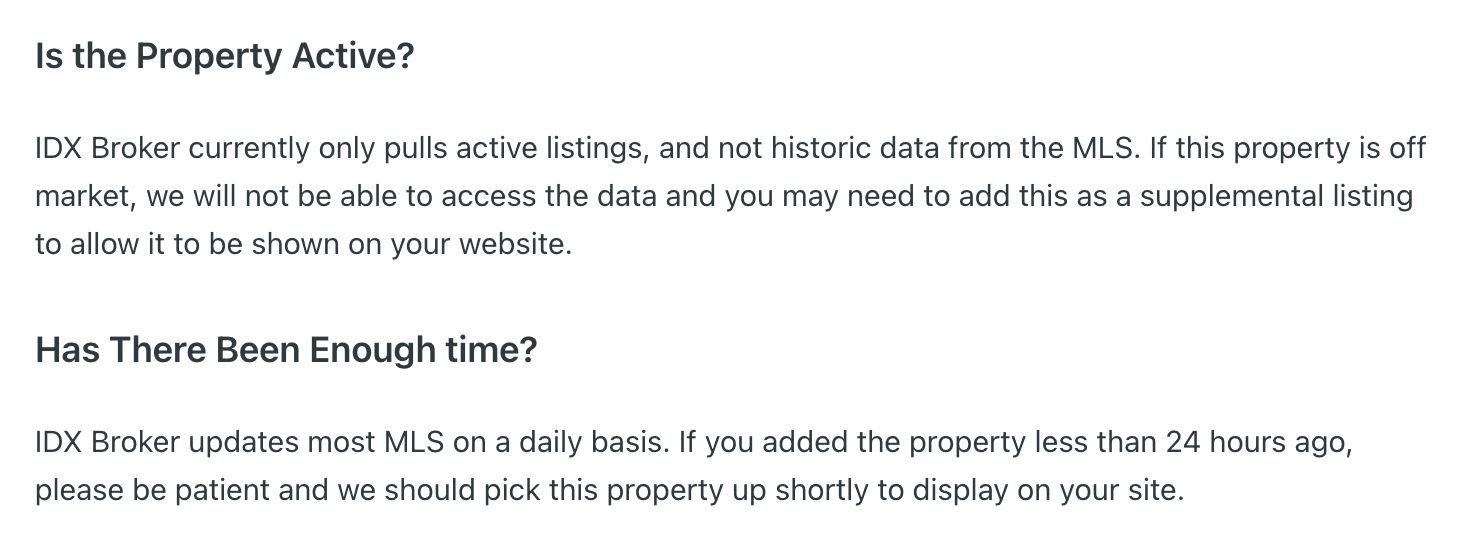
It is. Each per-MLS page carries a Last Update line under MLS/IDX Feed Details. The same page used to carry an Update Frequency row reading every hour, and that row was gone by October 2026. So IDX Broker's own figures are an hour and a day. Read the Last Update line for your MLS before you assume either. IDX Broker also pulls active listings only, so a sold house on an IDX Broker site is a copy that has not refreshed yet. It drops off when the copy does.
How fast do the other IDX vendors refresh?
Showcase IDX gets new listings as fast as every 15 minutes for most MLSs, slower where the MLS caps how often a vendor may pull, and says a status, price or photo change to a listing already on your site can take up to three hours. BoldTrail says most feeds update hourly or faster and some take longer, and blames the size of the update, limits the MLS puts on data consumption, and your browser's cache. Sierra Interactive syncs several times a day and will refresh a single listing by hand in five to ten minutes.
Luxury Presence is the most precise. It pulls the feed every three minutes and says changes show in about 15 to 20 minutes. Real Geeks says wait 15 to 30 minutes for the next sync. iHomefinder's figure for the industry as a whole is 15 to 60 minutes. Placester publishes nothing, so assume the 12-hour rule.
Why does Zillow still show the house as active?
Because Zillow is on its own feed and its own clock. Realtor.com's support page on listings that still show as active says it receives updates from most MLSs within 15 minutes and that a change can take up to 24 hours to fully show. It also names a case your vendor cannot fix: a property listed in more than one MLS can update on one listing before the other.
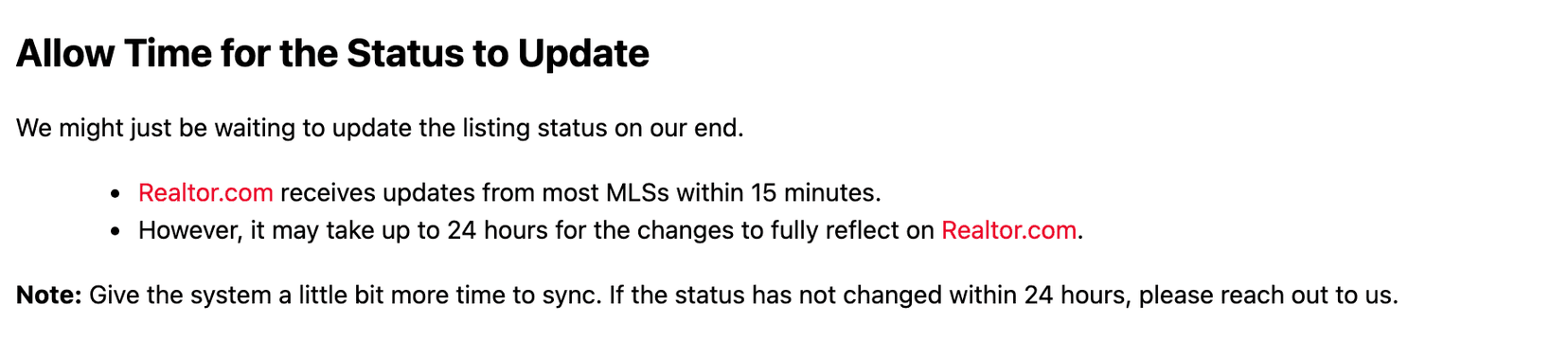
Zillow publishes two answers. A help article last edited in December 2023 says a new status shows within 24 to 48 hours after the source is updated. Two articles edited in late 2025 say a change at the MLS source should show shortly after. Both are live. Plan on 48 hours. Redfin's Why Redfin? page says it refreshes listings every two minutes. Its help page gives no interval for listing data, only that photos can take longer and to email support if they are still missing after 24 hours.
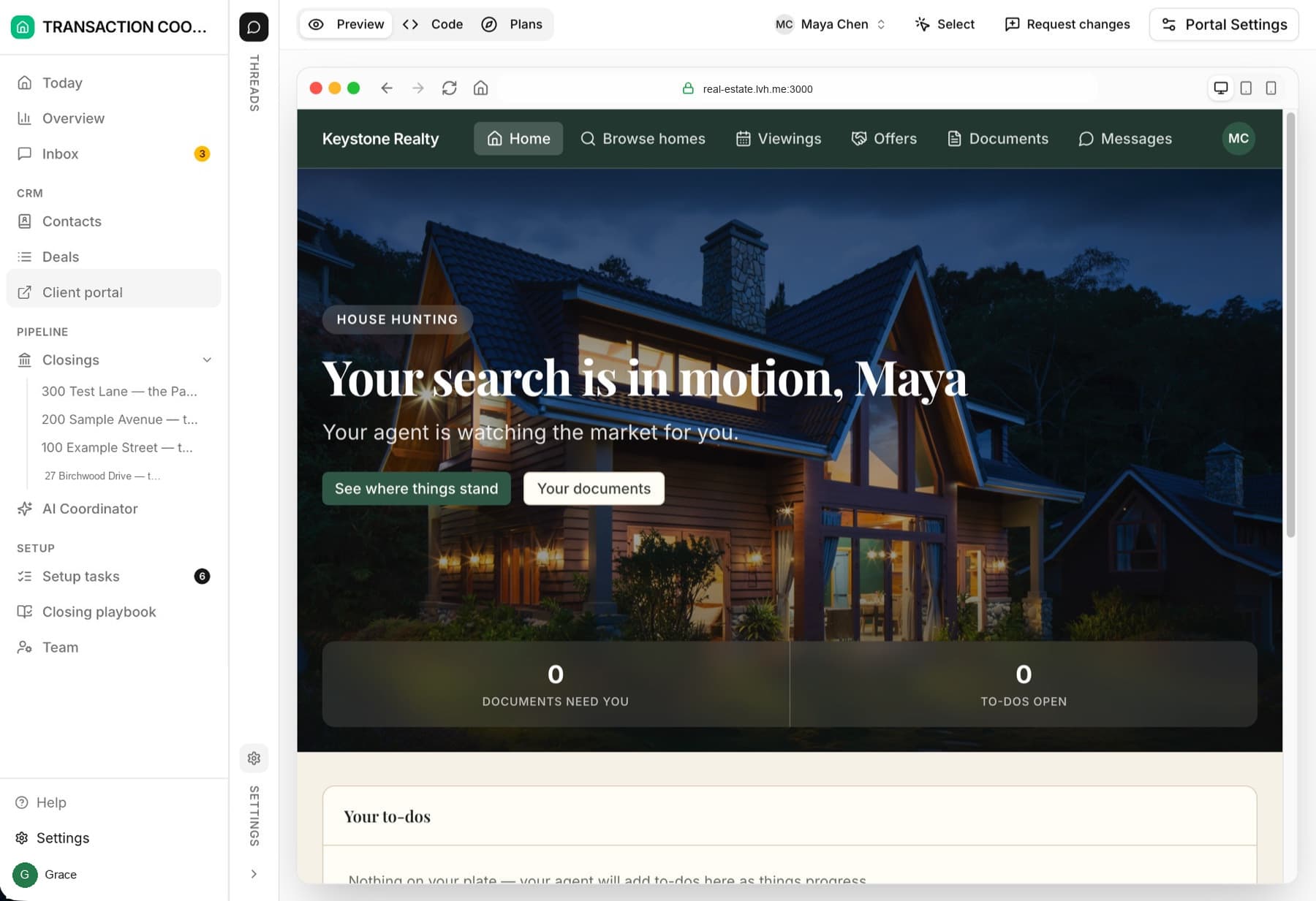
The person who sends you the Zillow link is usually your own buyer or seller, asking whether their deal is real. They should never be learning the status of their own closing from a portal. DeedSpring reads the executed contract into the deadlines on the file and gives your client a portal that shows where their closing stands, from the contract, so a portal lagging the MLS is Zillow's problem and never theirs.
What do I do when a client sends me the link?
Start at the MLS. Pull up the record yourself. If the MLS still says active, your website and the portals are right and the listing agent has not changed it. Nothing downstream can be fresher than the MLS.
If the MLS says sold, work down the chain. Reload your own site without the cache, and use the manual refresh if your vendor offers one. Then ask your vendor three things: the last-refresh time for your MLS, whether your site is on an IDX or a VOW feed, and whether it replicates through an aggregator such as MLS Grid, Bridge or Trestle. A VOW feed is allowed three days where IDX is allowed 12 hours. Sierra Interactive, for one, does not support VOW feeds, so its sites are on the shorter clock. An aggregator hop adds its own interval and its own request limits.
Give each party the time it says it needs before you escalate: three hours for a change on Showcase IDX, 24 hours on IDX Broker and Realtor.com, 24 hours for photos on Redfin. Past 24 hours you are past the national rule as well, and the vendor owes you a fix rather than an interval. Portals get their own call. Realtor.com and Zillow each publish a help page for a listing that still shows active, and your website vendor cannot touch either portal.
What should your client be looking at instead?
Your buyer under contract does not need an IDX feed to know where their deal stands. They need the contract's dates and who is doing what this week. DeedSpring reads the executed contract into the price, deposits, contingencies and deadlines on the file, checks every open closing every hour, and drafts the chases and client updates for you to send, with anything sensitive or negotiable always waiting for a person. Your buyers and sellers get a portal that shows their closing's status, the next steps and the documents, filtered to their side of the deal. When a client asks whether the house is really theirs, the answer is on the file, with the date it is due.
Starter is $15 a month for one closing a month. Standard is $25 a closing, less at volume, with unlimited agents and teammates and unused closings rolling over. Both are month to month.