
Explainer · MLS, IDX and listing data
IDX vs VOW vs BBO: which MLS feed your tool is on, and what each one can show
IDX is the public-advertising feed behind your website, VOW is the registered-client feed with deeper data, and BBO is the brokerage's internal feed with the most. Here is what each one carries, how stale it may be, who can opt out, and why your tool shows less than the MLS.
Which feed am I looking at?
Your brokerage website, your agent site and the listing search inside most consumer portals run on IDX. The MLS lets every participant advertise every other participant's listings there, on the MLS's terms. A site that makes the visitor register and accept terms before it will show a search is a VOW, a virtual office website, and it may show more. The feed inside your CRM, your transaction software or your production reports is a back-office feed, BBO, and the public never sees it.
Big Sky Country MLS's rulebook puts the pattern in one line: as the audience narrows from the public to a registered client to your own office, “the data available may become more inclusive.” The public gets the least. Your back office gets the most.
What each MLS feed carries
| Rule | IDX | VOW | BBO |
|---|---|---|---|
| Who gets it | Brokers, to advertise other brokers' listings on sites and apps they control. | Brokers, for consumers who have registered as their clients. | The brokerage's own systems: CRM, transaction software, reports. |
| Refresh floor | Every 12 hours. CRMLS allows 7 days. | Every 3 days. REcolorado requires 12 hours. | No floor in any rulebook we read. Assume it is as fresh as the vendor's last pull. |
| Statuses | Active, sold since 2012, non-confidential pending. Local rules often drop expired, withdrawn and coming soon. | Everything non-confidential. An MLS may hold back expired, withdrawn or pending. | Every participant's listings minus MLS-only fields. Some MLSs scope it to your own office. |
| Opt-out | Listing broker may refuse, blanket or per listing. Seller may withhold the address. | No broker opt-out. Seller may withhold the listing or address. | None. |
| Shown to the public | Yes. MLS-designated fields only, with source and disclaimer notices. | Only behind registration and terms of use. | Never. In-office applications only. |
Why can't my website show sold prices?
Because the MLS decides what goes in the IDX field set, and sold price is the field it most often keeps back. NAR's policy lets an MLS put sold data from January 1, 2012 onward into the IDX download, where sale prices are publicly accessible. The MLS then picks the fields. Spokane's IDX rules allow only Association-designated fields, and only listings flagged yes in the IDX Y/N field. Big Sky Country's Standard IDX carries active and pending listings and excludes sold price and closing date outright. Its IDX Plus adds sold listings, still without the sold price. The VOW feed gets both.
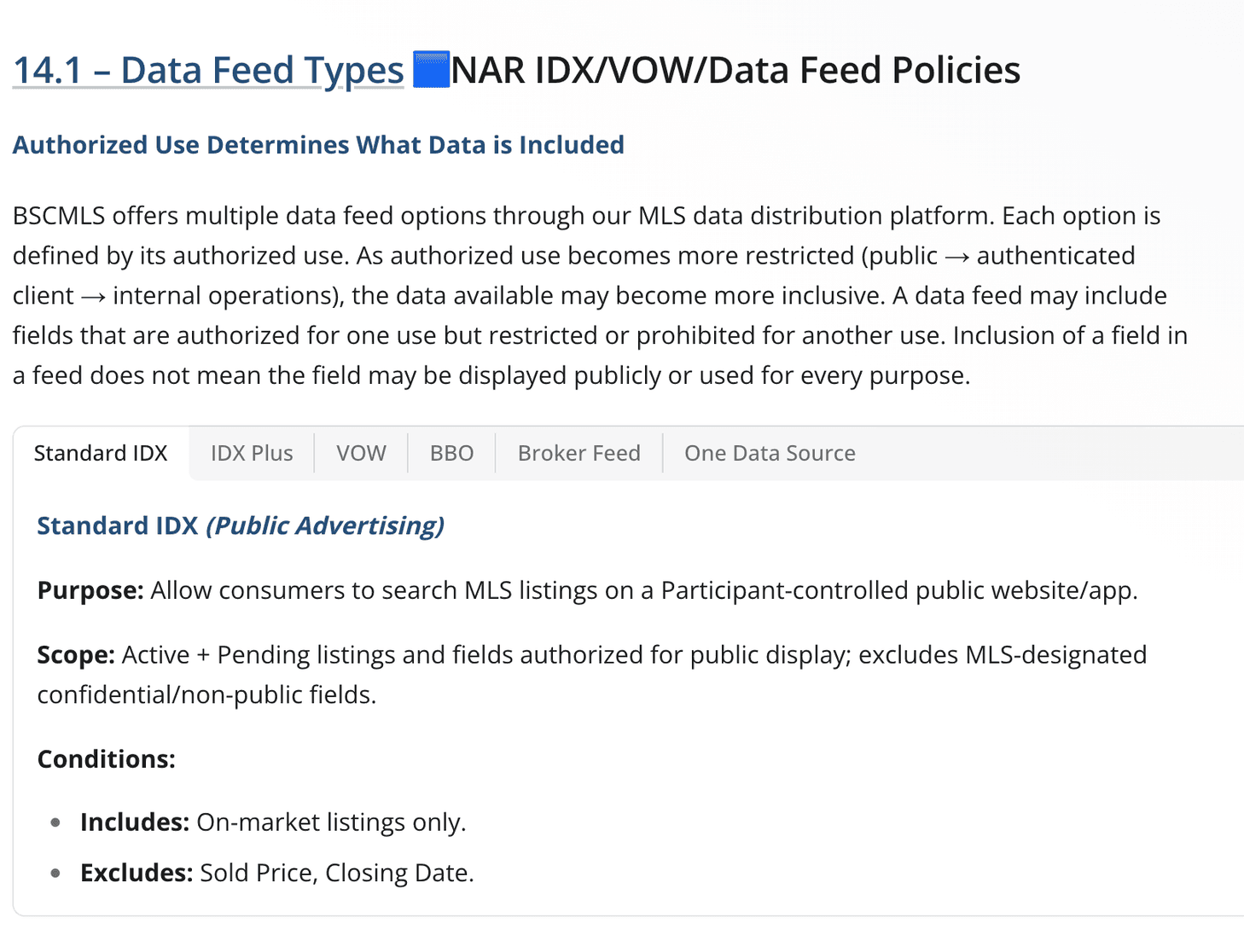
Expired and withdrawn listings go the same way. NAR lets an MLS bar them from IDX display, and Spokane and REcolorado do. ARMLS bars expired, cancelled and Coming Soon listings. So if a vendor's site shows what a house sold for and your own website cannot, either the vendor is on a VOW, or your MLS lets IDX carry the price and your website builder left the field out. Ask the builder which.
Why is a listing Pending in one tool and missing in another?
Because each MLS decides which statuses each feed carries, and Pending is the one they decide differently. Hawaii Information Service publishes a status-by-status table for its feeds. Active and Active Under Contract are in IDX and in VOW and BBO. Pending, called Under Contract there, is missing from IDX and present in VOW and BBO. Coming Soon, Expired, Hold and Withdrawn follow the same split. Closed is in IDX only for sales after January 1, 2012. Cross a state line and the answer flips: Big Sky Country's Standard IDX covers active and pending listings, CRMLS's IDX statuses include Pending, and NAR's own basic download includes non-confidential pending data. The same IDX website shows a Pending in Montana and California and hides it in Hawaii.
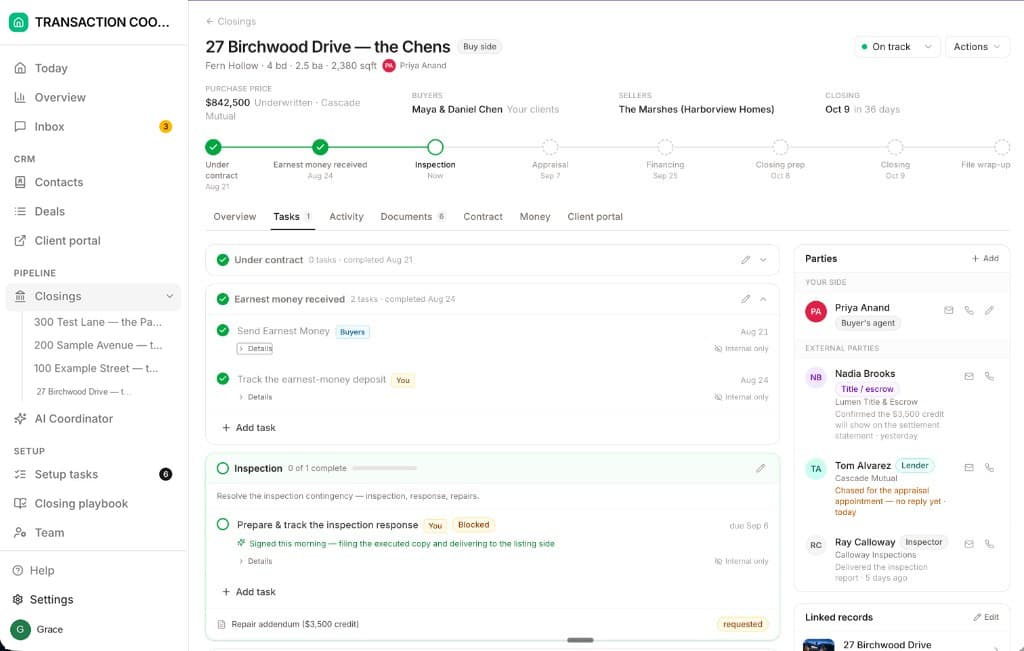
That status is also the most a portal can tell your client about a deal they are in. Pending says the house is under contract. It says nothing about the inspection deadline on Thursday or the financing contingency that runs out next week. Those dates live in the executed contract, and no feed carries them. DeedSpring works from the contract: upload it and the price, deposits, contingencies and dates become deadlines on the file, checked every hour.
How old is the data allowed to be?
NAR sets two floors. An IDX display must be refreshed at least every 12 hours. A VOW must be refreshed at least every three days. Most rulebooks restate them: Big Sky Country, Spokane, ARMLS and Stellar all say 12 hours for IDX, and Stellar's refresh rule adds that a refresh must drop anything removed from the MLS. Two differ. CRMLS, in rules effective July 10, 2026, lets an IDX display go seven days between refreshes while keeping the three-day VOW rule. REcolorado goes the other way and requires VOW content to be refreshed every 12 hours.
No rulebook we read sets a refresh floor for a back-office feed. Assume your BBO tool is as current as its vendor's last pull, and ask the vendor how often that is. A floor is the most stale the data may legally be. A vendor that pulls hourly beats it comfortably, and a vendor that pulls once a day is still inside the IDX rule.
Can a broker keep a listing out of my feed?
On IDX, yes. Unless state law requires written consent, the MLS presumes a listing broker agrees to IDX display, and the broker can refuse, across the board or one listing at a time. A broker who refuses across the board loses the right to show everyone else's listings on IDX. SFAR's guide adds that an office which opts out of IDX also loses its IDX feed, though it can still ask for a VOW. A seller can have the listing, or just the address, kept off the internet.
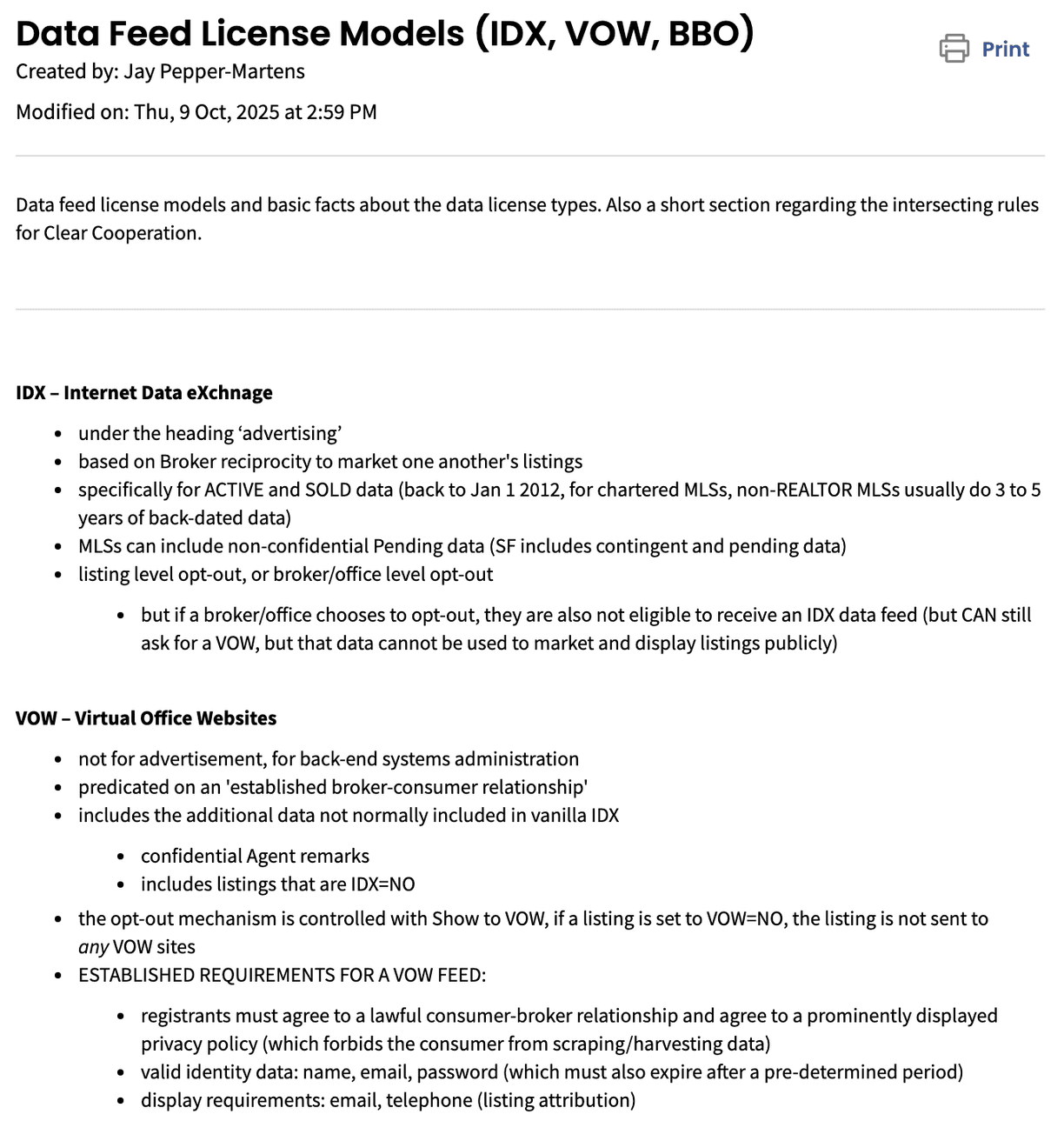
On a VOW the broker has no say. Showing other participants' listings needs no separate permission. The seller keeps the right to withhold the listing or address, and SFAR flags that per listing with a Show to VOW field. On BBO there is no opt-out at all. NAR's policy says participants cannot opt their listings out of back-office use, and Big Sky Country's rulebook repeats it almost word for word.
Why does my back-office tool only show our own listings?
Because back office means two different feeds, and your MLS may have given the vendor the smaller one. NAR's BBO policy defines the data as every participant's listings minus the fields only MLS staff see, for brokerage management, CRM, transaction management and statistics tools, and Big Sky Country copies that. SFAR's guide says that in many MLSs a BBO feed carries only the brokerage's own listings, while SFARMLS's own carries the whole MLS. REcolorado's data page splits the two products by name: Back Office is the all-MLS feed for tools, transaction management platforms included, and a brokerage's own data comes under a separate Participant Data Access Policy license. NAR keeps a separate policy for the own-listings feed too.
So a tool that shows only your office's deals is on an own-listings license, or on a BBO license your MLS has scoped that way. Assume own-listings until the vendor shows you otherwise. Either way the data stays private: ARMLS's Content Access Policy limits a BBO feed to in-office applications, and REcolorado bars Back Office feeds from public-facing websites.
What do I ask the vendor?
Three things, in writing: which license it holds in your MLS, which statuses that license carries there, and whether the feed is all-MLS or own-office. Ask for the MLS's own status table or rule section rather than the vendor's summary, because the same product sits on different licenses in different markets and the answer in Phoenix tells you nothing about Denver.
Do not accept a protocol as an answer. RESO Web API and RETS are ways of moving the data. ARMLS issues one Content License Agreement for IDX, VOW, BBO or AVM use, all delivered over a RESO-certified web API, and MLS Grid uses one standard license agreement for IDX, VOW and Back Office products. The license decides the payload. The API only delivers it.
The dates no feed carries
Every feed above stops at the listing: status, price, remarks, photos. The deadlines that decide whether the deal closes are in the executed contract, and they reach your tools only if someone types them in. DeedSpring reads them for you. Upload the executed contract and it extracts the price, deposits, contingencies and dates into deadlines on the closing, checks every active file every hour, flags what is slipping, and drafts the chases and client updates for you to send. Your buyers and sellers get a portal that shows the closing timeline, so Pending is no longer the whole story they see.
Starter is $15 a month for one closing a month. Standard is $25 a closing, less at volume, with unlimited agents and teammates. Both are month to month.