Workflow · Transaction coordinator operations
How to triage a real estate transaction that is falling behind
A file is behind when one milestone is past its contract date. Find that milestone, the party who owes the next document and the date the contract decides by, then chase, extend in writing or terminate. Here is the order, with what TREC, C.A.R. and FAR/BAR say about extensions.
How do you know a file is really behind?
Behind means a dated obligation has passed with nothing in writing to show it was met, or a dependency the next date needs has not started. The reminder in your calendar is not the test. The clause in the contract is, counted the way that form counts days. Triage starts the moment that is true and ends when every open item has an owner, a piece of written evidence you are waiting for, a decision date, and a client who has been told what changed.
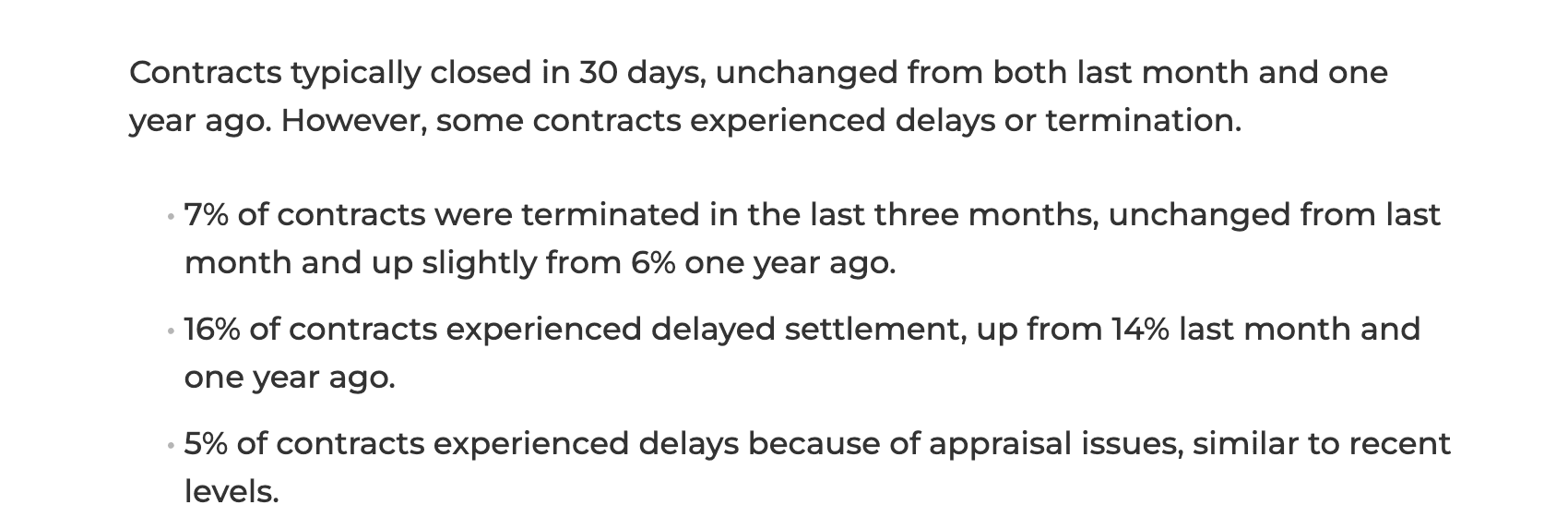
It happens more than agents admit. In NAR's September 2026 REALTORS® Confidence Index, 16% of contracts in the previous three months had a delayed settlement, up from 14% a month and a year earlier, and 7% were terminated. Appraisal issues delayed 5%. The typical contract closed in 30 days. The survey had 1,701 respondents between October 1 and 9, 2026.
Who does what when a file slips?
The coordinator runs the triage and keeps the log. The agent carries the decision to the client and negotiates with the other side. The lender and the title company each own their own clear to close. The buyer and the seller sign anything that changes a date. One Florida seller on r/realtors watched a May 27, 2025 closing move to May 30 and then to June 2 after HOA documents held up the buyer's lender and the Closing Disclosure went out on May 28, and asked whether there was any recourse against the lender. The reply that matters for triage:
“You don't have a contract with the lender.”
So chase the party your side has a contract with, and let that party chase their team. Another commenter warned the seller that asking the buyer for money at that point would change the Closing Disclosure and send the file back through underwriting.
Which blocker is it, and who owns it?
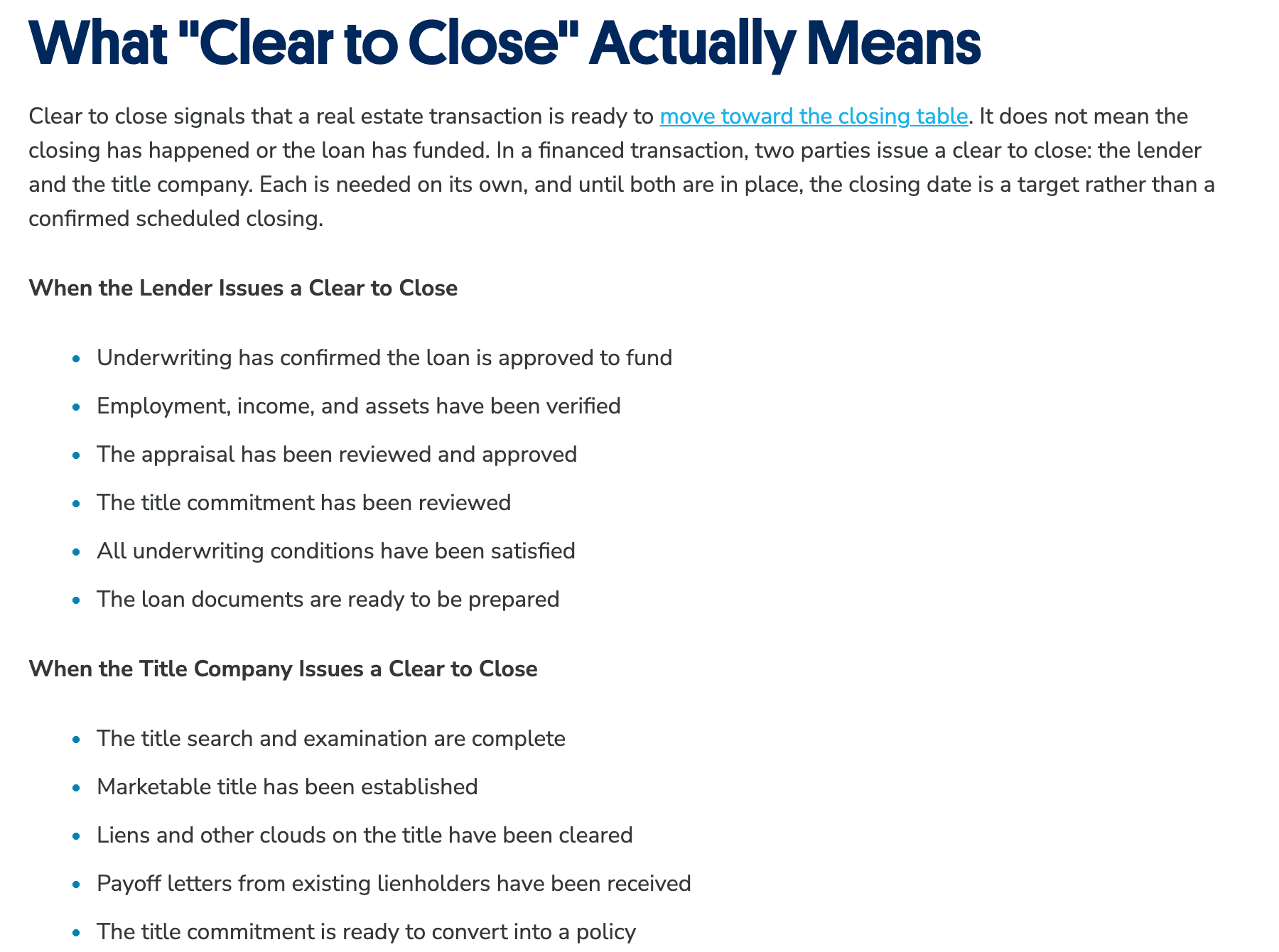
One blocker at a time. A financed deal has two separate clears to close, and Bluegrass Land Title puts it plainly: until both the lender and the title company have issued theirs, the closing date is a target. The title side needs payoff letters received and confirmed, and some payoffs, tax liens among them, are slow by nature. On a cash deal the title company issues the only clear. Upstream of the lender sits the appraisal, which Rocket Mortgage puts at 6 to 20 days from the order to the report, with the appraiser making contact about two business days after the order. At the far end, the Closing Disclosure has to be in the buyer's hands at least three business days before closing.
Blocker-to-owner matrix: who owns each blocker, what clears it and the date that decides it
| Blocker | Who owns it | What clears it, in writing | The date that decides it |
|---|---|---|---|
| Appraisal not back | The buyer’s lender, which orders it. | The appraisal report, or the lender’s written statement of the problem. | Texas: the 3rd day before closing. California: 17 days after acceptance by default. Florida: inside the Loan Approval Period. |
| Lender not clear to close | The buyer’s lender, reached through the buyer’s side. | The lender’s clear to close, then the Closing Disclosure. | Closing Disclosure in the buyer’s hands at least three business days before closing. |
| Title not clear to close | The title company. | Title’s own clear to close, with payoff letters received and confirmed. | The Closing Date. On TREC 20-19, miss it and the non-defaulting party may use the Paragraph 15 remedies. |
| Buyer’s financing notice not given | The buyer, through the buyer’s agent. | Texas: notice of termination plus the lender’s written statement. Florida: written notice either way. | Texas: the days written into ¶2A. Florida: before the Loan Approval Period ends, 30 days by default. |
| Repairs or inspection unresolved | Buyer and seller, through their agents. | Texas: a signed Amendment. California: written removal, cancellation or extension. Florida: written notice before the period ends. | Texas: the option period, 5:00 p.m. local. California: 17 days by default, then a Notice to Perform. Florida: 15-day Inspection Period. |
| Extension agreed but not signed | Both parties. | A fully executed amendment, Extension of Time Addendum or other written agreement. | Until it is signed, the original dates stand. |
What are the steps, in order?
Step 1: Confirm the slip against the contract
Open the clause that sets the date and recount it the way that form counts, since Florida's Standard F rolls a period ending on a Saturday, Sunday or national legal public holiday to the next day that is none of those.
Step 2: Name one blocking dependency
Write down the single item whose absence stops the next milestone: an appraisal report, a payoff letter, a buyer's signed notice. Never write “financing”.
Step 3: Ask the owner for the evidence, in writing
Email the buyer's agent for the lender's status or written statement, and the title company for its clear. A phone call saying it should be fine is not evidence, and on TREC 20-19 every notice between the parties has to be in writing anyway.
- Owner
- Coordinator
- Evidence
- The reply, filed on the closing
Step 4: Work out the decision date
This is the date the form stops waiting. Texas: the days written into the financing addendum for Buyer Approval, and the 3rd day before closing for the property. California: if the buyer has not removed or cancelled by the contingency day, the seller may cancel only after a Notice to Buyer to Perform that gives at least 2 Days. Florida: the end of the Loan Approval Period, after which the buyer proceeds as if paying cash and the seller may terminate in writing within 3 days.
- If it fails
- If the evidence is promised for after the decision date, the decision is the agent's today, not the lender's next week.
Step 5: Put three options to the agent: chase, extend or terminate
Chase if the evidence is due before the decision date. Extend if it is not and both sides still want the deal. Terminate on the form's own notice if the client is out.
- Owner
- Agent, with the client
Step 6: Paper the extension on the form’s own instrument
Texas uses the Amendment, with a real additional option fee if the option period is moving. California uses a written agreement, and C.A.R. publishes an Extension of Time Addendum for it. Florida's Paragraph 5 moves the Closing Date by itself for Closing Disclosure timing or force majeure, 7 days at most each. Any other change to the contract is valid only in writing, executed by the parties.
- Evidence
- The fully executed amendment, filed on the closing
- If it fails
- Nobody signs: the original contract stands as written, so go back to the previous step with termination on the table.
Step 7: Reflow the dates that hang off the moved one
A new closing date moves the Closing Disclosure deadline, the lender's final credit check 1 to 3 days before closing, the walk-through 24 to 48 hours before, and the wire. Tell the client the new date and what has to happen for it to hold.
Step 8: Log it and set the next check
One line per action, with the next check set to the earlier of the date the evidence was promised and the decision date.
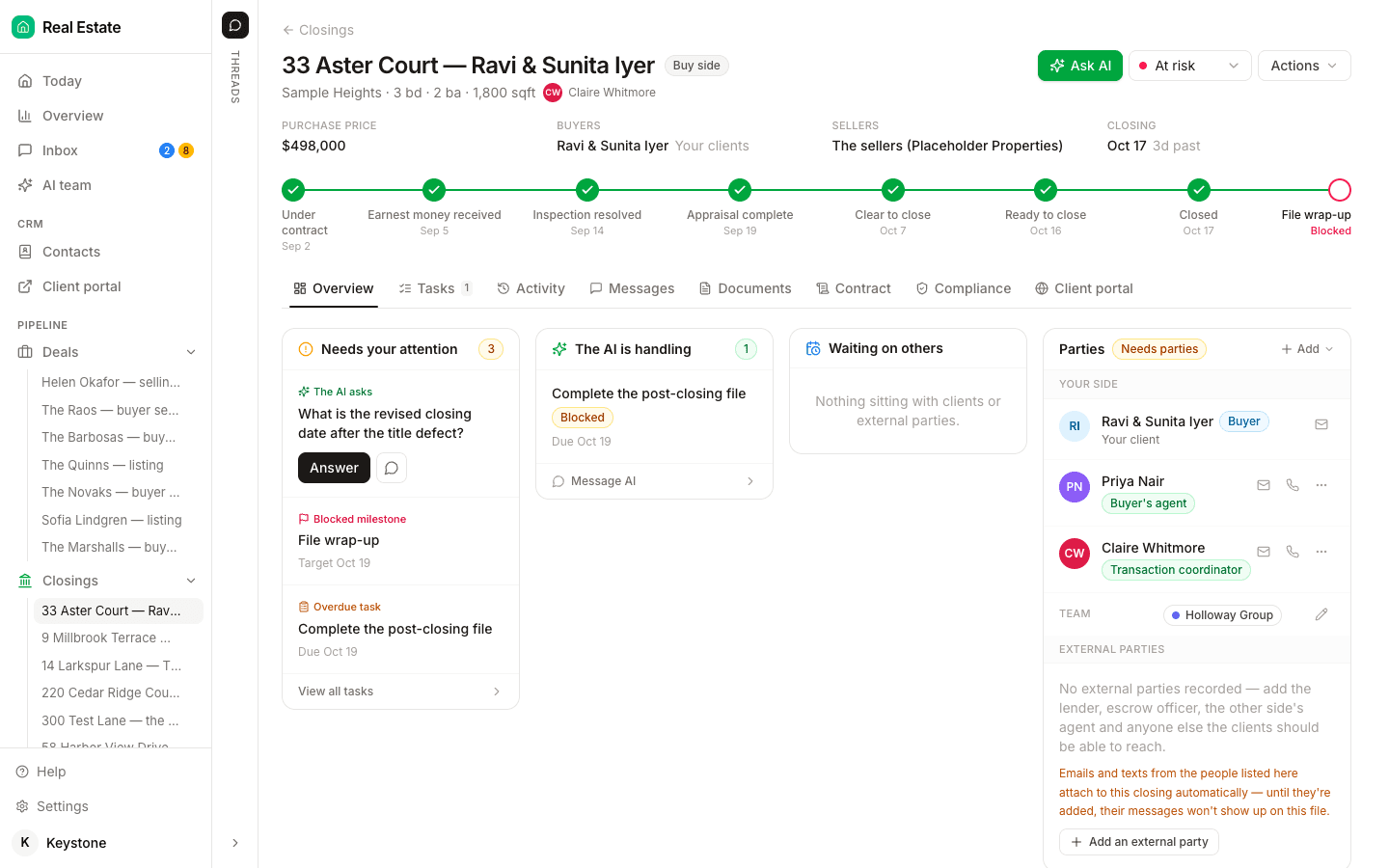
This is the loop DeedSpring runs for you. Its AI coordinator checks in on every active file every hour, and a milestone past target or a task nobody has moved is flagged on Today and on the closing's Overview, and in your Inbox if a person needs to act. You set the file's risk selector to On track, Caution or At risk and flag the one blocked milestone with a note. When the date moves, the countdown, the client's timeline and the attention list follow. It drafts the extension request for you to send, because a deadline that moves is always a draft for a person.
What does the contract say about extending?
The Texas contract says it in one line. TREC 20-19 “cannot be changed except by their written agreement”, and every notice must be in writing. The change goes on the Amendment to Contract: one box changes the closing date, one records an additional option fee for a new 5:00 p.m. option deadline, and one moves the date for the buyer's notice that Buyer Approval cannot be obtained. Texas REALTORS® tells members to write a real amount into that option-fee line, since blank or zero may make the amendment unenforceable, and that without a fully executed amendment the original contract remains in effect as written.
The C.A.R. purchase agreement puts it at the top of paragraph 14: the time periods “may only be extended, altered, modified or changed by mutual written agreement”. C.A.R.'s forms list carries an Extension of Time Addendum. Even after the contingency period ends, the buyer keeps the right to remove or cancel in writing until the seller cancels, and the seller can only cancel after a Notice to Buyer to Perform that gives at least 2 Days. A Demand to Close Escrow gives at least 3 Days before either side can cancel for a missed close.
Paragraph 5 of the FloridaRealtors/FloridaBar contract moves the Closing Date by itself in two cases, and both are capped. Paragraph 5(a): if the lender's funds are not available on the Closing Date because of Closing Disclosure delivery requirements, Paragraph 8(b) is checked, and loan approval and underwriting are done, the Closing Date extends for the period needed, “provided such period shall not exceed 7 days”. Paragraph 5(b) and Standard G do the same for a force majeure event, a reasonable time up to 7 days after it stops preventing performance. Outside the form's own provisions, Standard P makes any change to the contract valid only in writing, executed by the parties, and Standard F makes time of the essence.
When do you stop extending?
When the evidence will not arrive before the form's own cutoff and the client wants out, or when the other side will not sign. On the Texas Third Party Financing Addendum the buyer's exit for Buyer Approval runs for the days written into paragraph 2A and needs the lender's written statement of reasons. Miss it and the contract is no longer subject to Buyer Approval. The property exit, which covers the appraisal, runs to the 3rd day before the Closing Date, and the addendum makes time of the essence for the paragraph. On the Florida form a buyer who gives no written notice before the Loan Approval Period ends proceeds as if the cash box had been checked, and the seller may terminate in writing within 3 days. If the other side will not sign and the date passes, the file is the broker's and the client's decision from there, and the log below is what you hand them.
What goes in the recovery log?
TemplateRecovery action log
One line per action on the slipping file, kept on the closing so the agent, the broker and the client read the same record.
[Date] | [Milestone past target] | Blocker: [the one item missing] | Owner: [party] | Asked for: [written evidence] on [date] via [email/portal] | Decision date: [contract date and clause] | Decision: [chase / extend / terminate] | Paper: [amendment / ETA / notice, signed on date] | Client told: [date] | Next check: [date]
What does DeedSpring do when a file slips?
It does the watching and the chasing. Upload the executed contract and it reads the price, deposits, contingencies and dates into deadlines on the closing, then checks the file every hour and puts a milestone past target under Needs your attention. It will not mark a milestone done without evidence in writing. The extension request, the chase to the buyer's agent and the update to your client arrive as drafts for you to send.